
SCI Engineered Materials: Margin Compression Amid Volume Growth and Input Cost Volatility
SCI Engineered Materials, Inc. is growing revenue at a rapid pace, but gross margin pressure from rising raw material costs and product mix changes is eroding profitability leverage.
SCI Engineered Materials is posting strong top-line growth, with revenue for the three months ending September 30, 2026 up more than 50% year-over-year. However, gross margins are declining due to higher raw material costs and an adverse product mix shift, even as net income remains positive. Key watchpoints include raw material cost trends, margin stabilization, and any additional disclosure on customer or product mix.
SCI Engineered Materials, Inc. is experiencing a surge in revenue, with quarterly sales up more than 50% year-over-year, propelled by a combination of higher volumes, increased raw material input costs, and changes in product mix. The next phase for SCI will likely hinge on its ability to defend margins and clarify its competitive footing as market conditions evolve.
Revenue Expansion Outpaces Margins as Input Costs Rise
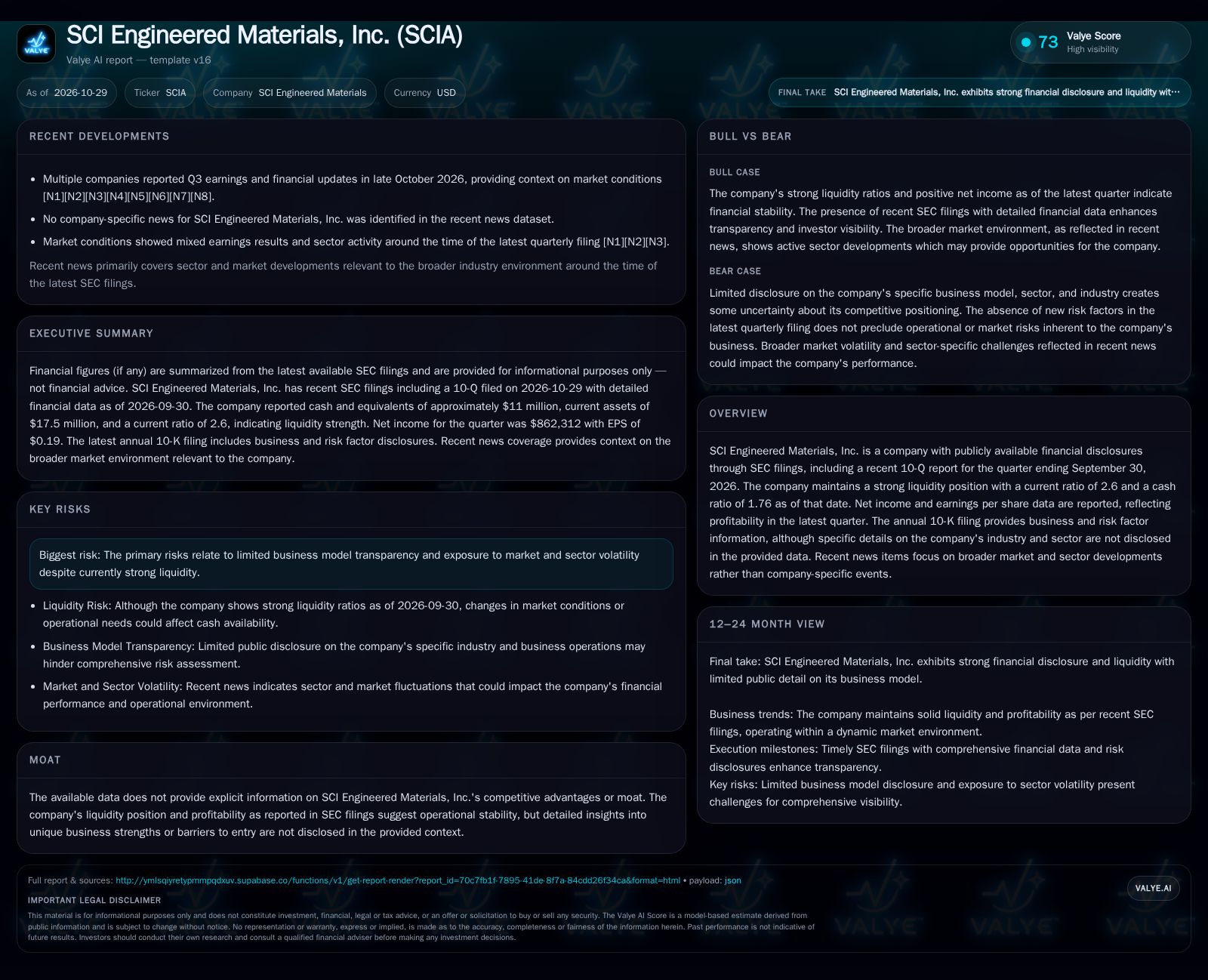
SCI Engineered Materials delivered a substantial increase in revenue for the three months ended September 30, 2026, reaching $8.06 million, up from $5.29 million in the same period the prior year—a jump of over 50% [S2]. This growth was attributed to a combination of higher raw material input costs, increased sales volume, and product mix shifts. However, these same factors contributed to a decline in gross margin, which fell to 21.0% from 25.2% year-over-year. Net income remained positive at $862,312, with basic and diluted EPS of $0.19, indicating continued profitability despite rising cost pressures. On the balance sheet, the company reported $11 million in cash and a current ratio of 2.6 as of September 30, 2026, reflecting a reported liquidity position [S2].
The interplay between volume growth and input cost inflation often creates a complex revenue narrative. While higher sales volumes typically signal market acceptance and operational scalability, when accompanied by rising input costs, the net effect on profitability can be muted or even negative. In SCI’s case, the simultaneous occurrence of volume increases and raw material cost escalation suggests that part of the revenue growth is nominal rather than purely organic. Understanding the extent to which price increases versus volume expansion contribute to revenue is critical, as it impacts cash flow quality and the sustainability of growth.
Moreover, shifts in product mix can have significant margin implications beyond raw material costs alone. If the company is moving toward lower-margin products—perhaps driven by customer demand or capacity constraints—this could exacerbate margin compression even if volumes rise. Conversely, a strategic pivot toward higher-margin, value-added products often requires upfront investment and time before margin benefits materialize. Thus, the observed margin decline may reflect transitional dynamics rather than permanent erosion, highlighting the importance of monitoring mix evolution alongside cost trends.
Volume Growth Meets Margin Headwinds: The Operating Equation
SCI’s revenue growth is being driven by a combination of higher volumes and increased raw material input costs, suggesting that some portion of reported sales growth is a pass-through of inflation rather than pure organic expansion. The company’s gross margin contraction—from 25.2% to 21.0% in the latest quarter—highlights the challenge of maintaining profitability when input costs rise faster than price realization or when the product mix shifts toward lower-margin offerings [S2].
Without explicit disclosure on contract structure or pricing power, it is plausible SCI operates in an industry where commodity price swings can be partially passed along to customers, but with some lag or dilution. The company reported cash and liquidity metrics for the period; these figures do not by themselves establish operating runway, investment capacity, financial flexibility, or financing capacity. The company’s ability to convert top-line growth into sustainable free cash flow will depend on whether it can stabilize or rebuild gross margins as raw material costs fluctuate.
The operating equation for SCI also hinges on the company’s pricing power and contract terms, which dictate how quickly and effectively input cost increases can be passed to customers. In industries characterized by commoditized products and highly competitive markets, pricing adjustments are often delayed or partial, compressing margins during inflationary periods. Conversely, firms with differentiated products or embedded customer relationships may negotiate price escalators or cost-sharing mechanisms that preserve profitability. Without explicit disclosure, assessing SCI’s pricing mechanisms remains speculative but central to forecasting margin trajectories.
Additionally, working capital management and operational efficiencies play a complementary role in margin resilience. For example, inventory management strategies, supplier diversification, and process improvements can mitigate the impact of raw material price volatility. If SCI can optimize these levers, it may partially offset input cost inflation even absent immediate pricing gains. Conversely, if rising costs coincide with supply chain disruptions or increased capital tied up in inventory, cash flow could be strained despite reported liquidity, underscoring the need to evaluate operational execution alongside headline financials.
Opaque End Markets and Unclear Moat: Assessing Relative Advantage
SCI Engineered Materials does not disclose its specific industry, major customers, or core product lines, making it difficult to assess its competitive positioning relative to peers. In general, companies supplying engineered materials or specialty inputs often face competition from both large, diversified materials producers and smaller niche firms. Pricing power is typically limited unless the supplier offers a highly differentiated product or is embedded in long-term customer processes.
The reported revenue growth could reflect market share gains, industry tailwinds, or simply input cost pass-through. Without detail on customer stickiness, contract duration, or unique technical capabilities, it is challenging to assess whether SCI possesses switching frictions, intellectual property, or scale advantages that would support above-average returns.
Margin Recovery and Product Mix Optimization Could Unlock Earnings Power
An upside scenario for SCI Engineered Materials would see the company successfully manage input cost volatility and optimize its product mix toward higher-margin offerings. If SCI can either negotiate better raw material terms, implement price increases that outpace future input inflation, or transition its sales mix toward proprietary or value-added products, gross margins could recover to prior levels or higher.
Confirmation of this scenario would come from a rebound in gross margin percentages in subsequent quarters, disclosure of new or expanded high-value customer relationships, or evidence of operating leverage as revenue growth translates into proportionally greater net income and cash flow. Additional transparency on customer retention, product differentiation, or contract structure would further support the thesis that SCI can sustain profitable growth even in a variable cost environment.
Sustained Growth with Ongoing Margin Pressure Defines the Near-Term Outlook
The most plausible trajectory is that SCI continues to grow revenue through a combination of volume gains and input cost pass-through, while gross margins remain under pressure due to persistent raw material volatility and product mix headwinds. Profitability is maintained, but operating leverage is limited as higher costs offset the benefits of scale.
This scenario would be confirmed by continued top-line growth in future quarters, stable or modestly declining gross margins, and steady—but not rapidly expanding—net income. Absence of significant new disclosures on customer concentration, end-market exposure, or margin drivers would reinforce the view that SCI is navigating a challenging cost environment without transformational change to its business model or competitive position.
Input Cost Shocks or Adverse Mix Could Erode Profitability
A negative scenario would see further increases in raw material costs, supply chain disruptions, or a continued shift toward lower-margin product lines, pushing gross margins below sustainable levels and risking a return to operating losses. If SCI is unable to pass through additional input inflation or if customer demand softens in key end markets, revenue could stagnate or decline while fixed costs remain, compressing profitability.
Evidence for this outcome would include a sharp drop in gross margin below 20%, negative net income in future quarters, or disclosure of significant sourcing or customer concentration risks.
What Will Clarify SCI Engineered Materials’ Margin and Growth Quality?
Quarterly gross margin trends: Continued margin compression or stabilization will be a direct indicator of SCI’s ability to manage input costs and product mix.
Revenue composition by product or customer (if disclosed): Greater detail would help assess whether growth is concentrated in high-value or commoditized segments.
Raw material cost volatility: Any commentary or data on sourcing, hedging, or supplier diversification would clarify exposure to input shocks.
Customer retention rates or contract duration (if disclosed): Evidence of recurring relationships would support arguments for switching costs or pricing power.
Disclosure of capital expenditure plans: Any planned investments could signal growth ambitions or defensive moves in response to market shifts.
Management commentary on competitive landscape: Insights into peer dynamics or end-market demand would sharpen understanding of SCI’s relative position.
Supply chain risk updates: Future filings discussing sourcing challenges or logistics disruptions would indicate potential threats to cost structure and delivery.
Disclaimer: This is research-only, informational analysis and not investment advice. It may include AI-generated interpretation and general industry context. Always verify important details using primary sources.

Comments