
Champions Oncology Advances Integrated Oncology Research Amid Financial Headwinds
Champions Oncology leverages proprietary PDX models and data platforms to fuel oncology drug discovery while managing operational losses and capital constraints.
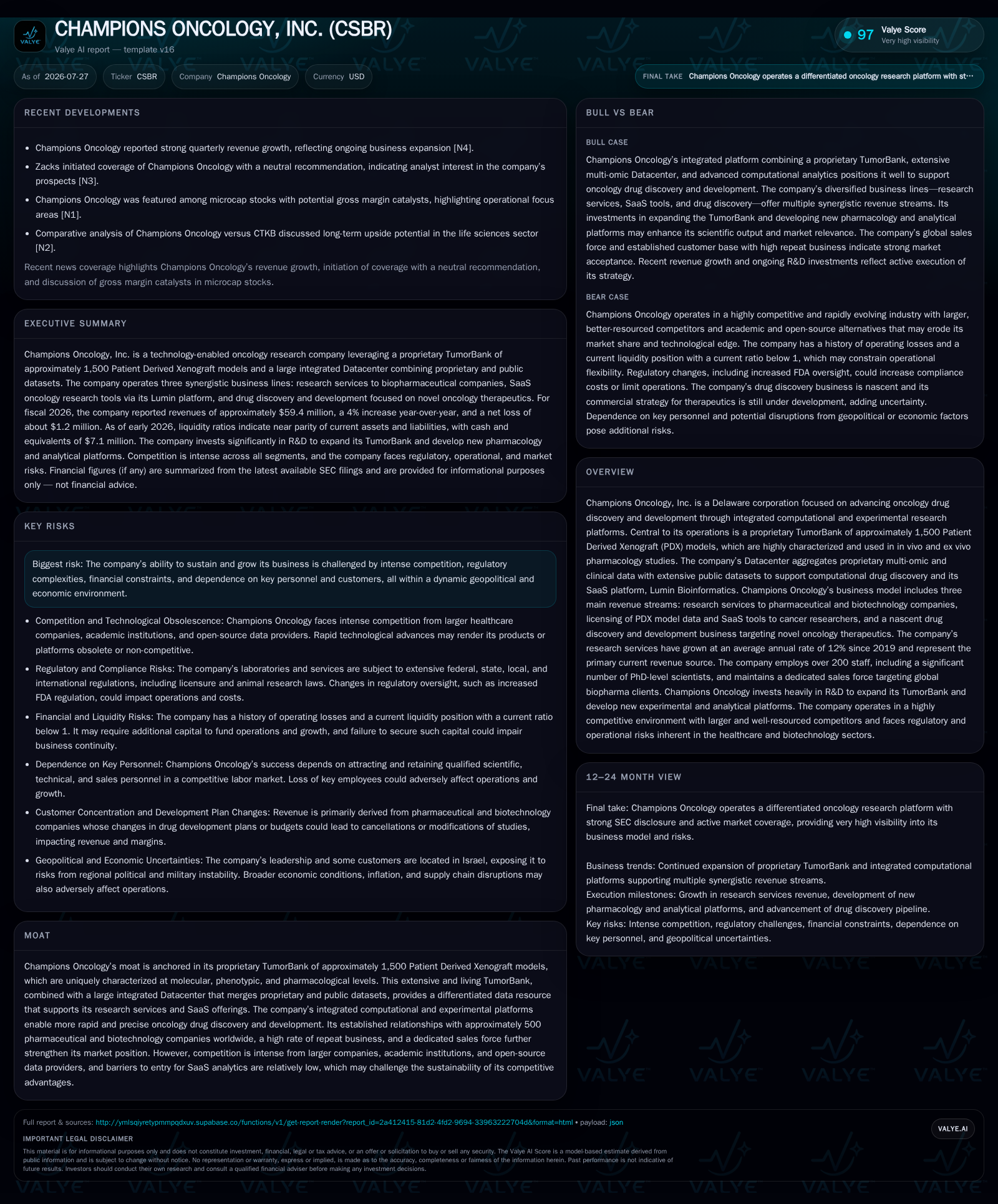
Champions Oncology, a specialist in translational oncology research, reported steady revenue growth driven by its proprietary TumorBank of approximately 1,500 Patient Derived Xenograft (PDX) models and supportive SaaS offerings. Despite increased R&D investment and platform expansion fueling innovation, the company continued to operate at a net loss with cash reserves sufficient through mid-2027. The competitive landscape remains challenging as Champions balances growth in research services, SaaS licensing, and nascent drug discovery efforts within an evolving regulatory environment.
Recent Operating Update
Closing fiscal 2026, Champions announced audited financials showing total revenues near $59.4 million, supported by expansion in study size and the number of returning customers across their approximately 500 pharmaceutical and biotechnology clients worldwide [S3], [S5]. This steady commercial traction validates the demand for their specialized translational oncology services and SaaS bioinformatics tools despite persistent losses requiring careful liquidity oversight.
Business Model
Champions Oncology operates a three-pronged business model comprising:
Research Services: Anchored by about 1,500 proprietary PDX tumor models maintained in their TumorBank. These models are implanted and expanded in murine hosts to enable complex preclinical pharmacology studies that closely mimic metastatic cancer patient profiles common in clinical trials. Services are sold directly to biopharmaceutical companies via a dedicated sales force (45 personnel) focused on enlarging study volume and depth [S6]. Typical projects range from $125k to over $500k per study when conducted under Good Clinical Laboratory Practice (GCLP) regimes necessary for regulatory contexts.
SaaS Licensing: Through their Lumin Bioinformatics platform, Champions licenses access to an integrated Datacenter—a proprietary aggregation of multi-omic molecular data (
3,500 datasets), clinical responses (3,000), and in vivo drug responses (3,500)—combined with extensive public datasets (20,000 records). The annual subscription model provides scalable recurring revenue potential but faces competitive pressures from open-source bioinformatics tools which limit pricing escalation [S10], [S25].Drug Discovery & Development: A nascent segment leveraging AI-driven computational approaches layered on their experimental pharmacology platforms targeting high-value areas such as antibody-drug conjugates, immune oncology therapies, and cell therapies. This division works in scientific isolation from service lines to avoid conflicts but is currently an investment-heavy endeavor without material revenue contribution yet. Pipeline maturation strategies include possible spinouts or licensing collaborations [S6], [S25].
Revenue mechanics depend heavily on customer contract structuring — primarily fixed-price research studies with incremental pricing on complexity while SaaS revenue depends on license renewals and user adoption metrics. Margins vary widely; research services have lower gross margins due to animal model upkeep and lab costs whereas SaaS margins could improve as scale increases.
Industry Structure & Competitive Position
Champions operates within the highly specialized oncology translational research subset of biotechnology supporting pharma R&D programs primarily preclinical stage. Its value chain position involves providing predictive PDX models which are critical for early drug efficacy evaluation before human trials.
Competition arises from multiple angles:
- Large contract research organizations (CROs) like Charles River offer broad oncology preclinical testing but may lack the depth of PDX characterization.
- Biotech firms like Crown Bioscience maintain competing PDX banks but differ slightly in tumor subtype focus.
- Academic and government labs provide alternative tumor models often available via non-exclusive or open-source arrangements undermining exclusivity.
- SaaS competitors such as Tempus Labs specialize in oncology data analytics but with different dataset compositions.
Champions differentiates itself by maintaining a "living" TumorBank allowing longitudinal characterization expansion—molecularly deepening phenotypic datasets—which supports its integrated Lumin analytic platform [S1], [S10]. Yet these assets also require continuous capital infusion amid technology shifts demanding perpetual innovation.
Growth Drivers
Key drivers supporting Champions’ growth include:
- Increasing global oncology drug development spending boosts demand for predictive preclinical models reflective of complex patient biology.
- Expansion of multi-omic datasets facilitates precision medicine trends enabling better therapeutic target identification through computational analytics.
- Rising adoption of AI-enhanced bioinformatics tools supports growth of SaaS revenues linked to Lumin platform usage.
- Pharmaceutical outsourcing shift favors specialized CROs with proven targeted oncology expertise over generalist service providers.
- Investments in novel pharmacology platforms aiming at radiopharmaceutical evaluation augment service breadth attracting new customers.
- Development of internal drug discovery assets offers optional long-term value creation beyond service monetization when targets advance toward commercialization [S22], [S25].
Risks & Growth Constraints
Risks inherent to Champions’ strategy are emblematic of smaller biotech players balancing innovation investment against financial stability:
- Intense competition pressures margins; larger CROs deploy scale advantages while academia/open data reduces differentiation in datasets.
- Regulatory uncertainties including FDA’s evolving stance on laboratory developed tests (LDTs) may raise compliance costs or constrain product offerings [S5], [S21].
- Dependence on key scientific personnel for maintaining technical excellence creates talent retention risk amid industry hiring wars.
- Customer concentration could arise if major biopharma clients scale back development budgets or change outsourcing priorities impacting study bookings.
- Capital constraints evidenced by a current ratio below parity (0.96 as of April 30, 2026) necessitate cautious cash burn management lest operational continuity be threatened without additional funding sources [F1], [S1].
- Long sales cycles for new customers slow expansion pace particularly for higher price SaaS licenses requiring demonstrated analytic ROI.
- Developing internal drug discovery pipeline introduces high R&D cost burden with uncertain timelines for clinical progression or monetization [S14], [S25].
What To Watch Next
Key milestones will include:
- Quarterly updates on revenue composition focusing on growth rates across research services vs SaaS licensing segments highlighting platform adoption success.
- R&D expenditure trends indicating pace of analytical platform enhancements linked to deeper TumorBank characterization or novel modalities incorporation.
- Progress disclosures regarding lead drug discovery targets advancing toward validation or early clinical candidate selection helping transition asset monetization effort beyond service reliance.
- Hiring and recruiting outcomes as science staff expansion aids both service quality retention as well as internal pipeline innovation capabilities.
- Any announcements regarding partnerships or licensing deals arising from validated targets that may provide upfront capital inflows or milestone payments.
- Regulatory changes affecting lab licensure or animal testing protocols impacting operating efficiencies or service availability.
Financial Profile Discussion
The balance underscores challenges common among small biotech CROs navigating cyclicality in pharma R&D budgets coupled with technology development burn that often outpaces early service margin generation. Hence sustainability hinges on continuous sales force effectiveness improving customer counts plus locking-in higher-value project engagements together with accelerating SaaS subscription adoption—a recurring high-margin revenue stream essential to offset fluctuating service income.
Overall, Champions remains committed to investing substantially into its multi-platform ecosystem designed for synergistic growth across research services, SaaS tools licensing, and emerging drug discovery pipelines but must balance this ambition against its limited financial runway until further scale or outside financing can solidify profitability prospects.
This analysis is based solely on publicly available SEC filings dated through July 27, 2026. It does not constitute investment advice or research views but aims to provide an informed industry-level interpretation grounded strictly in cited evidence.
Disclaimer: This is research-only, informational analysis and not investment advice. It may include AI-generated interpretation and general industry context. Always verify important details using primary sources.

Comments