
COtwo Advisors Physical European Carbon Allowance Trust's Structural Exposure to EU Carbon Market Dynamics
CTWO provides direct exposure to EU carbon allowances via a trust model, aligning with the regulated EU Emissions Trading System.
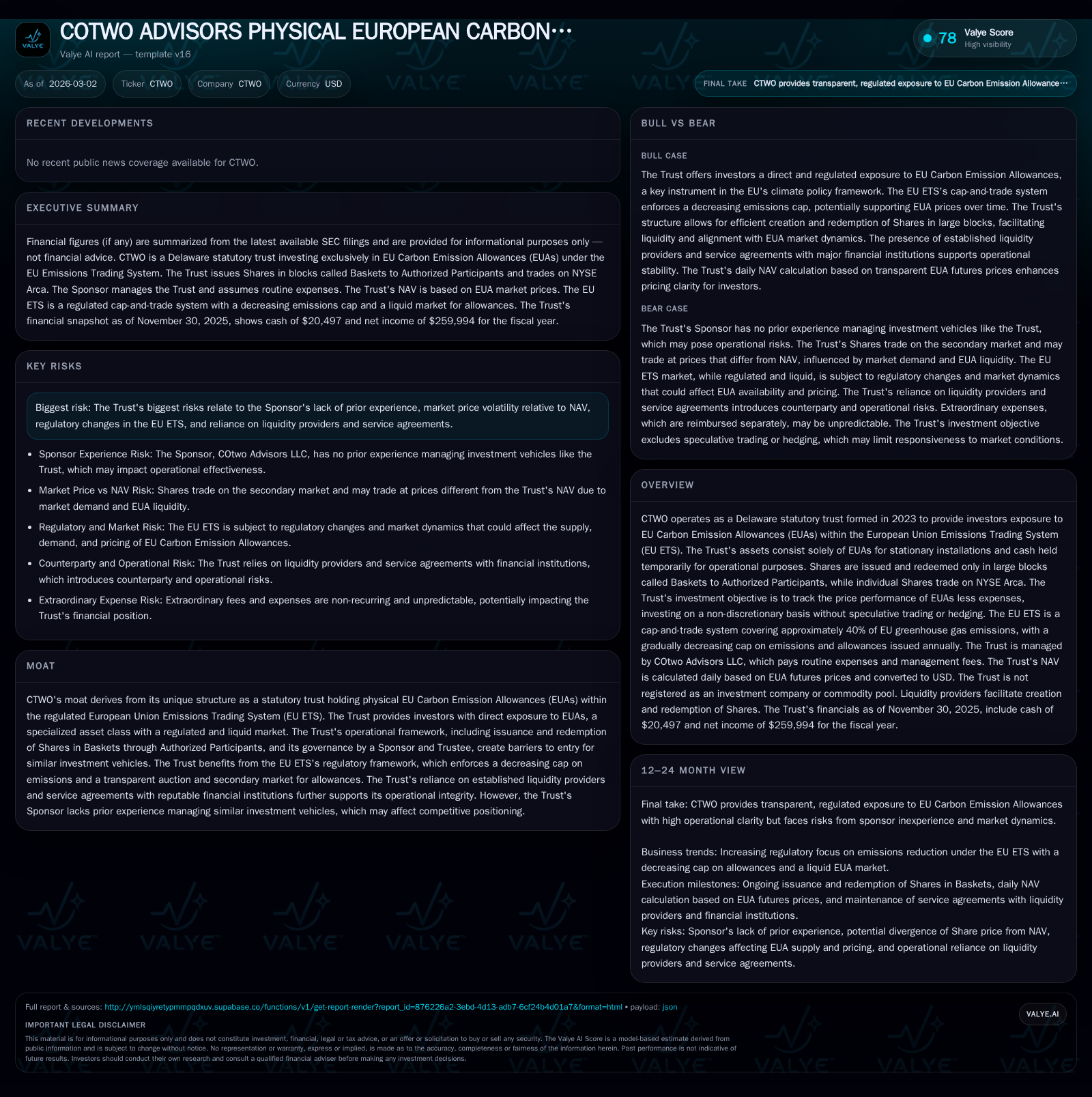
Formed in early 2023, COtwo Advisors Physical European Carbon Allowance Trust (CTWO) offers investors fractional ownership of physical EU carbon emission allowances (EUAs) through NYSE Arca-traded shares. Its structure as a Delaware statutory trust holding only EUAs and cash, combined with issuance and redemption in large baskets by authorized participants, positions CTWO uniquely in the emerging EU carbon asset class. The trust’s investment objective is to track EUA prices minus expenses, with no speculative trading or hedging. Growth drivers hinge on EU ETS regulatory tightening and growing carbon market liquidity, while risks derive from sponsor inexperience, market volatility, and regulatory changes. Capital allocation reflects minimal operational expenses absorbed by the sponsor, negligible income generation with modest positive net income and return on equity evidenced through [F1].
Company Overview
COtwo Advisors Physical European Carbon Allowance Trust (CTWO) was established as a Delaware statutory trust on January 12, 2023, governed by an amended trust agreement dated November 27, 2023 between COtwo Advisors LLC (the Sponsor) and Wilmington Trust as Trustee [S1][S9]. The Trust’s sole assets comprise European Union Carbon Emission Allowances (EUAs) for stationary installations covered by the EU Emissions Trading System (EU ETS) along with cash temporarily held for operational purposes such as paying expenses or managing share creation/redemption processes.
Shares represent fractional undivided beneficial interests in the Trust’s net assets and are only issued or redeemed in Baskets consisting of 50,000 Shares each. These Baskets are transacted exclusively with Authorized Participants—specialized broker-dealers or institutions qualified under stringent criteria—which helps maintain tight operational control and minimizes dilution risk [S1][S21]. Individual shares trade freely on the NYSE Arca exchange under the symbol “CTWO,” providing retail liquidity without direct redemptions by ordinary investors.
Investment Objective and Strategy
CTWO aims to track closely the price performance of physical EUAs less the Trust’s expenses. It does so on a non-discretionary basis, explicitly excluding speculative trading or hedging activities. This passive exposure seeks to provide investors direct access to one of the most significant environmental commodities globally underpinned by EU-wide climate policy [S1][S9].
Operationally, the Trust does not hold any other instruments besides physical allowances and cash needed for administrative processes. The EUAs themselves are held securely within the European Union Registry (Union Registry), ensuring transparency and regulatory compliance [S1].
Past Growth and Historical Performance
Since inception in early 2023, CTWO's growth trajectory has been modest due to its recent establishment and niche focus. The Trust reported a net income of $259,994 for the fiscal year ending November 30, 2025, representing an approximate return on equity of 13.5% based on available equity metrics—a respectable start given limited operational scale [F1]. Operating income showed a loss of $7,332 during the same period reflecting upfront startup costs and operating expenses [F1].
Cash and equivalents stood at $20,497 at fiscal year-end, indicating sufficient liquidity for near-term obligations. There is no reported leverage; CTWO operates without debt [F1][S7][S26].
Historical performance (annual)
| FY |
|---|
| 2025 |
Source: SEC companyfacts cache [F1].
This limited dataset illustrates early-stage operational footing rather than revenue-driven growth as seen in traditional enterprises.
Industry Context: European Union Emissions Trading System (EU ETS)
The EU ETS is a cornerstone of Europe's climate policy aiming to reduce greenhouse gas emissions cost-effectively through a cap-and-trade mechanism covering about 40% of total emissions within member countries. Annual EUA issuance decreases steadily each year as emission caps tighten per regulatory mandate, increasing scarcity and potentially supporting price appreciation over time [S17][S16][S28].
It operates alongside linked emissions trading schemes in Norway, Switzerland, Iceland, and Liechtenstein but remains isolated from markets such as California's Cap-and-Trade or China’s national ETS due to lack of transferability of allowances outside jurisdictions [S20].
Future Growth Prospects
CTWO’s growth prospects fundamentally depend on three pillars:
- EU Policy Evolution: Continued tightening of emissions caps will restrict supply growth of allowances gradually enhancing EUA prices which directly benefits CTWO’s net asset value.
- Market Maturity & Liquidity: Expansion in participation from financial institutions aiming for carbon exposure could increase creation/redemption volumes boosting secondary market liquidity.
- Investor Appetite for ESG Assets: Increasing demand among institutional investors for carbon-linked assets drives capital inflows into specialized vehicles like CTWO.
Conversely, caps could be softened or replaced due to political shifts; breakthroughs in emissions technology could reduce EUA demand; or new regulations altering EUA definitions/scopes could adversely affect prices or trading flexibility [S11][S17][S28]. Moreover, CTWO must manage potential price volatility disparities between its share price versus net asset value stemming from factors like EUA market activity or basket redemption timings [S19][S27].
All these factors should be carefully monitored as milestones for assessing Trust growth potential.
Capital Allocation & Returns
The Sponsor charges an annual management fee of approximately 0.79% based on daily NAV payable monthly in arrears covering routine administrative costs including trustee fees, marketing expenses via Foreside Fund Services LLC, transfer agent State Street Bank services among others—all reimbursed by the Sponsor itself meaning ordinary operating expenses do not directly burden shareholders beyond this fee [S27][S14][S15]. Extraordinary costs such as litigation would be funded separately by the Trust if incurred.
Dividend distributions are not standard practice since CTWO focuses primarily on asset appreciation rather than income generation; liquidations result in pro rata distributions after settling liabilities [S10]. No share repurchases have been indicated nor dividend declarations made given current structure.
From reported figures for FY25: net positive earnings coupled with adequate cash balances suggest conservative capital stewardship with modest returns currently driven more by market movements in EUA prices than operational leverage [F1].
Moat and Competitive Positioning
CTWO’s structural moat arises from its unique position offering direct physical exposure to one of the most regulated cap-and-trade systems globally through a legally distinct statutory trust vehicle providing fractional shares actively tradable on a U.S. exchange platform. This setup creates barriers for alternatives seeking similar pure-play access while preserving transparent custody arrangements managed by reputable entities [S1].
Its relationship with major liquidity providers Redshaw Advisors Ltd. and Vertis Environmental Finance Ltd.—prominent players within EUA markets—adds operational efficacy enabling efficient basket creations/redemptions at competitive prices despite inherent underlying market complexities [S7][S8][S15]. However,the limited track record of its Sponsor COtwo Advisors LLC introduces execution risk compared to more established managers [S4].
Risks Summary
Key identified risks include:
- Sponsor Inexperience: Lack of historical performance may challenge effective administration or marketing impacting growth.
- Market Price Volatility: Share price divergence from NAV due to external trading dynamics affecting investor sentiment.
- Regulation Changes: Amendments to EU ETS rules could disrupt allowance values or legal frameworks underpinning CTA exposures.
- Service Provider Dependencies: Heavy reliance on authorized participants and liquidity providers whose withdrawal could impair operations.
- Technological/Market Fragmentation: Absence of centralized carbon market monitoring increases vulnerability to irregularities complicating valuation transparency [S11][S16][S20].
Outlook & What to Watch (Analysis)
While explicit forward guidance from management is unpublished, industry developments will dictate CTWO’s trajectory:
- Monitoring adjustments enacted under the Market Stability Reserve mechanism which modulates supply dynamically based on surplus standings is critical.
- Tracking participation rates from global institutional investors attracted to regulated carbon credit exposure can signal demand trends impacting share liquidity.
- Regulatory announcements concerning scope expansions or tightening across sectors including aviation could alter allowance supply-demand fundamentals materially.
- The evolution of secondary EUA futures markets influences spot pricing essential for fair NAV reflection.
- Sponsor scaling expertise and marketing effectiveness will determine capital inflow velocity over time.
Investors should consider these parameters when assessing potential long-term viability given substantial regulatory complexity inherent in carbon markets.
Conclusion
COtwo Advisors Physical European Carbon Allowance Trust represents a pioneering effort delivering straightforward access to physical European carbon emission credits traded within a tightly regulated ecosystem crucial to global decarbonization strategies. Despite nascent status marked by restricted historical financial data and sponsor infancy challenges,[F1] its foundational alignment with broad environmental imperatives combined with robust infrastructure partners provides a stable platform worth monitoring closely as the global carbon economy matures further. The blend of structured issuance/redemption mechanisms fused with passive objective tracking encapsulates both opportunity and risk embedded deeply in European climate policy evolution.
This analysis is informational only and does not constitute investment advice.
Disclaimer: This is research-only, informational analysis and not investment advice. It may include AI-generated interpretation and general industry context. Always verify important details using primary sources.

Comments