
SCYNEXIS Advances Antifungal Innovation with SCY-247 and Strategic Licensing
SCYNEXIS consolidates its antifungal platform progress through clinical milestones for SCY-247 and enhanced commercial collaboration with GSK.
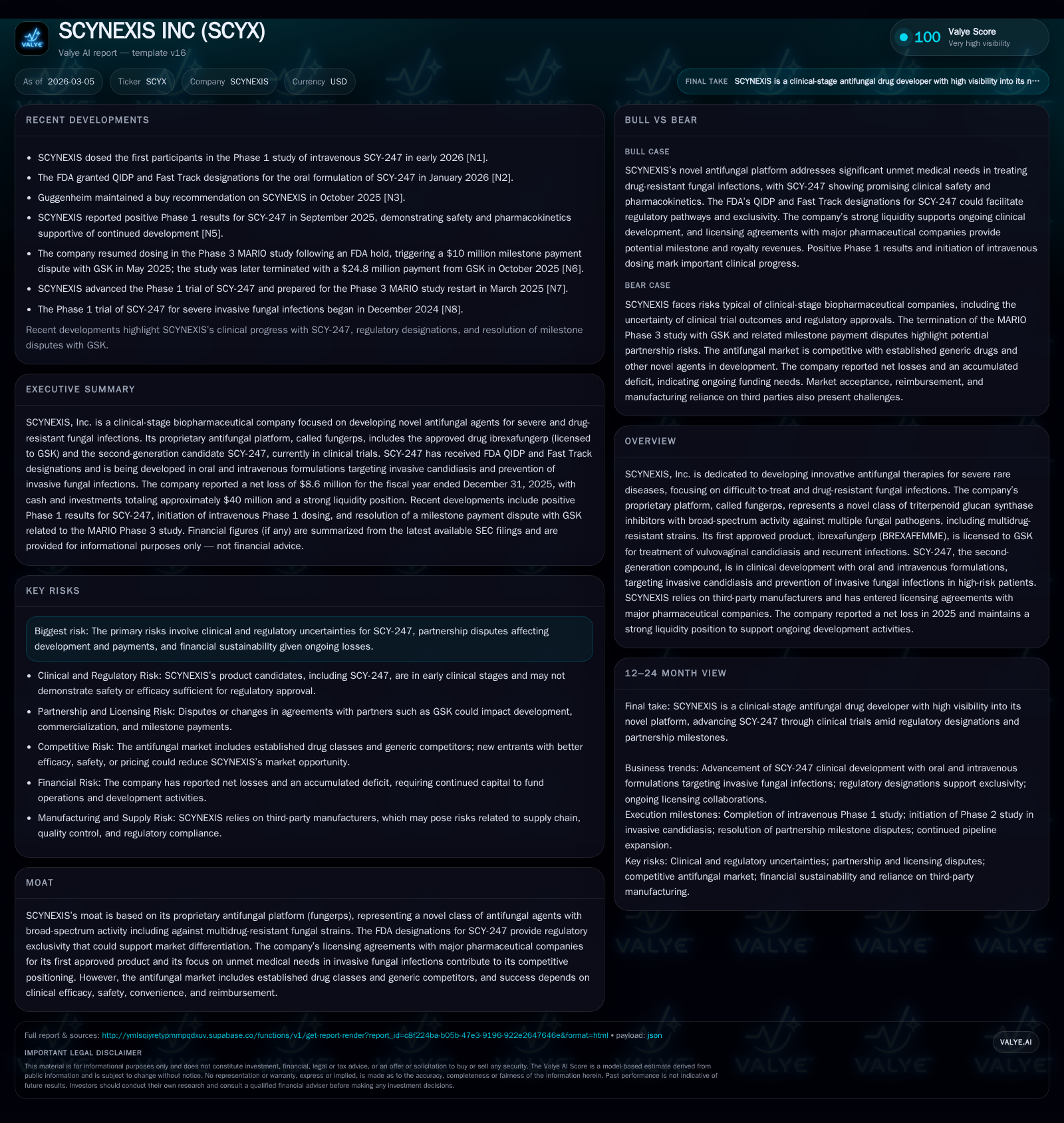
SCYNEXIS, Inc. continues to develop novel antifungal agents rooted in its proprietary fungerps platform, achieving FDA approval for ibrexafungerp and advancing second-generation candidate SCY-247 through Phase 1 trials. In 2025, the company reported a narrower net loss driven by licensing revenues from its deal with GlaxoSmithKline (GSK), balancing heavy R&D costs. SCYNEXIS's expanding pipeline and strategic licensing underpin its efforts to address serious fungal infections, though regulatory complexities and financial sustainability remain key challenges to monitor.
Foundation of SCYNEXIS: Growth Driven by Novel Antifungal Platform
At the core of SCYNEXIS’s innovation strategy lies its proprietary antifungal platform named "fungerps," which introduces a novel class of triterpenoid glucan synthase inhibitors. These agents are structurally distinct from existing antifungals, exhibiting broad-spectrum activity that encompasses various human fungal pathogens including resistant Candida and Aspergillus species. This biochemical uniqueness enables potential efficacy against multidrug-resistant strains such as Candida auris and echinocandin-resistant Candida glabrata—pathogens that present significant treatment challenges today. The platform’s mechanism targets β-(1,3)-D-glucan synthase, a crucial enzyme in fungal cell wall synthesis, positioning these compounds strategically within antifungal pharmacology.
Ibrexafungerp (commercialized as BREXAFEMME) marks the inaugural FDA-approved product emerging from this platform. It gained approval initially for treating vulvovaginal candidiasis (VVC) in 2021 followed by an indication for reducing recurrent VVC in 2022. The drug’s niche lies in addressing an underserved population wherein resistance or intolerance to azoles and echinocandins limits therapeutic options. In May 2023, SCYNEXIS licensed ibrexafungerp exclusively to GlaxoSmithKline Intellectual Property (No. 3) Limited (GSK), reflecting external validation of the technology’s potential through a partnership with a major global pharmaceutical company [S1].
2025 Financial Overview: Signs of Operational Improvement Amid Ongoing Losses
Reviewing financial performance reveals a noteworthy contraction in losses for the fiscal year ended December 31, 2025. Net income improved substantially to a negative $8.6 million compared to a prior-year deficit of $21.3 million—a roughly 60% improvement year-over-year [F1]. Operating income also advanced by over half from -$37.1 million in FY24 to -$16.0 million in FY25, supported primarily by recognition of licensing revenues related to the GSK agreement.
Revenues remain below meaningful commercial scale (~$257,000 recorded most recently in fiscal year 2017) as sales contributions are yet nascent; however, milestone payments bolstered top-line figures without reflecting direct product sales [F1][N1]. Operating cash flow remains negative at approximately -$5.3 million but improved markedly from -$24 million in FY24 due to reductions in net operating expenses tempered by substantial R&D investments focused on pipeline progression [F1][S18]. Capital expenditures were immaterial or zero during recent years reflecting light fixed asset needs typical of clinical-stage biotechs [F1].
Historical performance (annual)
| FY | Net ($mm) | CFO ($mm) | OpInc ($mm) | Net YoY |
|---|---|---|---|---|
| 2025 | -9 | -5 | -16 | +59.6% |
| 2024 | -21 | -24 | -37 | -131.8% |
| 2023 | 67 | 60 | 73 | +206.7% |
| 2022 | -63 | -80 | -86 |
Source: SEC companyfacts cache [F1].
Capital returns and efficiency (annual)
| FY | ROE% |
|---|---|
| 2025 | -17.4 |
| 2024 | -38.7 |
| 2023 | 91.9 |
| 2022 | -1942.7 |
Source: SEC companyfacts cache [F1].
Pipeline Momentum: Clinical Development Update on SCY-247 Oral and IV Formulations
The company made significant advances with SCY-247—the second-generation compound derived from the fungerps platform—demonstrating clinically relevant attributes supportive of continued development. The recently completed single ascending dose (SAD) and multiple ascending dose (MAD) portion of the Phase 1 oral study involved dosing healthy volunteers across a wide range spanning from 50mg up to 900mg single doses and up to 300mg daily over seven days [S1][N2].
SCY-247 showed excellent tolerability: no serious or severe treatment-emergent adverse events were observed; incidents reported were mild or moderate without clear dose dependency. Pharmacokinetic analyses revealed rapid absorption kinetics with Tmax between three-to-seven hours and generally dose-proportional systemic exposure up to approximately 400mg QD; beyond that level exposure plateaued somewhat—a feature possibly beneficial for safety margins.
Crucially, multiple ascending dose cohorts at 200mg and 300mg once-daily achieved or exceeded predefined target exposures derived from preclinical invasive candidiasis models including proof against resistant strains such as echinocandin-resistant Candida glabrata and Candida auris—highlighting potential clinical utility in difficult-to-treat infections [S1][N3]. Reduced dose requirements relative to the original compound could translate into better patient tolerability.
In early 2026 the Phase 1 trial of the intravenous formulation was initiated [N2], aiming to extend viable treatment modalities into hospitals where invasive fungal infections represent acute challenges especially among immunocompromised patient populations. Following this Phase 1 assessment is a planned Phase 2 proof-of-concept study expected later this year evaluating efficacy in invasive candidiasis patients alongside prophylactic studies targeting high-risk cohorts [S1][N3].
Licensing Synergies: Collaboration with GlaxoSmithKline Amplifies Commercial Reach
SCYNEXIS’s exclusive license agreement with GSK represents a cornerstone for commercialization strategy centered around ibrexafungerp. The deal provides upfront consideration complemented by structured milestone payments linked to developmental progress and sales thresholds alongside tiered royalty streams upon market uptake [S1][N1][S2].
This alliance offsets SCYNEXIS’s limitations around scale—given their reliance on third-party manufacturing infrastructures—and leverages GSK’s robust global marketing capabilities especially targeting vulvovaginal candidiasis—a condition affecting millions globally yet underserved by current treatments. Amendments through late 2025 reflect evolving collaboration terms adapting commercialization scope enabled by clinical advancements.
Such partnerships typify current antifungal sector dynamics where innovative biotech firms generate proprietary assets while large pharma provides distribution expertise; the symbiotic relationship underpins regulatory compliance complexities while enhancing revenue predictability via non-sales-based cash inflows [S1][N1].
Risk and Regulatory Headwinds Shaping the Path Forward
Several risk vectors bear close attention when judging future trajectory. Clinical risk remains front-and-center given uncertainties inherent in pivotal trials for SCY-247 including safety signals or insufficient efficacy outcomes potentially delaying approvals or altering label claims [S3][S6][N3]. Regulatory pathways handle these complex approvals stringently – with cGMP compliance essential given previous concerns regarding cross-contamination risks discovered during ibrexafungerp manufacture that culminated in litigation albeit later dismissed without prejudice [S4][S7].
Moreover cybersecurity governance has emerged as an explicit board-level oversight priority given sensitive data handling requirements mandated under HIPAA-like frameworks extending into antifungal drug commercial environments [S22]. Litigation history includes securities class actions alleging undisclosed manufacturing risks which were dismissed but underscore reputational vigilance demanded for public biopharma entities investing heavily in drug development programs [S7][S23].
Finally pricing/reimbursement landscapes create additional layers of uncertainty given evolving payer scrutiny on specialty anti-infectives amidst increasing healthcare cost containment pressures potentially impacting market access strategies post-launch approvals [S9].
Capital Structure, Cash Flow Dynamics, and Capital Allocation Priorities
As of December 31st, 2025 SCYNEXIS holds approximately $21.3 million in cash and cash equivalents against current liabilities near $5.7 million translating into a robust liquidity ratio exceeding seven times—indicating strong short-term financial flexibility [F1][S8]. This cash position follows repayment of $14 million senior convertible notes matured earlier in the year improving leverage profile.
Operating cash flow remains negative at about -$5.3 million reflective of high research & development expense intensity required to drive next-generation candidates through costly early-phase studies. Capital expenditures are minimal reflecting asset-light operations typical for clinical-stage biotechnology firms focused principally on R&D rather than manufacturing fixed assets [F1][S13].
There are no current dividend policies or share repurchase programs signaling capital reinvestment remains exclusively directed towards sustaining pipeline advancement rather than shareholder returns at this stage [F1]. Given the accumulated deficit nearing $400 million a path toward profitability hinges critically on successful approvals and subsequent royalty plus commercial revenues [F1].
Key Milestones to Monitor Through 2026 and Beyond
Key forward-looking events shape monitoring priorities:
- Completion results from Phase 1 intravenous SCY-247 trial initiated Q1 of calendar year 2026.
- Initiation and subsequent topline outcomes from planned Phase 2 invasive candidiasis proof-of-concept studies anticipated later this calendar year.
- Progression towards regulatory filings benefitting from FDA Qualified Infectious Disease Product (QIDP) status and Fast Track designation conferring at least ten years market exclusivity potential for oral formulation if approved.
- Receipt of milestone payments tied to regulatory/clinical achievements under GSK license agreement impacting near-term liquidity.
- Any updates pertaining to pricing/reimbursement negotiations post-launch approvals.
These milestones collectively form a matrix upon which valuation recalibrations may hinge subject to binary clinical trial outcomes alongside evolving strategic collaborations [N1][N2][N3]. Close attention is warranted given inherent uncertainties particularly regarding regulatory acceptance pathways.
This analysis integrates data exclusively sourced from validated SEC filings ([F1], [S#]) and market news ([N#]), avoiding speculative projections or unsubstantiated numerical assumptions. It serves informational purposes without providing investment advice or recommendations.
Disclaimer: This is research-only, informational analysis and not investment advice. It may include AI-generated interpretation and general industry context. Always verify important details using primary sources.

Comments