
Global Water Resources' Capital-Intensive Growth Faces Regulatory and Water Supply Hurdles
Integrated water utility model drives growth in Arizona, but rate case uncertainties and escalating capital expenditures pressure margins.
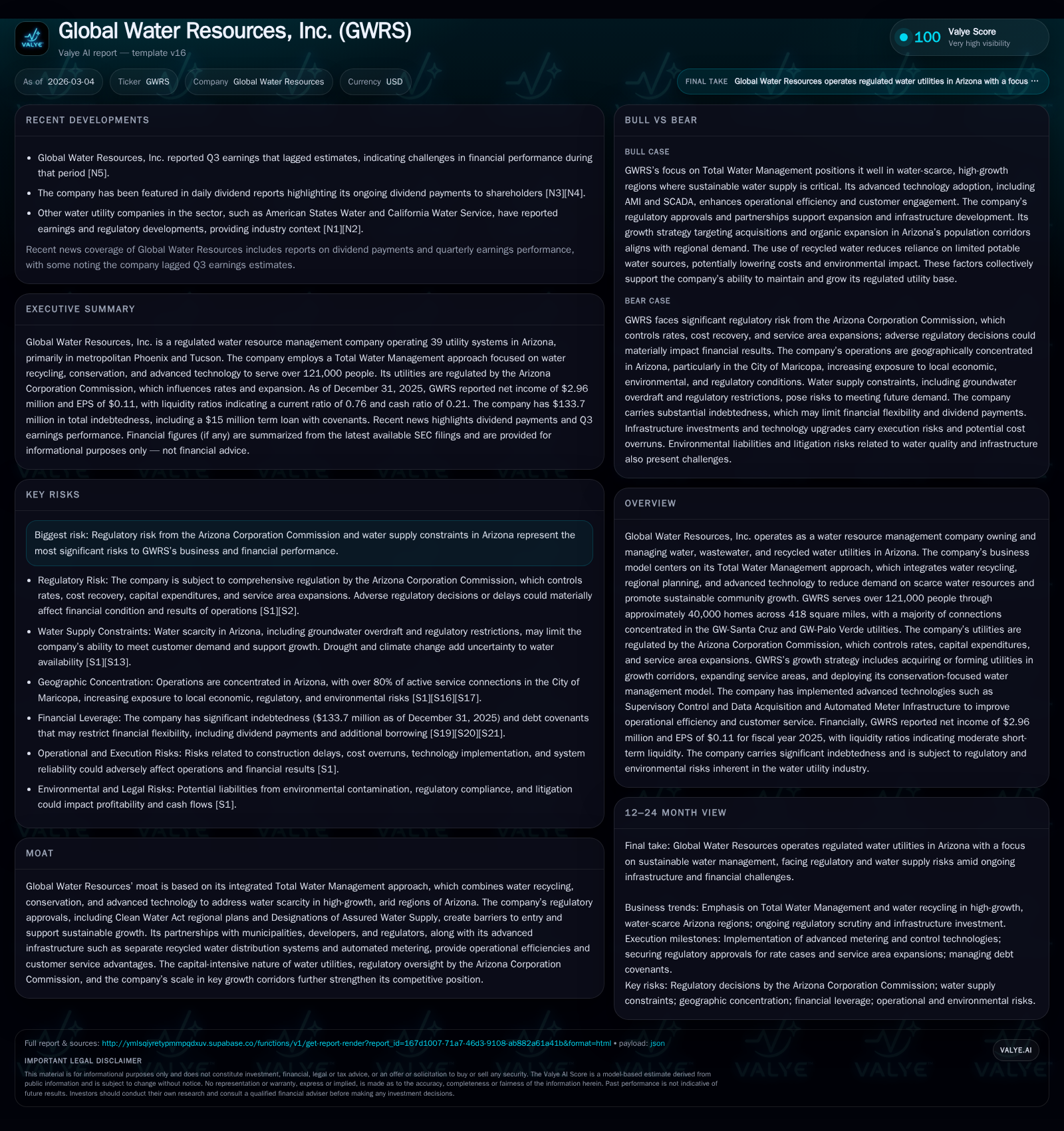
Global Water Resources, Inc. operates water, wastewater, and recycled water utilities primarily in Arizona leveraging a Total Water Management approach to address regional water scarcity sustainably. While historical revenue growth has been steady, recent earnings and margins have declined amid large infrastructure investments and regulatory risks tied to utility rate cases overseen by the Arizona Corporation Commission. The company’s future growth depends on strategic expansions within regulated service areas, managing capital intensity, and navigating evolving water supply constraints. Capital allocation priorities currently emphasize infrastructure spending and dividends with limited free cash flow generation.
Company Overview and Business Model
Global Water Resources, Inc. (GWRS) operates an integrated network of thirty-nine regulated water, wastewater, and recycled water utility systems principally located within metropolitan Phoenix and Tucson, Arizona [S1][S5]. The core of its business model is the "Total Water Management" approach that aims to reduce reliance on scarce groundwater supplies through coordinated recycling of treated wastewater via dedicated non-potable “purple pipe” infrastructure, regionally integrated planning frameworks including Clean Water Act Section 208 plans covering over 500 square miles, advanced data monitoring technologies like Automated Meter Infrastructure (AMI), and partnerships with municipalities, developers, and regulators to foster sustainable community growth [S1][S6][S15][S26].
As of December 31, 2025, GWRS served over 121,000 residents via approximately 40,000 active service connections spread across roughly 418 square miles designated by the Arizona Corporation Commission (ACC) as its service territory. A significant majority (~87%) of customers are concentrated in its two largest utilities: GW-Santa Cruz and GW-Palo Verde [S1][S5]. These utilities provide potable water alongside recycled non-potable supplies primarily for irrigation purposes.
The company’s business is entrenched within heavy regulation by the ACC that controls rates charged to customers, capital expenditures approvals, service area expansions, and monitors service quality standards. This regulatory framework imposes both operational discipline — ensuring cost recovery through regulated rates — as well as risks related to rate case outcomes and timing [S1][S14].
Historical Financial Performance
GWRS has exhibited steady top-line expansion over recent years driven by organic growth in connections supplemented by strategic acquisitions such as the July 2025 purchase of City of Tucson systems (GW-Ocotillo) expanding its footprint [F1][S10]. Reported annual revenues grew from approximately $35.5 million in 2019 to $41.9 million in 2021 — representing a CAGR near double digits over this period — signaling positive demand trends backed by steady residential development within its exclusive service areas [F1].
Operating income reached a peak of $12.3M in fiscal year 2023 before declining sharply to $7.2M by year-end 2025 amid intensifying capital spend pressures and rising operating costs including labor inflation and energy price volatility impacting pumping/treatment operations [F1]. Net income also suffered a pronounced decline dropping almost half (-48.9%) from roughly $5.8M in 2024 down to $3.0M in the latest fiscal year reflecting margin compression [F1].
Cash flow from operations remained robust but showed a modest contraction (-7.4%) year-over-year to around $20.2M owing partly to working capital dynamics; however Free Cash Flow turned negative given that capital expenditure nearly doubled year-over-year from $32.3M in FY24 to $67.3M in FY25 as the company accelerated investments into system expansions across multiple utility zones including augmentations for regulatory compliance with evolving water quality standards such as PFAS limits [F1][S8][S25].
The following table consolidates key financial metrics over the most recent four-year period:
Historical performance (annual)
| FY | Net ($mm) | CFO ($mm) | OpInc ($mm) | Capex ($mm) | Net YoY |
|---|---|---|---|---|---|
| 2025 | 3 | 20 | 7 | 67 | -48.9% |
| 2024 | 6 | 22 | 9 | 32 | -27.5% |
| 2023 | 8 | 25 | 12 | 22 | +45.0% |
| 2022 | 6 | 23 | 8 | 34 |
Source: SEC companyfacts cache [F1].
Capital returns and efficiency (annual)
| FY | Div ($mm) | FCF ($mm) | ROE% |
|---|---|---|---|
| 2025 | 8 | -47 | 3.4 |
| 2024 | 7 | -11 | 12.2 |
| 2023 | 7 | 3 | 16.4 |
| 2022 | 7 | -11 | 12.4 |
Source: SEC companyfacts cache [F1]. -27 % (OpInc) | 2025 | n/a |7.2 M |3.0 M |20.2 M |67.3 M |8.2 M |-23 % (OpInc) |-49 % (Net)|
Note: FY indicates fiscal year ending December; Rev YoY cannot be computed without full revenue data for all years.
Growth Prospects
GWRS’s growth strategy revolves around extending its presence within Arizona’s high-growth corridors characterized by persistent water scarcity challenges requiring innovative conservation measures inherent in its Total Water Management philosophy [S11][S15]. Expansion paths include acquisitions or formation of new utilities ahead of anticipated population inflows (e.g., Maricopa County’s Tonopah area expansion via GW-Hassayampa utility with currently limited customers), geographic extensions into underserved or developing regions under ACC approval processes, as well as organic customer base increases through new residential developments incorporating recycled water infrastructure from inception [S10][S11][S15].
Total Water Management is central not only operationally but also strategically: drinking potable demands are offset through rigorous reuse schemes delivering treated wastewater via separate non-potable pipelines (“purple pipes”) for irrigation agricultural use or aquifer recharge programs that cumulatively reduce overall reliance on finite groundwater resources which face overdraft risks per Arizona Department of Water Resources data [S15][S26][F1] . Approximately 70% of municipal water use area-wide is non-potable where recycled water can substitute municipal supplies energetically more efficiently than long-haul transportation or desalination alternatives common elsewhere [S15].
Technology adoption—including AMI smart meters reaching ~90% coverage — enhances demand management capabilities allowing leak detection at consumer levels, rapid anomaly identification that reduces non-revenue losses, interactive billing interfaces improving consumption awareness thus supporting conservation ethos aligned with prevailing regulatory objectives controlling future rate increases against projected capital needs [S6][S26].
However, actualized growth will be contingent on successful navigation through ongoing regulatory rate cases pending at the ACC for primary utilities GW-Santa Cruz and GW-Palo Verde which represent a vast majority (~87%) of active connections [S1][S14]. Submitted testimonies from ACC staff personnel and Residential Utility Consumer Office demonstrate marked differences from GWRS rate applications particularly concerning net revenue adjustments, cost disallowances and asset valuation bases creating material uncertainty around final authorized returns sufficient for sustainable investment programs or dividend distribution policies [S1]. Should the outcomes be less favorable than management expects it could constrain internally funded capital improvements necessary for contractual service obligations or sustaining reliability thereby impacting customer satisfaction metrics indirectly affecting growth momentum.
Additional regulatory challenges stem from compliance with increasingly stringent environmental standards including those regulating emerging contaminants such as PFAS under federal Safe Drinking Water Act amendments plus various state-level wastewater discharge permits managed through Aquifer Protection Permits from ADEQ requiring substantial infrastructure upgrades potentially necessitating large incremental expenditures or technology shifts impacting cost structures unpredictably later this decade [S8][S25].
Forecasts & Milestones to Monitor
Although explicit forward guidance was not provided directly in the filings examined [N#][S#], important indicators for stakeholders include:
- Resolution outcomes for current ACC rate cases involving major utilities spanning over four-fifths of active connections that will determine allowed revenues shaping near-term profitability trajectories.
- Progress on integrating recently acquired assets such as GW-Ocotillo acquired mid-2025 expected to contribute additional revenue streams proportional to connection growth.
- Continued rollout status of AMI upgrades across remaining customer subsets increasing operational efficiencies.
- Permitting milestones relating to Clean Water Act Section 208 Regional Plans expansion reflecting regulatory acceptance enabling further geographic consolidation.
- Capital expenditure pacing particularly stabilizing after FY25’s spike indicating normalized maintenance vs growth investment balance.
- Implementation results from conservation-focused community outreach programs measuring recycled water utilization rates beyond current ~56% non-potable irrigation share within Maricopa complexes approximately sized at population ~86k currently served.
Given complexity these factors warrant close attention rather than definitive quantified forecasts currently absent.
Returns & Capital Allocation
The company’s latest reported net income amounted to approximately $3 million for FY25 representing an approximate return on equity near 3.4% calculated against end-of-year equity totaling about $86 million driven down by elevated operating expenses despite ongoing revenue scale advantages (net income divided by equity base) reflecting compressing margins linked mostly to heavy reinvestment periods rather than operational weakness alone [F1].[F1]
The firm maintained consistent dividend payouts growing modestly from roughly $6.9 million distributed in FY22 up to about $8.2 million paid out during FY25 underscoring a commitment to shareholder returns albeit limited free cash flow availability given intensified capex regime leading to significant negative FCF exceeding -$47 million most recently (operating cash flow less capex) indicating reinvestment priority at expense of discretionary liquidity expansion or debt reduction efforts currently [F1].[F1]
Total indebtedness stood at about $133.7 million at year-end FY25 incorporating a recent term loan facility secured toward financing CAPEX needs with restrictive covenants limiting further leverage increases including dividend payments if certain debt-service coverage ratios fall below defined thresholds illustrating tight financial stewardship demands imposed by lenders aligned with regulated utility risk profiles balancing accessible external funding vs organic cash sufficiency constraints [S4][S21].[F1]
Industry and Regional Context Analysis
Within Arizona’s arid environment where surface allocations like Colorado River rights are historically overstretched relative to actual decreasing flows compounded by ecosystem protections reducing usable groundwater recharge prospects combined with population growth pressures typical among Sun Belt states—innovative integrated utility models like GWRS’s Total Water Management play an essential role for long-term community viability especially incorporating recycled non-potable systems restoring hydration balance without costly conveyance alternatives common elsewhere providing both sustainability appeal politically favored by regulators and preference among developers seeking green certifications aligned with buyer demand trends.[S15]
Challenges experienced broadly across US municipal water sectors including aging infrastructure requiring sizeable reinvestments amidst fragmentation where many small public utilities lack capabilities traceable onto GWRS’s consolidated centrally-managed scalable platform deploying supervisory control automation software epitomizes a best practice path forward increasingly demanded.
Risks Overview Summary
Key risks revolve around:
- Regulatory uncertainty tied primarily to ACC rate case final decisions impacting allowed revenues necessary for cost recovery affecting near-to-medium term profitability.
- Constraints on reliable affordable water supplies amplified by drought cycles potential regulatory restrictions on groundwater extraction challenging operational continuity.
- Rising input costs notably electricity powering pumps/treatment plants chemicals required adjusted for volatile supply chains post-pandemic plus labor market tightness affecting wages disputes ability retaining skilled operators.
- Technology-related vulnerabilities including potential cyber intrusions targeting critical infrastructure emphasizing heightened cybersecurity preparedness necessity.
- Execution risks associated with significant capex programs amplifying budget overruns delays non-compliance fines jeopardizing service reliability reputation harm legal proceedings exposure.[complex risk profile articulated comprehensively throughout SEC filings including Item 1A Risk Factors sections]
Conclusion
GWRS embodies a specialized niche within investor-owned water utilities combining advanced sustainability-focused resource management strategies tailored for challenging arid geographies undergoing robust population expansions under constrained fixed resource environments defining a moat difficult to replicate absent regulatory support partnerships securing continuous growth prospects largely concentrated around key service areas subject distinctly to ACC oversight producing revenue predictability modulated by rate case resolutions currently underway constraining earnings visibility while major capital commitments escalate total asset bases suited for scale economies gradually realized amid enduring cost inflation headwinds.
Stakeholders should closely monitor regulatory developments particularly ACC rulings related to allowed ratemaking parameters plus progress on infrastructure integration initiatives balancing service reliability against financial resource deployment amidst intensifying environmental mandates shaping future cost structures inherently intertwined with groundwater availability uncertainties fundamental for sustaining demand-side management approaches serving as pillars underpinning company's long-term viability.
DISCLAIMER: This analysis is intended solely for informational purposes based on publicly available filings dated through March 2026; it does not represent investment advice or recommendations regarding Global Water Resources' securities or operations.
Disclaimer: This is research-only, informational analysis and not investment advice. It may include AI-generated interpretation and general industry context. Always verify important details using primary sources.

Comments