
Rigetti Computing’s Struggles and Strategies in Scalable Quantum Hardware Development
Rigetti’s proprietary modular multi-chip architecture and Fab-1 integration underscore ambitious quantum scaling amid steep financial losses.
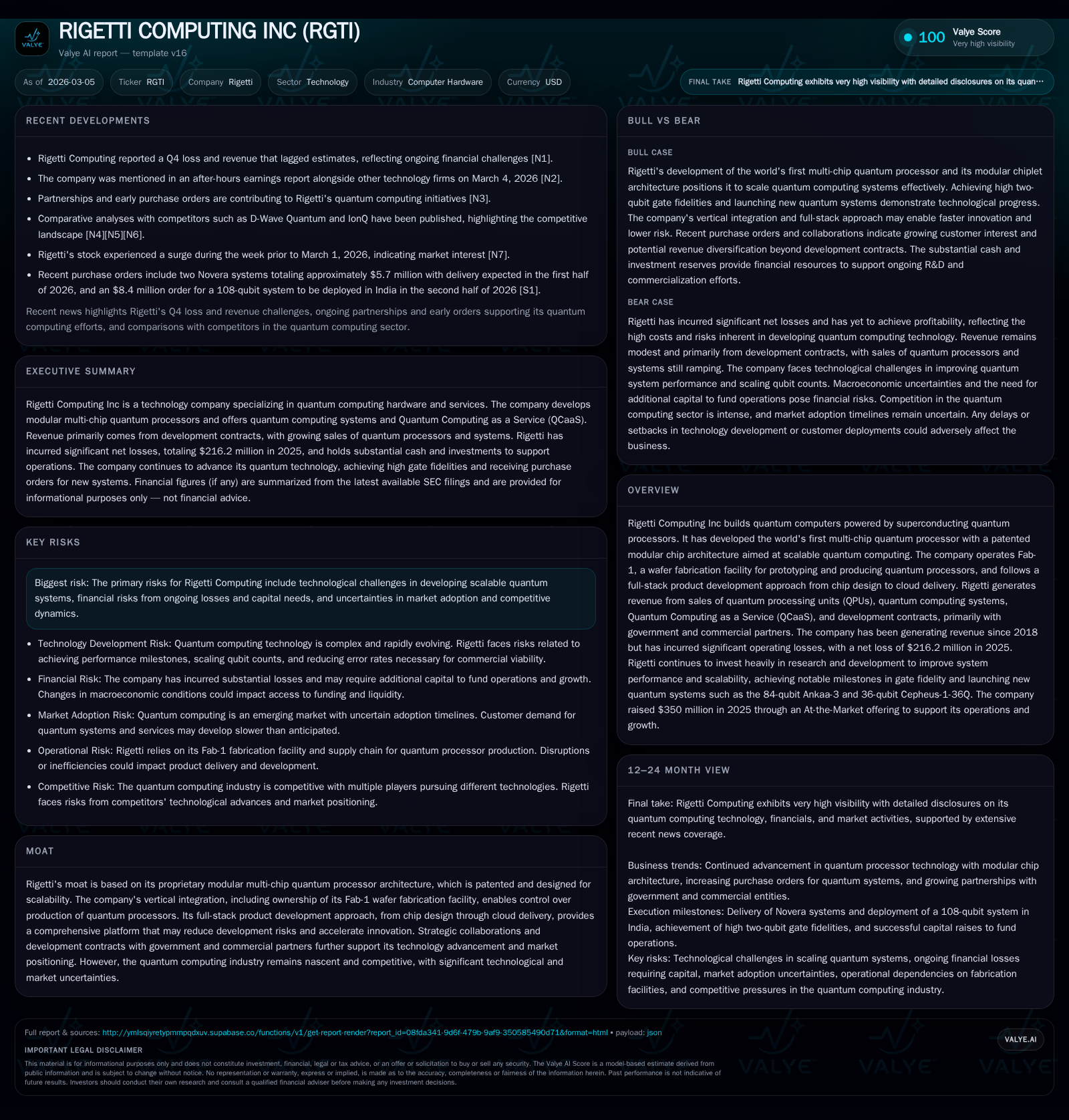
Rigetti Computing has pioneered a patented modular quantum processor architecture that promises scalability in quantum computing, supported by its vertically integrated Fab-1 wafer fabrication facility. Despite generating revenue since 2018 across multiple streams including QCaaS and quantum processors, the company faced a 34% revenue decline in 2025 to $7.1 million alongside mounting operating losses totaling $84.7 million. Its heavy investments in R&D aim to overcome technological bottlenecks, but the nascent market and competitive landscape pose significant risks. Strong balance sheet liquidity contrasts with cash burn exceeding $77 million, with no dividends or buybacks planned, reflecting a capital-intensive pursuit of quantum advantage and commercial viability.
From Breakthrough Chips to Headlines: Tracing Rigetti's Revenue Growth History
Since initiating revenue generation in 2018, Rigetti Computing has expanded its sales across quantum processing units (QPUs), quantum computing systems, Quantum Computing as a Service (QCaaS), and development contracts primarily with government and commercial clients [N7][S4]. The company's signature innovation—the patented modular multi-chip superconducting processor architecture—anchors its product portfolio, designed to mitigate scalability limits typical of monolithic quantum chips.
Historically, this architectural feat, coupled with full-stack control from chip design through cloud deployment, helped drive progressive top-line growth up to 2024. However, available financial disclosure highlights that total revenues peaked near $10.79 million in 2024 before sliding sharply by 34% to approximately $7.09 million in 2025 [F1][N2][S4]. This contraction reflects both adoption challenges of high-cost hardware platforms within an immature quantum ecosystem and transitional dynamics shifting revenue mix toward lower-margin system deliveries.
Historical performance (annual)
| FY | Net ($mm) | CFO ($mm) | OpInc ($mm) | Capex ($mm) | Net YoY |
|---|---|---|---|---|---|
| 2025 | -216 | -59 | -85 | 19 | -7.6% |
| 2024 | -201 | -51 | -69 | 11 | -167.6% |
| 2023 | -75 | -51 | -72 | 9 | -5.0% |
| 2022 | -72 | -63 | -109 | 23 |
Source: SEC companyfacts cache [F1].
Capital returns and efficiency (annual)
| FY | FCF ($mm) | ROE% |
|---|---|---|
| 2025 | -77 | -39.6 |
| 2024 | -62 | -158.8 |
| 2023 | -60 | -68.5 |
| 2022 | -85 | -47.6 |
Source: SEC companyfacts cache [F1].
¹Based on available operating income data comparing FY24 to FY23 [F1].
This uneven revenue trend reflects the complex interplay between early-stage product adoption reluctance and elevated fixed costs associated with advanced chip production and system integration.
Decoding the Declines: What Changed in 2025?
The pronounced revenue dip and margin compression during fiscal year 2025 tie closely to system scaling obstacles detailed in Rigetti’s earnings call transcript [N1] and annual filing [S1]. The company disclosed operational headwinds rooted in the technical difficulty of ramping output for its modular multi-chip processors, alongside slow uptake of QCaaS offerings which depend on client migration toward functional cloud-based quantum workloads.
Moreover, the mix shifted toward deliveries of recently developed 24-qubit and 36-qubit systems featuring higher materials costs and thinner gross margins [S9]. These factors combined to depress total gross profit by nearly two-thirds compared to the prior year [F1]. Market uncertainties around practical application readiness for fault-tolerant quantum computation contribute additional pressure on near-term sales ramp.
Financially, these operational challenges translated into a steeper operating loss swing from minus $68.5 million in 2024 to minus $84.7 million in 2025—a 24% increase—highlighting intensified investment despite shortfall in top-line growth [F1][N1][S1].
Full-Stack Control: Assessing Fab-1’s Role in Product and Innovation Advances
Central to Rigetti’s competitive moat is Fab-1—a proprietary wafer fabrication facility based in Fremont, California—that affords essential vertical integration uncommon among peers reliant on external foundries [S1][N7][F1]. Fab-1 enables rapid prototyping cycles for superconducting qubits, critical given the sensitivity of yield optimization steps like lithography precision and cryogenic packaging.
Operational control at this stage supports flexibility to refine the modular chip assembly unique to Rigetti’s multi-chip architecture approach. By managing wafer-level processes including deposition, patterning, and dicing internally, Rigetti seeks to mitigate supply chain variability common within fragile quantum device manufacturing ecosystems.
With lease commitments extending through late 2029 for Fab-1 facilities [S1], ongoing capital expenditures have grown sharply—increasing approximately 68% YoY to nearly $18.7 million during 2025—to maintain cutting-edge capabilities aligned with their roadmap for scalable fault-tolerant designs [F1][S6]. Such scaling ambitions underpin future cost efficiencies but require upfront cash outlays that exacerbate current operating leverage.
Partnerships and Pipeline: Near-Term Growth Catalysts and Their Limitations
Strategic collaborations remain pivotal for Rigetti’s near-term growth visibility as the firm primarily serves government entities accounting for roughly ninety percent of revenue stream [S23][N7]. Additionally, commercial partnerships foster co-development contracts enabling incremental revenue inflows while expanding use cases for memory-efficient QCaaS offerings.
However, sector-native adoption lags due to requisite customer transitions into hybrid classical-quantum frameworks as well as scarcity of proven large-scale applications [S24]. Contracted development efforts demand bespoke integrations contributing variable delivery schedules challenging predictable revenue expansion [N7][S24].
Further complicating prospects is intensifying competition highlighted by peers engaging M&A activity aimed at broadening capabilities—IonQ’s strategic acquisitions exemplify such pressure—potentially accelerating consolidation within this embryonic ecosystem [N5][S7]. Consequently, while contract pipelines signal promise for incremental scale-up, tangible revenue catalysts are constrained by macroeconomic funding environments coupled with persistent technological immaturity.
Financial Performance Deep Dive: Operating Losses, Cash Burn, and Capital Allocation
Despite incremental improvements in operating stability relative to earlier years—operating income losses narrowed somewhat from the nadir of negative $109 million recorded in 2022—the financial profile remains deeply challenged [F1]. The firm reported a net loss exceeding $216 million in fiscal year 2025 reflecting elevated R&D expense growth (up over $11 million YoY) invested heavily into platforms advancing qubit coherence time enhancements and error correction capabilities [F1][S6][N1].
Operating cash flow remains significantly negative at about minus $58.5 million annually with capex pushing free cash flow further into deficit territory near minus $77 million indicating sustained cash burn imperative for technology maturation [F1]. Nevertheless, robust liquidity buffers afford runway protection: cash plus equivalents stood healthy at approximately $44.9 million at year-end along with an exceptionally strong current ratio around 37:1 evidencing ample short-term solvency [F1][S8].
From a capital allocation perspective, management has eschewed dividends or share repurchase programs amidst prioritizing reinvestment into R&D activities essential for securing future commercialization milestones [S18]. Equity expanded sharply between years due to fundraises supporting Fab-1 upgrades and general operations.
| FY | Operating Cash Flow (USD mln) | Capital Expenditures (USD mln) | Estimated Free Cash Flow (USD mln)* | Equity (USD mln) |
|---|---|---|---|---|
| 2025 | -58.54 | 18.68 | -77.22 | 546.20 |
| 2024 | -50.63 | 11.10 | -61.73 | 126.59 |
| *Estimated as Operating Cash Flow minus Capital Expenditures from reported figures [F1] |
Outlook Amid Market Hype: Risks and Uncertainties in Commercializing Quantum Hardware
Risks include technology readiness uncertainties inherent to superconducting qubit platforms attempting large-scale error correction implementation within modular architectures [S7][N14]. Financial risk stems from relentless capital demands set against uncertain timing of meaningful revenue inflection points critical for breaking losses equilibrium.
Competitive intensity also heightens given peers' strategic maneuvers via M&A positioning that may accelerate capability consolidation elevating barriers for specialized players like Rigetti [N5]. Market adoption remains speculative given evolving quantum software stacks linking physical QPU layers to disruptive end-user applications requiring complex hybrid workflows.
These multifaceted risks situate Rigetti firmly within early-stage commercialization where proof points related to stable system uptime at scale constitute crucial validation hurdles impacting valuation perspectives going forward.
What to Watch Next: Key Milestones and Potential Inflection Points
Absent formal long-term guidance beyond cautious commentary offered in recent earnings calls [N1], attention gravitates toward identifiable catalysts such as expansions of QCaaS cloud platform usership metrics alongside announcements regarding upgraded multi-chip arrays under testing regimes potentially breaking previous qubit count ceilings.
Additionally, crystallization of longer-dated government contract wins or commercial pilot projects could support incremental revenue even as product roadmaps outline scale-up timelines involving enhanced chip coherence times paired with fabrication yield enhancements at Fab-1 [N7][S2]. Share-based compensation disclosures suggest retention efforts targeting skilled talent participation aligned with enterprise growth phase requirements.
Investors will prudently monitor quarterly traction on product delivery volumes juxtaposed with operating expense moderation as proxy gauges for evolving leverage dynamics within the firm's tech-heavy cost base structure.
This report is based solely on publicly available information including SEC filings ([F1], [S#]), company disclosures ([N#]) and is not intended as investment advice or recommendations but rather an analytical overview reflecting current company status through March 2026.
Disclaimer: This is research-only, informational analysis and not investment advice. It may include AI-generated interpretation and general industry context. Always verify important details using primary sources.

Comments