
OmniAb Inc. Reports Strengthened Platform Adoption but Endures Operational Losses
Despite growing partnerships and program activity fueled by proprietary antibody discovery platforms, OmniAb continues to experience operating losses and faces downstream royalty uncertainties amid healthcare reforms.
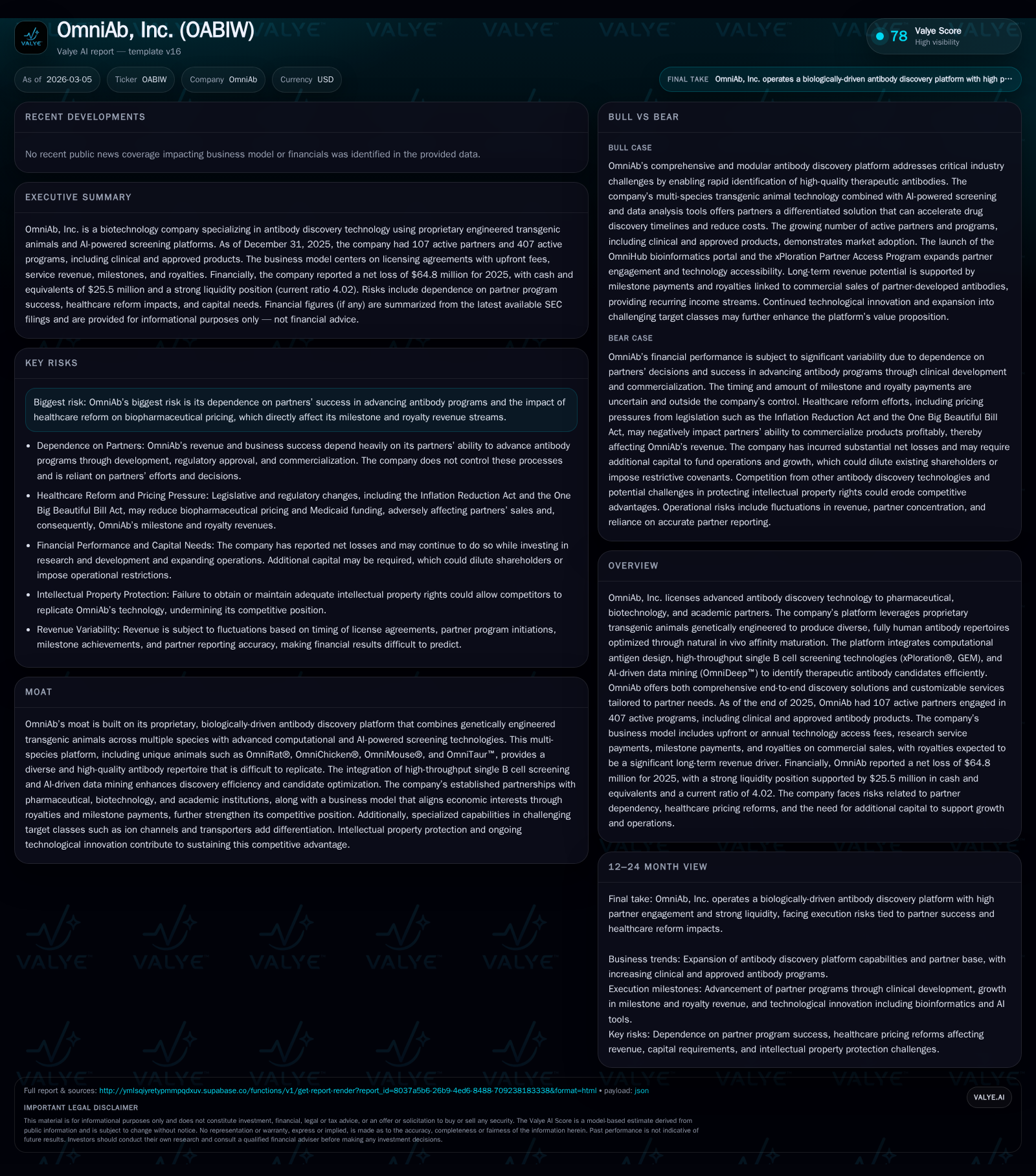
OmniAb, Inc. has expanded its partner base to over 100 entities and grown its active discovery programs to more than 400 by the end of 2025, reflecting solid adoption of its multi-species transgenic antibody platform. This biological and AI-powered technology uniquely positions OmniAb in the competitive therapeutic discovery sector. However, financial results remain challenged with a $69 million operating loss in 2025, driven by ongoing development investments. Additionally, evolving U.S. and global healthcare pricing reforms pose risks to the realization of milestone and royalty revenues tied to partners’ commercial success.
Evolution of Growth: Partnership Expansion and Program Footprint
By the close of 2025, OmniAb had established significant engagement across the biopharmaceutical sector with 107 active partners using its discovery platform in 407 distinct programs [S1]. This progressive expansion from earlier years underscores an accelerating adoption curve fueled by OmniAb’s capacity to streamline antibody discovery through its engineered transgenic hosts combined with computational support. Notably, these programs encompass various stages including preclinical research up to advanced clinical trials, signaling broad industrial trust in OmniAb’s technology integration [S1]. Historical performance metrics corroborate that platform acceptance has been a key driver propelling revenue streams from upfront licensing fees and research services.
Technological Differentiation Through Multi-Species Transgenic Platforms
OmniAb’s moat is anchored by its proprietary multi-species suite comprising genetically modified animals tailored for fully human antibody repertoires optimized through natural in vivo affinity maturation [S1]. These include well-validated lines such as OmniRat®, OmniChicken®, OmniMouse®, and OmniTaur™, each providing structural diversity essential for targeting challenging epitopes often inaccessible using single-species or synthetic libraries. Complementing these biological assets are advanced screening technologies like xPloration® and GEM that enable phenotypic profiling at single B cell resolution, ensuring efficient isolation of high-affinity candidates. Moreover, OmniDeep™, an AI and machine learning driven framework interwoven throughout the platform, mines next-generation sequencing data alongside computational antigen design to accelerate candidate identification [S1]. The combined effect is a thoroughly differentiated discovery engine blending biological intelligence with digital sophistication.
Financial Performance Trends: Operating Losses Within a High-Development Phase
Financially, OmniAb continues to operate at a loss befitting a high-investment biotech enterprise focusing on innovation expansion rather than near-term profitability [F1]. Operating income for FY2025 was -$68.97 million, marking a modest 7.4% improvement from -$74.5 million in FY2024 but still reflective of substantial ongoing expenditure related to R&D and scaling activities [F1]. Net losses worsened marginally by 4.4% YoY to -$64.78 million in FY2025 compared to prior years [F1], indicating persistent challenges balancing cost structure against revenue growth. Operating cash flow showed some improvement (-$36.45 million in FY2025 versus -$39.66 million prior year), though free cash flow remained negative around -$37 million after capital expenditures which notably decreased by nearly 70% YoY to $565K reflecting lower infrastructure outlays [F1]. These figures align with industry patterns where early-stage biotech players sustain losses pending maturation of partner-derived milestones.
Historical performance (annual)
| FY | Net ($mm) | CFO ($mm) | OpInc ($mm) | Capex ($mm) | Net YoY |
|---|---|---|---|---|---|
| 2025 | -65 | -36 | -69 | 1 | -4.4% |
| 2024 | -62 | -40 | -75 | 2 | -22.5% |
| 2023 | -51 | 2 | -69 | 2 | -126.6% |
| 2022 | -22 | -4 | -27 | 17 |
Source: SEC companyfacts cache [F1].
Capital returns and efficiency (annual)
| FY | FCF ($mm) | ROE% |
|---|---|---|
| 2025 | -37 | -24.3 |
| 2024 | -42 | -21.6 |
| 2023 | 1 | -16.1 |
| 2022 | -21 | -6.5 |
Source: SEC companyfacts cache [F1].
Table: Historical Financial Performance from FY2022-FY2025 [F1]
Navigating Healthcare Policy Risks Impacting Downstream Royalty Potential
An especially salient risk is the evolving legislative environment surrounding drug pricing that threatens downstream royalty revenues which depend on commercial successes realized by partners [S4][S5][S21]. The Inflation Reduction Act enacted in August 2022 introduces Medicare drug price negotiations alongside inflationary rebates under Medicare Part B/D that can significantly suppress pharmaceutical manufacturers' revenues starting from 2023 through subsequent years [S5]. Additionally, recent reductions in Medicaid funding enacted via the One Big Beautiful Bill Act in July 2025 constrain patient enrollment and covered services adversely impacting product sales volume potential [S2][S12]. State-level interventions further compound this complexity through prescription drug affordability boards instituting upper payment limits or price caps on pharmaceuticals at the state level [S4][S22]. Collectively these federal and state reforms introduce considerable uncertainty into future royalty income projections linked directly to partners’ market performance.
Capital Allocation and Cash Flow: Cash Burn, Liquidity, and Equity Position
Despite ongoing losses and negative free cash flows approximating $37 million in FY2025 post-capex investments [F1], OmniAb sustains a comparatively strong liquidity position fortified by $25.5 million cash balances and about four times greater current assets than liabilities resulting in a current ratio near 4.0 at year-end [F1]. Total equity stood at approximately $267 million descending over recent years consistent with accumulated deficits since inception [F1]. Capital expenditures sharply declined representing a shift away from heavy fixed asset investments likely due to maturation of core infrastructure supporting operations [F1]. Return on equity remains negative around -24.3% as net losses persist relative to shareholder equity invested [F1]. This operational cash burn profile corresponds with expected enterprise financing strategies favoring reinvestment into platform enhancement rather than dividend or buyback distributions.
Pipeline Expectations and Milestone Visibility in Partner-Led Therapeutics
The company emphasizes its structured platform licensing model where revenues derive primarily from upfront fees plus milestone payments linked directly to partner advancement of antibody programs [S1]. Currently partnered programs include 27 clinical candidates progressing through development phases; two candidates under regulatory review; and three commercially approved products successfully launched leveraging OmniAb technologies [S1]. This pipeline breadth reflects promising future earning potential albeit contingent entirely on third-party clinical success trajectories outside OmniAb’s direct control [S1]. Visibility into milestones inherently depends on timing of partner trial initiations/completions regulatory filings and approvals creating temporal uncertainty around expected payments.
Competitive Moat Built on Biological Intelligence™ and AI Integration
The cornerstone differentiation is the proprietary Biological Intelligence™ framework encapsulating both engineered animal immune systems capable of generating naturally affinity-matured human antibodies as well as AI-driven analytics embedded throughout discovery workflows [S1]. Advanced immunization techniques paired with computational antigen design markedly improve efficiency obtaining functional antibodies capable addressing traditionally difficult targets including bispecific formats enabled via constructs like OmniFlic® rats or OmniClic® chickens [S1]. The AI components encompass high-throughput sequence mining coupled with phenotype-based candidate selection assisted by machine learning algorithms within the OmniDeep™ suite allowing optimization for attributes such as binding affinity stability developability as well as novelty metrics vital for therapeutic innovation [S1]. Collectively these elements erect significant barriers against competitors reliant solely on synthetic libraries or mammalian systems lacking comparable repertoire diversity.
Outlook & Market Dynamics: Challenges and Opportunities Ahead
Looking forward though growth prospects remain vibrant given expanding industrial interest evidenced by increasing partner engagement (107 partners; >400 programs), earnings trajectory will likely stay pressured reflecting continuing R&D investments required for sustained platform leadership . Regulatory landscapes including tightening drug pricing policies represent formidable external headwinds that may dampen milestone and royalty receipts linked inherently to commercial uptake rates of partner-derived therapeutics . Investors should monitor quarterly disclosures for new strategic partnerships that might signal broadening market acceptance along with milestone achievement announcements potentially lifting near-term revenue visibility . Additionally technological advances extending ultra-long CDRH3 regions accessible through OmniUltra™ platforms into peptide modalities represent innovative vectors for unlocking treatments against refractory targets indicating further runway for differentiation-driven pipeline enablement [S1]. Strategic vigilance towards legislative changes influencing payor coverage dynamics particularly Medicare Part D remodels will remain necessary given their direct bearing on systemic commercialization economics affecting all biopharma players.
This analysis synthesizes data sourced primarily from company SEC filings including the latest Annual Report Form 10-K filed March 2026 ([S1],[F1]) alongside associated Risk Factor disclosures ([S4],[S5],[S21]) detailing regulatory impact considerations without extrapolative assumptions beyond presented data points or forward-looking guidance not explicit in source documents. The commentary aims to provide an informed assessment without investment recommendations.
Disclaimer: This is research-only, informational analysis and not investment advice. It may include AI-generated interpretation and general industry context. Always verify important details using primary sources.

Comments