
Cadrenal Therapeutics Advances CAD-1005 Amid Clinical and Financial Crossroads
The latest quarterly update highlights CAD-1005’s regulatory progress and clinical trajectory intertwined with urgent liquidity challenges shaping Cadrenal's near-term outlook.
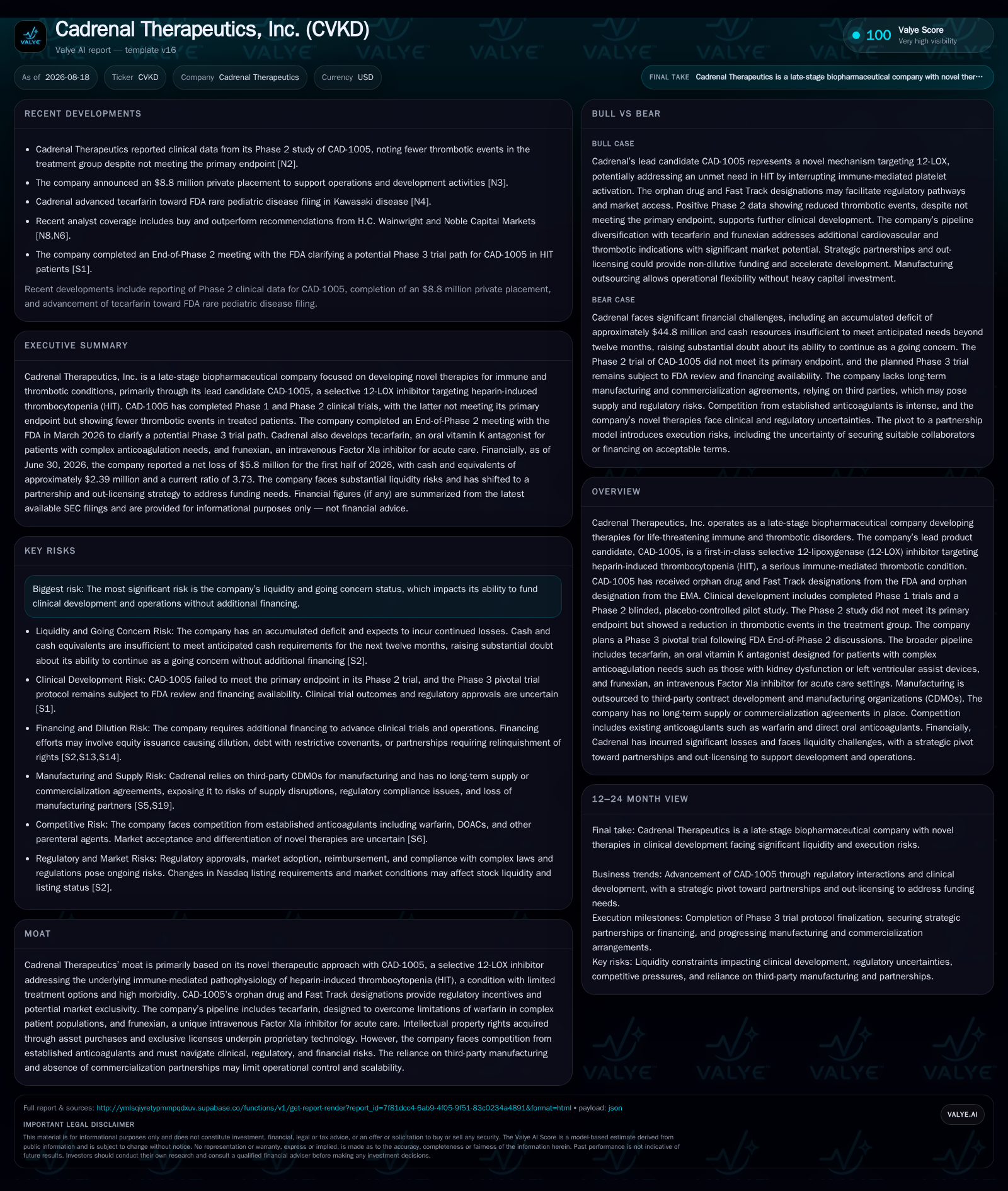
Cadrenal Therapeutics, a late-stage biopharmaceutical company, reported incremental clinical progress for its lead candidate CAD-1005 following FDA End-of-Phase 2 discussions, setting the stage for a pivotal Phase 3 trial in heparin-induced thrombocytopenia (HIT). Despite orphan drug and Fast Track designations providing regulatory tailwinds, CAD-1005’s Phase 2 results showed only partial efficacy signals requiring confirmatory trials. Meanwhile, Cadrenal faces substantial liquidity constraints with cash reserves insufficient for a full Phase 3 development cycle absent additional financing or partnerships. The blended dependency on third-party manufacturing and limited pipeline breadth further sharpen operational risks. Monitoring clinical trial initiation milestones and capital raising outcomes will be critical to assessing the sustainability of Cadrenal’s development strategy.
Latest Quarterly Update: Regulatory Progress Anchors Development Strategy
In its August 2026 Form 10-Q filing, Cadrenal Therapeutics detailed continued advancement of its lead candidate CAD-1005 following acquisition of the selective 12-lipoxygenase platform in late 2025 [S1][S2]. The company completed a critical FDA End-of-Phase 2 (EOP2) meeting in March 2026 that outlined potential registrational pathways for an upcoming pivotal Phase 3 trial targeting heparin-induced thrombocytopenia (HIT), a rare but severe immune-mediated thrombotic disorder. While final protocol details await FDA review of formal meeting minutes, this regulatory milestone reduces late-stage clinical uncertainty by clarifying endpoint expectations and trial design parameters—key risk mitigants in biotech development cycles [S1].
The preceding Phase 2 study was a blinded, placebo-controlled pilot involving 24 patients which did not meet its primary statistical endpoint but showed encouraging trends such as lower thrombotic event rates in treated patients versus placebo arms [N2][N3]. This partial efficacy signal aligns with typical early-stage readouts where promising mechanistic action requires larger confirmatory trials to satisfy regulatory standards. Given HIT's complexity and limited treatment options, the FDA's openness to CAD-1005’s novel mechanism offers potential expedited pathways but remains contingent on rigorous Phase 3 evidence.
Business Model and Pipeline Focus: Concentrated Yet Innovative Portfolio
Post-acquisition strategic realignment has focused Cadrenal primarily on CAD-1005 within a newly formed Cardiac Acute Critical Care Franchise [S1][S5]. This focus aligns corporate resources behind therapies addressing urgent unmet needs in acute immune-thrombotic conditions where accelerated development pathways are plausible.
Supporting this core asset are two additional clinical-stage candidates: tecarfarin, an oral vitamin K antagonist designed as a warfarin alternative tailored for complex patient subsets such as those with kidney impairment or left ventricular assist devices (LVADs), and frunexian, an intravenous Factor XIa inhibitor intended for acute hospital settings involving medical device-related coagulation activation [S1]. While these assets diversify therapeutic modalities within cardiovascular care, they remain pre-commercial with substantial R&D investment needed before potential registrational trials.
This portfolio structure reflects typical late-stage biotech archetypes balancing high-risk/high-reward innovative platforms against constrained capital. With revenue generation dependent on successful progression of mainly one lead candidate—CAD-1005—the company faces concentration risk common among small-scale developers.
Regulatory Incentives: Orphan Drug and Fast Track Designations Enhance Competitive Position
CAD-1005 benefits from orphan drug designation granted by both U.S. FDA and European Medicines Agency (EMA), coupled with FDA Fast Track designation for treatment and prevention of HIT [S1]. These statuses confer meaningful competitive advantages including extended market exclusivity periods post-approval—typically seven years in the U.S.—and opportunities for expedited FDA review processes.
Fast Track status facilitates rolling submissions during ongoing clinical studies and fosters enhanced agency engagement throughout development phases, potentially shortening time-to-market relative to non-designated peers. Orphan drug incentives also alleviate some financial burdens via fee waivers and reduced regulatory hurdles.
While these designations bolster commercial moats and pricing leverage typical of rare disease markets, ultimate differentiation hinges on demonstrating compelling safety and efficacy profiles amid established anticoagulant therapies—a challenge underscored by mixed Phase 2 data.
Operational Risks: Third-party Manufacturing Dependencies Limit Control
Cadrenal relies extensively on contract development and manufacturing organizations (CDMOs) for producing drug substance and product required for clinical supplies [S1][S2]. This outsourcing model reduces fixed capital expenditures but introduces risks related to quality control variability, capacity limitations, scheduling reliability, and cost inflation.
Such dependencies can delay trial initiations or regulatory submissions if manufacturing bottlenecks or compliance issues arise—a risk amplified during costly late-phase development where supply chain disruptions can exacerbate cash burn rates due to fixed overheads combined with premium outsourcing fees.
Peers in similar therapeutic areas often balance internal manufacturing capabilities against external partnerships; Cadrenal currently operates without significant internal production capacity buffers, increasing execution risk.
Financial Position: Liquidity Constraints Pose Near-Term Challenges
As of June 30, 2026, Cadrenal held approximately $2.4 million in cash and equivalents versus current liabilities near $1.5 million, resulting in a healthy current ratio of about 3.7x driven primarily by liquid assets rather than operational cash flow sufficiency [F1]. However, given ongoing operating losses—net loss totaled roughly $5.8 million over the first half of calendar year 2026—and anticipated ramp-up in R&D spending ahead of pivotal trials, this cash position is inadequate to fully fund planned activities beyond several months without fresh capital infusion.
The company’s accumulated deficit climbed to nearly $44.8 million by mid-year reflecting sustained negative earnings characteristic of clinical-stage biotechs investing heavily before commercialization [F1]. Management acknowledges substantial doubt about continuing as a going concern absent successful financing through equity offerings under ATM facilities or PIPE arrangements subject to issuance restrictions imposed by recent transactions [S2]. Additional options include strategic partnerships or licensing deals aimed at monetizing the Cardiac Acute Critical Care Franchise centered on CAD-1005 to shore up liquidity while mitigating dilution risks.
This financial profile typifies emerging growth biopharmas whose operational viability depends heavily on sequential funding rounds tethered closely to positive clinical milestones or monetization events attracting institutional investor support.
Growth Drivers: Regulatory Milestones and Strategic Partnerships
Key growth catalysts include finalization of Phase 3 protocol incorporating FDA feedback from EOP2 meeting minutes—a critical step confirming clear regulatory expectations enabling trial initiation [S1][S2]. Successful enrollment commencement in pivotal trials will validate developmental momentum essential for investor confidence.
Strategic partnerships or out-licensing agreements could unlock upfront payments providing non-dilutive capital while sharing commercialization risks—a vital approach given liquidity constraints [S5][S24]. Progress updates on secondary pipeline candidates tecarfarin and frunexian offer potential optionality though require further investment commitment.
Watchpoints: Execution Risks Amid Financial Pressures
Investors should monitor several near-term factors influencing Cadrenal’s trajectory:
- Receipt of formal FDA comments on Phase 3 protocol leading to trial initiation timelines;
- Announcements regarding partnering deals or licensing collaborations that could enhance financial runway;
- Additional fundraising activities beyond ATM sales restricted by PIPE terms including potential debt financings;
- Clinical data releases from ongoing or future studies impacting valuation prospects;
- Operational impacts from third-party manufacturing performance affecting trial supply continuity.
Successful navigation through these milestones will determine whether Cadrenal can sustain its developmental path toward commercialization or faces protracted resource limitations increasing execution risk.
Financial Profile Discussion
Disclaimer: This is research-only, informational analysis and not investment advice. It may include AI-generated interpretation and general industry context. Always verify important details using primary sources.

Comments