
Ensysce Biosciences Advances TAAP and MPAR® Opioid Platforms While Facing Liquidity Constraints
The clinical-stage company focuses on novel abuse-deterrent opioid prodrugs with pivotal Phase 3 trials underway but contends with significant funding uncertainty.
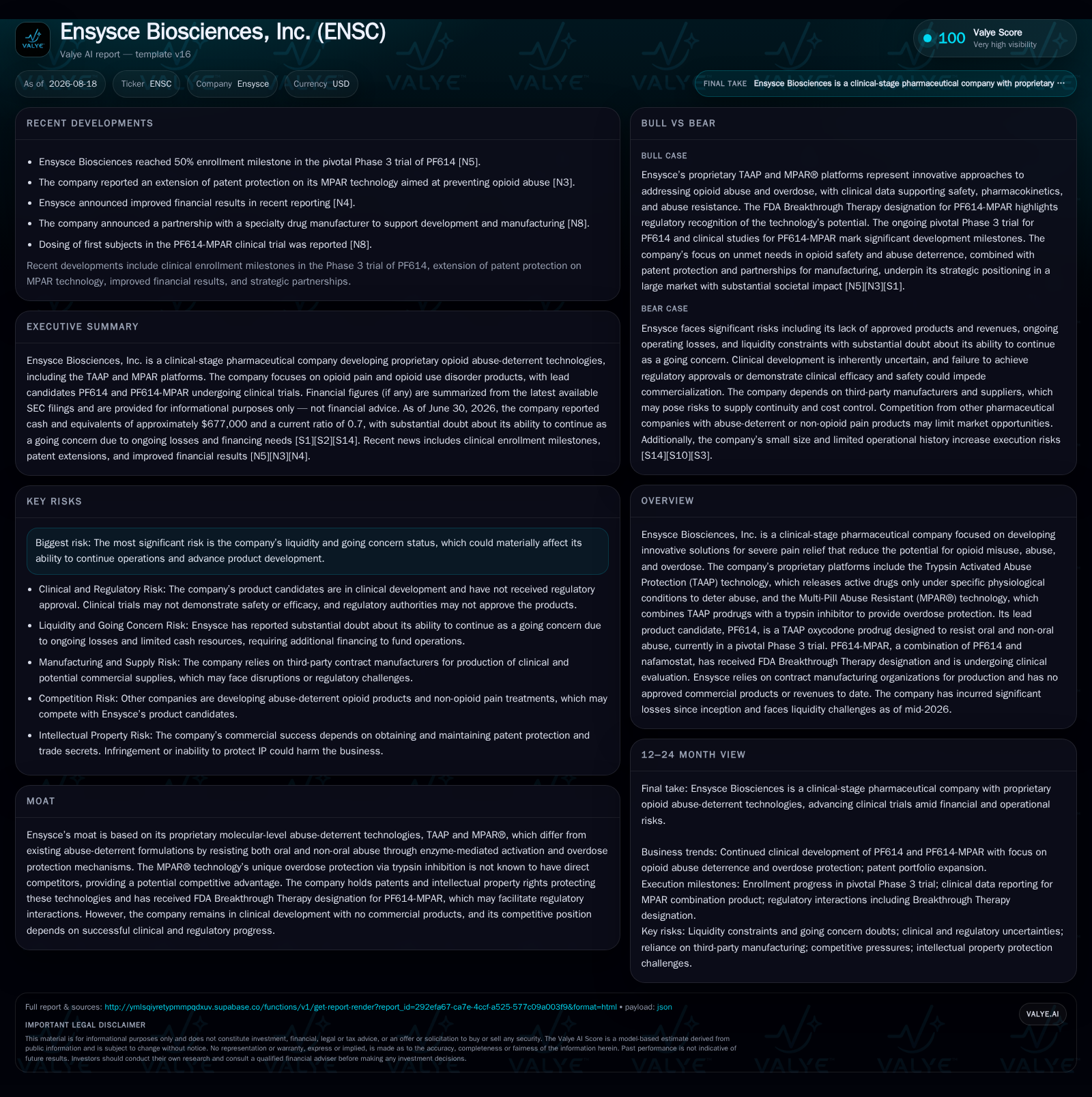
Ensysce Biosciences operates at the clinical development frontier seeking to address severe pain treatment while mitigating opioid abuse and overdose risks through proprietary molecular prodrug technologies. Its lead candidate, PF614, utilizes the TAAP platform in a pivotal Phase 3 trial and, combined with nafamostat in the MPAR® platform, holds FDA Breakthrough Therapy designation. Despite technological differentiation and regulatory progress, the company faces persistent financial losses and liquidity challenges that cloud its ability to sustain operations without additional financing. Outsourced manufacturing reliance and lengthy regulatory timelines further complicate Ensysce’s path to commercialization within a competitive abuse-deterrent opioid landscape.
Recent Operating Update
Ensysce Biosciences’ latest quarterly filing dated August 13, 2026 confirms that its lead product candidate PF614 — a Trypsin Activated Abuse Protection (TAAP) oxycodone prodrug — has advanced into a pivotal Phase 3 clinical trial designed to validate its abuse-resistant properties against both oral and non-oral misuse [S2]. Simultaneously, their combination product PF614-MPAR®, comprising PF614 together with nafamostat (a trypsin inhibitor), continues clinical evaluation under an FDA Breakthrough Therapy designation granted to accelerate development given its novel overdose protection mechanism [S1]. These developments signal progression from early-stage research into late-stage clinical validation critical for eventual regulatory approval. Yet the filings also highlight Ensysce’s ongoing operational challenge: it remains pre-revenue with no product sales or commercial approvals to date [S1].
Business Model Overview
Ensysce operates as a clinical-stage pharmaceutical developer focusing exclusively on creating improved opioid analgesics designed at the molecular level to prevent prescription drug abuse and overdose. Its revenue model awaits successful commercialization post-regulatory approval, after which value generation would typically arise from drug sales directly or via licensing agreements with larger pharma entities. Currently, all laboratory research, preclinical studies, and clinical trials are financed through equity offerings and grant funding. Production is outsourced entirely to contract manufacturing organizations (CMOs), consistent with industry practice for small biotechs lacking internal manufacturing infrastructure [S1]. Ensysce’s strategy hinges on differentiating itself via proprietary platforms — TAAP enables selective drug activation by digestive enzymes only under intended physiological conditions, thus inhibiting common routes of misuse; MPAR® adds a safety layer preventing overdose by co-administering an inhibitor targeting enzymatic pathways associated with toxicity [S1].
Industry Structure and Competitive Positioning
The biotechnology sector addressing opioid misuse is particularly challenging due to high regulatory barriers and intense competition from both established pharmaceutical manufacturers and emerging specialty developers. Key competitors include Purdue Pharma and Collegium Pharmaceuticals — firms with experience in abuse-deterrent opioids though typically based on physical barrier formulations rather than molecular prodrugs. Unlike these peers, Ensysce’s approach utilizes enzyme-triggered activation mechanisms protected by patents, suggesting potentially stronger durability if approved [S1]. Regulatory scrutiny by the FDA has intensified since new guidances in 2017 raised evidentiary burdens for abuse-deterrent claims; no new opioid ADFs have cleared since then, underscoring the difficulty in gaining market entry [S1]. Despite technological innovation, the pathway to viable products is long, necessitating extensive clinical demonstration of both efficacy in pain relief and robust abuse resistance.
Growth Drivers
Critical growth drivers for Ensysce are centered on successful execution of its Phase 3 program for PF614 — demonstrating that it effectively deters multiple forms of drug abuse without compromising analgesic efficacy will be pivotal. The Breakthrough Therapy designation for PF614-MPAR® potentially expedites this process by enabling more frequent FDA interactions and priority review if data supports safety and effectiveness claims [S1]. Additional upside may come from expanding indications beyond severe pain or developing complementary molecules leveraging their molecular delivery platforms. Strategic partnerships could not only infuse capital but also facilitate marketing expertise essential for commercial success in competitive prescription drug markets.
Risks and Constraints
However, Ensysce faces substantial risk factors typical of early-stage biotech firms alongside industry-specific challenges. The most prominent is its precarious financial condition: as of June 30, 2026 cash reserves stood at approximately $676K against current liabilities exceeding $4 million — yielding a current ratio near 0.7 — highlighting acute short-term liquidity stress and raising substantial doubt about its ability to continue as a going concern absent additional financing [F1]. Operating losses are ongoing due to heavy R&D expenditures required for costly clinical trials without offsetting revenue streams [S2]. Failure to secure sufficient capital could force scaling back or halting development efforts altogether.
From a regulatory standpoint, the complex approval environment for opioids labeled as abuse-deterrent places elevated hurdles on Ensysce’s clinical data requirements; failure or delay in obtaining FDA approval would materially impair future prospects [S1]. Additionally, intellectual property litigation risks inherent in highly specialized biotech sectors pose threats that could divert management resources or incur costly settlements [S1]. Manufacturing dependencies on CMOs expose operational risks related to supply continuity and scale-up timing.
Competition from generic opioids unchanged by deterrent technologies remains strong; shifting prescriber habits influenced by government policies around opioid prescribing guidelines add uncertainty to market penetration potential even post-approval.
What to Watch Next
Key near-term milestones include enrollment progression and readouts from PF614’s Phase 3 study which will shape subsequent regulatory submissions. Monitoring any updates from FDA interactions under the Breakthrough Therapy pathway for PF614-MPAR® may shed light on conditional approval probabilities. Capital raises or strategic collaborations would be crucial indicators resolving liquidity constraints; absence thereof heightens risk of operational disruption. Investors should also track any patent prosecution developments or legal challenges affecting platform exclusivity.
Financial Profile Discussion
As of the latest quarter ended June 30, 2026, Ensysce reported cash and cash equivalents of approximately $676K while total debt was estimated around $197K resulting in negative net debt positioning near -$480K given net cash less debt [F1]. Yet the current liabilities tally surpasses $4 million compared with current assets at roughly $2.8 million producing a current ratio below one (approximate 0.7), signifying constrained short-term liquidity [F1]. This aligns with the company's reiterated warning about substantial doubt regarding its ability to continue as a going concern without further financing efforts [S1]. Operating income remains negative reflecting persistent R&D spend typical for firms yet without any commercial revenues [F1].
Capital formation through equity issuance or licensing deals will be essential for sustaining pipeline progression through expensive late-stage trials. This cash flow profile exemplifies common financial patterns among clinical-stage biotech companies pre-commercial launch who face timing mismatches between investment needs and value realization.
This analysis reflects available information from recent SEC filings made by Ensysce Biosciences through August 2026 combined with industry context around biotechnology firms developing abuse-deterrent opioid therapies. It aims to provide an informed view on operational status, strategic positioning, growth outlooks, challenges, and financial health without implying investment research views.
Disclaimer: This is research-only, informational analysis and not investment advice. It may include AI-generated interpretation and general industry context. Always verify important details using primary sources.

Comments