
TurnOnGreen's Strategic Pivot to EV Infrastructure Amid Custom Power Market Challenges
Q2 2026 results show moderate revenue growth fueled by EV charging solutions alongside ongoing liquidity constraints and operational losses.
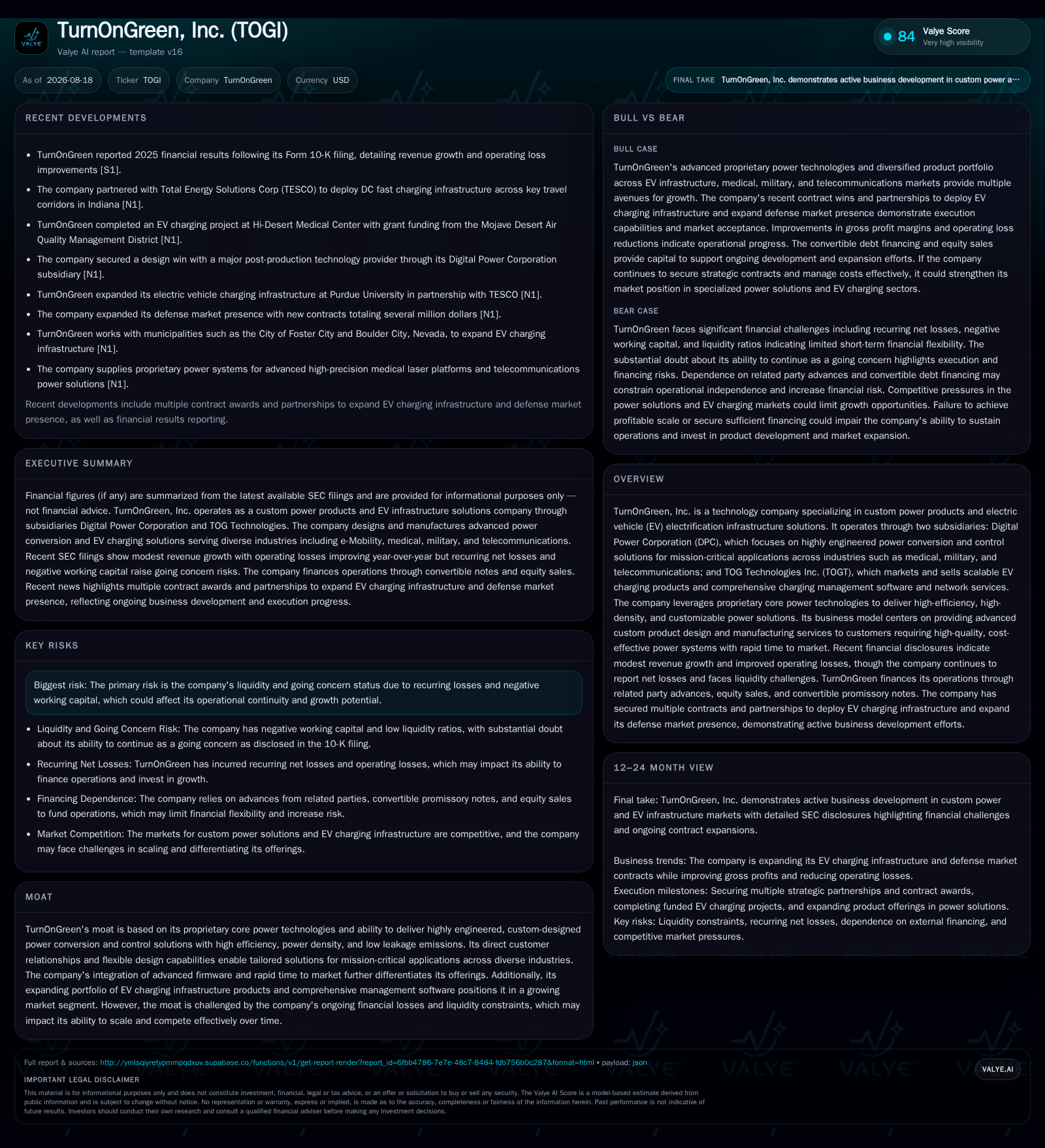
TurnOnGreen, Inc. reported modest sequential revenue growth in Q2 2026, reaching $1.75 million, primarily driven by expansion in its electric vehicle (EV) charging segment under TOG Technologies. Gross margin improved to 47% through tighter cost control and lower software expenses, yet the company continues to incur operating losses due to elevated interest costs from convertible debt and sustained spending on general administration. The business remains balanced between Digital Power’s mission-critical custom power products and TOG Technologies’ scalable EV charging hardware and management software. However, persistent negative working capital below a 0.25 current ratio signals acute liquidity risks that could hinder scaling efforts despite underlying demand for advanced power solutions in defense and e-Mobility markets.
EV Segment Growth Drives Revived Top Line but Margins' Improvement Reflects Cost Control
In the second quarter of fiscal 2026, TurnOnGreen reported revenues of $1.754 million, up 4% from $1.692 million in the year-ago quarter [S2]. This modest top-line growth was largely fueled by increased sales in the EV charging segment operated through TOG Technologies Inc. (TOGT), which now accounts for approximately 17% of total company revenues [S1]. Cost of goods sold fell by 8%, driving a gross profit rise of 21% to $821,000 and pushing gross margin from roughly 40% last year to above 47% this quarter [S2]. The margin expansion reflects effective cost management including reduced software expenses and material costs alongside optimized manufacturing processes for both custom power products and scalable charging stations [S3]. Operating expenses decreased by nearly 18%, primarily through a $202,000 reduction in general and administrative costs relative to Q2 2025 [S17]. As a result, operating loss was cut by almost seventy percent to $154,000.
Despite the positive trajectory in revenue and gross margin metrics validating early market traction for its integrated EV infrastructure offering, the absolute scale remains small compared to peers operating mature EV charging networks or custom power suppliers like Vicor Corporation or Delta Electronics known for higher volumes and stronger profitability profiles. However, for TurnOnGreen the incremental sales lift indicates initial success expanding its presence within the growing e-Mobility demand ecosystem.
Proprietary Power Conversion Tech Underpins High-Quality Mission-Critical Revenue Streams
TurnOnGreen's foundational strength lies in Digital Power Corporation (DPC), which designs ruggedized power modules tailored for mission-critical applications across defense, aerospace, medical instrumentation, telecommunications, and industrial automation markets [S1]. These solutions emphasize high power density combined with superior power conversion efficiency and extremely low leakage emissions—qualities essential for life-sustaining environments often governed by rigorous U.S. and international military standards (MIL-STDs) [S1].
The company leverages proprietary integrated circuit implementations with customized embedded firmware that enable rapid design customization meeting precise customer specifications while maintaining short product development cycles [S1][S2]. This capability supports long-term multi-year contracts featuring high-volume production forecasts that offer revenue visibility uncommon among many industrial custom manufacturers. These mission-critical contracts contribute consistency amid cyclical industrial demand fluctuations.
While DPC benefits from strong technical barriers to entry helping reduce pricing pressure risks relative to commoditized standard power products, sustained profitability depends on maintaining technology leadership, managing supply chain robustness given complex components sourced globally, and securing contract renewals amid evolving customer needs.
Industry Competitive Dynamics: Positioning Among Custom Power Electronics and Emerging EV Infrastructure Players
TurnOnGreen operates at the intersection of two technically demanding industrial hardware niches: highly engineered custom power electronics for critical defense/industrial applications and electric vehicle (EV) charging infrastructure solutions targeting residential through ultra-fast commercial deployment segments. Each domain has distinct competitive dynamics.
Custom power electronics manufacturing involves sizeable engineering complexity and customization requiring nimble R&D investment focusing on improving power efficiency percentages and form-factor density. Peer benchmarks such as Vicor Corporation or Delta Electronics illustrate these dynamics with broader scale OEM customer penetration and established long-term production contracts providing more predictable cash flow streams.
Conversely, the EV charging market exemplified by firms like ChargePoint or Blink Charging entails rapidly evolving standards around charger interoperability coupled with increasing importance of integrated network services including subscription-based management software platforms. Here TurnOnGreen’s TOGT subsidiary competes by offering scalable charging products backed by proprietary core power technologies aimed at enhancing charger performance while controlling costs.
This dual-market exposure presents both opportunity from adjacent technology leverage but also execution challenges balancing distinct channel structures, pricing models (product sales vs subscription services), and customer buying motivations ranging from mission solution procurement to capital equipment/fleet operators emphasizing total cost of ownership.
Balancing Growth Ambitions: Challenges Integrating Scalable Hardware With Software Network Services
TurnOnGreen is transitioning from historically bespoke custom hardware production toward an integrated model combining scalable EVSE (electric vehicle supply equipment) residential/commercial chargers with networked software offerings enabling subscription-based charging station management [S1][S2]. While this strategic pivot aligns with broader electrification megatrends supporting decarbonization initiatives globally, it increases operational complexity requiring enhanced product development velocity alongside sophisticated SaaS capability building.
Delivering ultra-fast chargers at commercial scale implicates procurement logistics sensitivity where component shortages could delay shipments adversely impacting topline momentum. Concurrently expanding network service subscriptions demands growing customer support infrastructures accentuating fixed-cost absorption pressures affecting near-term margins.
This complexity heightens execution risk given TurnOnGreen’s limited financial resources amidst ongoing net losses compounded by capital-intensive R&D spending required to maintain proprietary technological differentiation on both hardware firmware fronts.
Growth Drivers Reliant on Electrification Trends, Contract Visibility, and Product Development Velocity
TurnOnGreen’s forward growth prospects depend heavily on accelerating electric vehicle adoption fueling increasing demand for varied EV charging deployment use cases including residential homes, workplaces, public fleets, hospitality venues aside from municipal educational campuses served currently [S1]. TOGT’s ability to scale deliveries will be critical; KPIs such as order backlog length and subscription service uptake rates emerge as key indicators to gauge demand realization over coming quarters.
Simultaneously Digital Power’s established presence supplying defense/aerospace customers offers steady revenue streams underpinned by multi-year production forecasts furnishing contract renewal visibility conducive for measured capacity investments [S1][S2]. R&D intensity relative to sales will remain a crucial metric reflecting innovation pipeline health enabling successive product generations meeting increasingly stringent environmental/regulatory standards while improving power efficiency metrics vital for customer retention.
Government clean energy incentives promoting infrastructure build-outs provide additive tailwinds but require prudent capital stewardship given heightened competition from larger diversified industrial electronics firms alongside well-funded emerging pure-play EV infrastructure vendors.
Risks—Liquidity Constraints, Market Competition, Technological Obsolescence Affect Scalability
A salient concern reflected consistently across recent filings is TurnOnGreen’s weak liquidity position indicated by a severely negative working capital figure ($9.3 million as of June 30, 2026) resulting in a current ratio approximating only 0.24—far below healthy benchmarks suggesting major short-term obligations exceed current asset buffers substantially [F1][S2]. The recurring net losses forecasted until sizable volume product shipments materialize continue exacerbating going concern doubts acknowledged explicitly within SEC disclosures.
The company has sought bridge financing through convertible notes aggregating approximately $1.1 million issued in multiple tranches since late 2025 carrying interest rates around 10–12%, escalating interest expense burdens which further pressure profitability measures [S3][S23]. Such financial leverage elevates refinancing risk particularly absent robust cash flow generation capabilities.
Additional risks encompass potential supply chain disruptions affecting lead times/costs of key components notably semiconductor chips required in precision power electronics; competitive pressure inducing price erosion especially within commoditized segments; integration challenges between hardware/software components undermining time to market; plus intellectual property protection imperatives necessary given reliance on proprietary embedded firmware technology.
Milestones Ahead: Production Scale-Up, Subscription Uptake Tracking
Critical upcoming milestones will center on scaling production volumes at TOGT’s EV hardware segment without proportionate margin dilution—a balance indicative of manufacturing process maturity—as well as measurable gains in subscription-based charging network management adoption evidencing stickier recurring revenue streams beyond one-off hardware sales [S2]. Furthermore, announcements regarding contract extensions or new multi-year OEM partnerships within Digital Power would corroborate the durability of mission-critical custom solution revenues.
Cash and equivalents stood at approximately $65,000 as of September 30, 2022, while total debt was about $75,000 and net debt around $10,000 as of December 31, 2023 [F1]. Current assets totaled roughly $2.9 million against current liabilities exceeding $12.2 million as of June 30, 2026, resulting in a distressed current ratio near 0.24—signaling substantial immediate funding gaps necessitating external capital infusions or asset restructuring efforts [F1].
While convertible notes recently raised approximately $1.1 million provide interim working capital support at relatively high interest rates approaching double digits with cumulative quarterly interest expense increments of over $100,000 tied directly thereto [S3][S23], this strategy imposes additional fixed charges reducing net income notwithstanding gross margin improvements.
Recurring operating losses are anticipated until meaningful scale efficiencies emerge from scaled volume deliveries combined with increasing software-driven network service subscriptions generating higher margin contributions per unit sold. The company’s reliance on its parent entity for financing injections adds uncertainty regarding future liquidity availability especially amid volatile market environments challenging speculative investment appetite towards highly leveraged small-cap industrial enterprises exhibiting constrained free cash flow generation capacity.
Continued attention is warranted on cash conversion cycle improvements alongside stringent cost discipline aligned tightly with phased upscaling leveraging multi-year contract commitments underpinning Digital Power’s custom solution leg ensuring broad revenue base diversification minimizing concentration risk exposures over time.
This analysis synthesizes TurnOnGreen's latest quarterly data emphasizing the tension inherent in balancing nascent growth areas in electric vehicle infrastructure against persistent financial headwinds typical among niche industrial hardware innovators transitioning into more software-integrated business models amid competitive pressures.
Disclaimer: This is research-only, informational analysis and not investment advice. It may include AI-generated interpretation and general industry context. Always verify important details using primary sources.

Comments