
Commvault Systems Inc: Navigating Cyber Resiliency in a Competitive Software Landscape
Commvault delivers a comprehensive cyber resiliency platform integrating data protection across on-premise and multi-cloud environments, pivoting towards subscription-based SaaS models amidst intensifying industry competition.
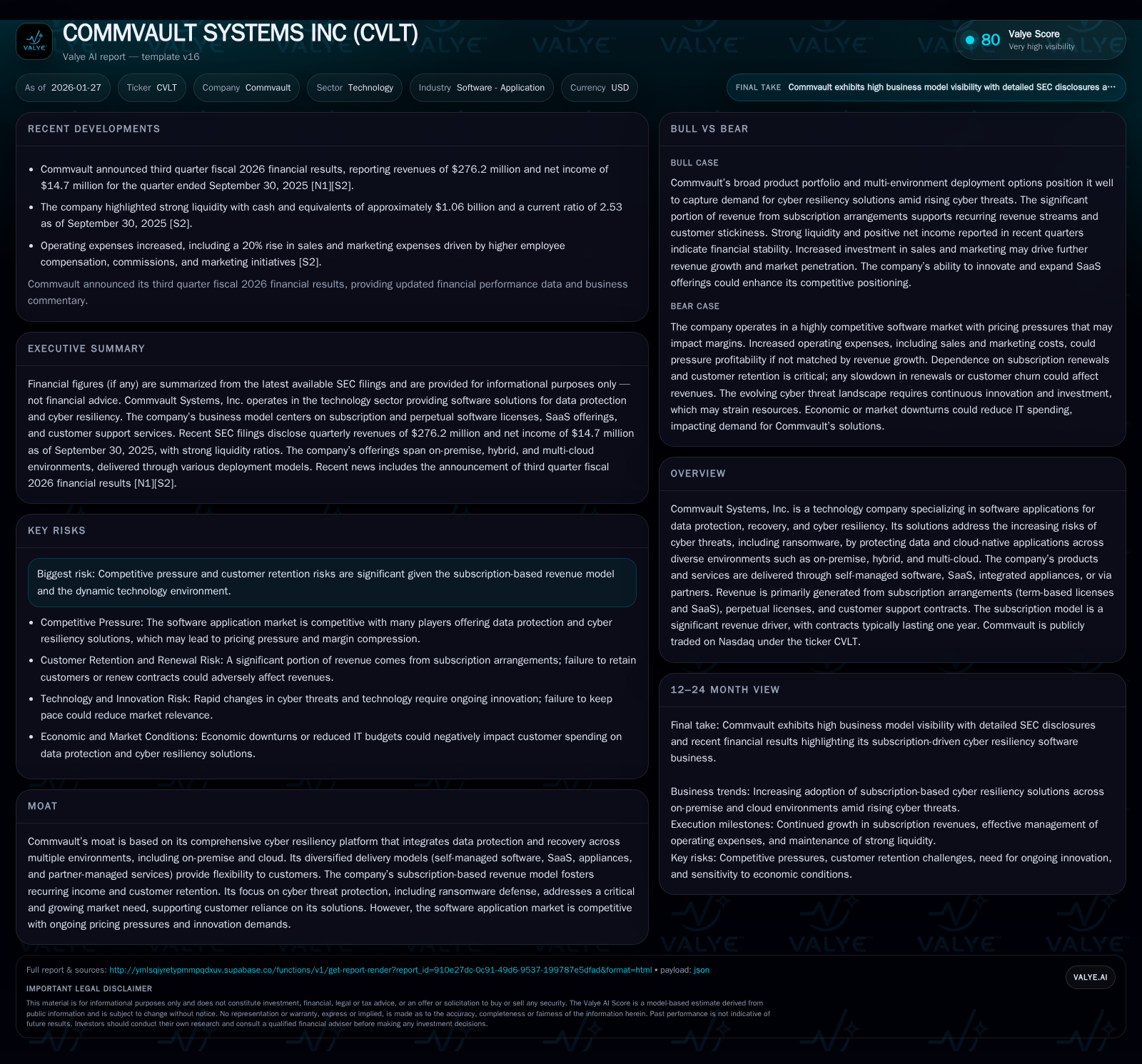
Commvault Systems Inc is focused on providing data protection, recovery, and ransomware defense through a flexible platform spanning on-premise, hybrid, and multi-cloud deployments. Recent quarterly results show steady growth fueled by subscription revenues, reflecting the industry’s shift toward recurring revenue models. The company’s competitive moat lies in its integrated cyber resiliency offerings and diversified delivery methods, though it faces ongoing pressure from innovation demands and pricing competition. Key economic dynamics revolve around managing SaaS infrastructure costs and sustaining customer retention in a subscription-heavy business.
What Changed Recently
Commvault reported its third quarter fiscal 2026 financial results highlighting continued growth in subscription-based revenues, which remain the backbone of its business model [N1]. The company’s results reflect steady demand for cyber resiliency solutions amidst escalating ransomware and cyber threat concerns globally. There is no indication of significant M&A activity or large strategic shifts in this quarter, but investment in sales and marketing accelerated by 20%, notably in compensation and customer acquisition initiatives [S6]. SaaS revenue growth continues to drive incremental costs in hosting and infrastructure, impacting gross margins [S10]. Overall, the quarter underscores the company’s ongoing transition toward a SaaS-heavy subscription model and the operational challenges accompanying scale.
Business Model as a System
Commvault operates a complex software application business focused on data protection, recovery, and cyber resiliency spanning on-premise, hybrid, and multi-cloud environments [S2]. It delivers its solutions through multiple avenues: self-managed software licenses (term-based and perpetual), Software-as-a-Service (SaaS), integrated appliances, and partner-managed services. This diversified delivery approach addresses varied customer preferences and IT architectures, from large enterprises managing their own infrastructure to those preferring managed or cloud-native services.
Revenue is principally generated from subscription arrangements, which include term-based licenses and SaaS offerings typically contracted on an annual basis [S2]. Perpetual license sales and customer support contracts supplement this, though the latter are decreasing as the company pivots to subscription. The subscription model fosters recurring revenue streams, improving revenue visibility and enabling upselling and cross-selling opportunities.
Cost of revenues includes hosting and infrastructure costs for SaaS, which have risen due to acquisitions and organic growth. Cost of goods sold accounts for roughly a third of SaaS revenues, reflecting the capital-intensive nature of cloud operations [S10]. Operating expenses, especially sales and marketing, have increased to support customer acquisition and retention, critical in a competitive subscription market [S6].
Liquidity metrics indicate a strong balance sheet with over $1 billion in cash and equivalents and a current ratio of approximately 2.5, positioning Commvault with financial flexibility to invest and weather industry cyclicality [Derived].
Industry Map & Competitive Battlefield
The data protection and cyber resiliency software market is intensely competitive and rapidly evolving. Commvault faces competition from legacy incumbents offering backup and recovery solutions, cloud-first newcomers emphasizing SaaS and cloud-native protection, and specialist cybersecurity firms focused on ransomware defense.
Key competitors include vendors with broad enterprise portfolios that bundle data protection with broader IT management suites, as well as cloud hyperscalers offering native backup and resiliency services. The proliferation of hybrid and multi-cloud environments has raised customer expectations for seamless, integrated protection across heterogeneous infrastructure, demanding continuous innovation.
Pricing pressure is prevalent as vendors compete to secure and retain enterprise contracts. Customers increasingly prefer subscription models for flexibility and ease of budgeting, pushing traditional perpetual license models into decline. The presence of integrated appliances alongside software and SaaS offerings creates a complex competitive dynamic where delivery flexibility and ecosystem partnerships are differentiators.
Customer retention is a critical battleground, given the annual term nature of subscription agreements. Service quality, platform reliability, and continuous feature enhancements directly influence renewal rates. Partner channels and managed service offerings add layers to go-to-market strategies but also require alignment and incentive management.
Where the Economics Become Real
Commvault’s unit economics pivot on expanding subscription revenue while managing SaaS infrastructure costs and operating expenses. SaaS margins are pressured by hosting costs, which increased year-over-year partly due to acquisitions and organic growth in the SaaS base [S10]. Achieving scale is necessary to absorb fixed cloud infrastructure investments and improve profitability.
Sales and marketing costs have risen 20% year-over-year, driven largely by higher compensation and commissions reflecting increased headcount and revenue growth efforts [S6]. This investment is essential to acquire new customers and sustain renewal rates in a competitive market but weighs on near-term operating leverage.
The cost of customer support revenue remains a meaningful portion of service-related costs but has slightly declined as a percentage of revenue, potentially indicating operational efficiencies [S10]. Perpetual license revenue cost is minimal but shrinking in relative importance, consistent with the shift to subscription.
Deferred revenue on the balance sheet, reflecting contracted but unrecognized revenue, is a key metric for assessing the health and visibility of recurring streams but detailed figures were not disclosed in the provided sources. The strong cash position and liquidity ratios afford Commvault the runway to invest in R&D, marketing, and infrastructure needed to compete effectively.
Diligence Questions / Disconfirming Signals
- How rapidly is the shift from perpetual to subscription licensing evolving, and what impact does this have on cash flow timing?
- What is the renewal rate for subscription contracts, and how volatile is customer churn in the current competitive environment?
- To what extent are infrastructure cost increases for SaaS offerings offset by pricing power or scale economies?
- How differentiated is Commvault’s ransomware defense compared to emerging startups and cloud-native competitors?
- What are the customer concentration risks, especially among large enterprises, and what geographic diversification exists?
- How effective are the increased sales and marketing investments in driving sustainable top-line growth?
- What is the roadmap for new product innovation to maintain competitive positioning amid rapid technological change?
- Are there any material legal, regulatory, or cybersecurity risks disclosed that could materially impact operations?
This analysis is based on publicly available information and recent company disclosures. It does not constitute investment advice or recommendations. Investors should conduct their own due diligence and consult professional advisors before making any investment decisions.
Disclaimer: This is research-only, informational analysis and not investment advice. It may include AI-generated interpretation and general industry context. Always verify important details using primary sources.

Comments