
CEL-SCI CORP Seeks Capital for Confirmatory Phase 3 Study Amid Regulatory Uncertainty
Recent quarterly disclosures highlight CEL-SCI’s urgent capital needs to fund pivotal trials of its immunotherapy Multikine.
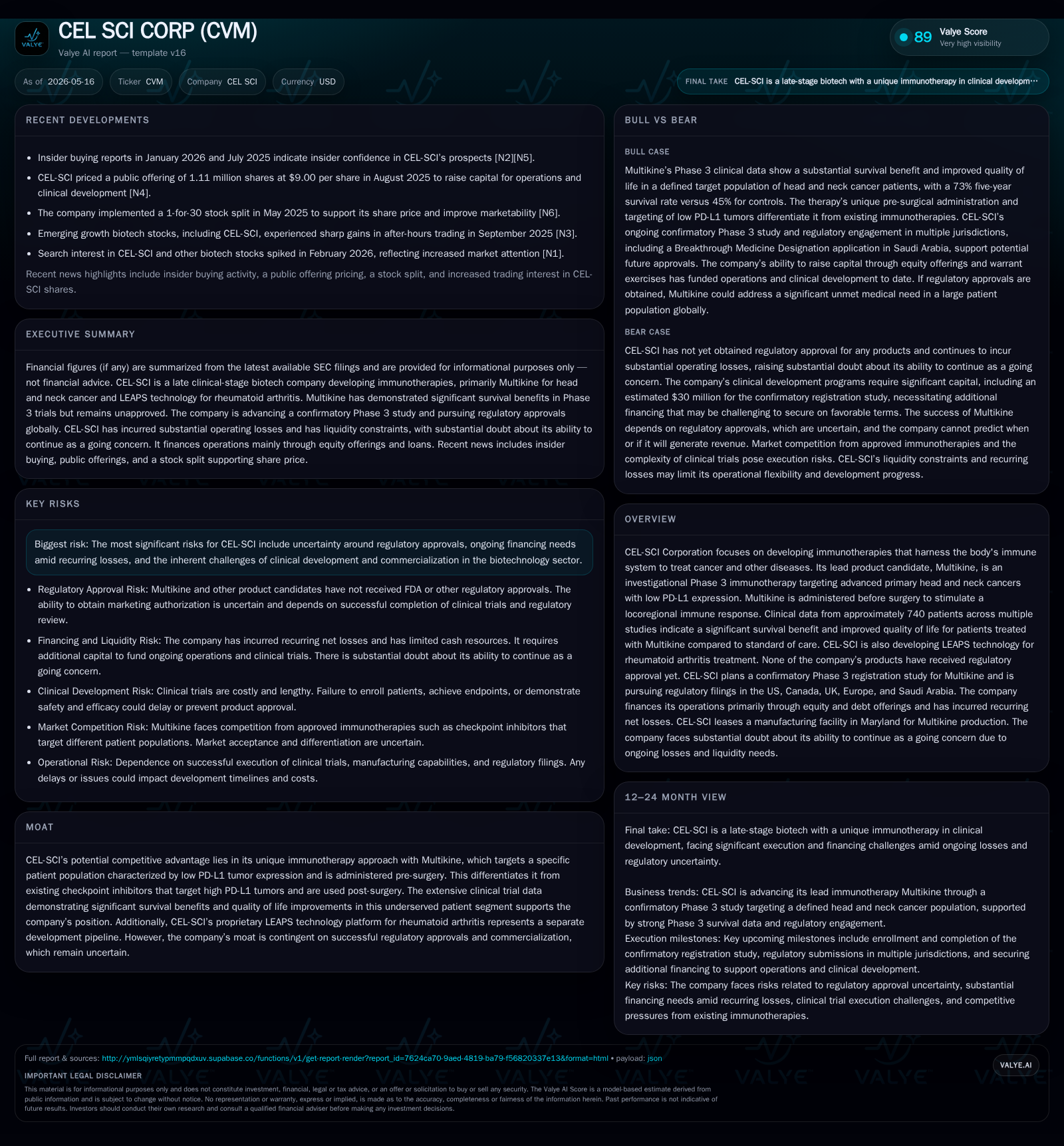
CEL-SCI remains focused on advancing Multikine, a Phase 3 immunotherapy for head and neck cancers, targeting a patient segment underserved by current checkpoint inhibitors. The company’s May 2026 quarterly report underscores significant financing challenges, with an estimated $30-$35 million needed for a confirmatory registration study critical to regulatory approval pathways. Despite promising survival data and strategic partnerships in the Middle East, CEL-SCI operates under substantial doubt about its going concern status due to ongoing losses and limited liquidity. Long-term growth hinges on successful trial completion, regulatory clearances, and capital availability.
Recent Operating Update
CEL-SCI Corp's latest quarterly report filed on May 15, 2026 ([S2]) paints a picture of acute liquidity challenges as the company prepares for a crucial confirmatory Phase 3 trial of its lead candidate, Multikine. The estimated cost for this registration trial is between $30 million and $35 million, funds which CEL-SCI acknowledges it currently lacks and must secure through additional equity financings or long-term financing arrangements.
Management underscores that their operational viability depends on completing drug development, obtaining FDA approvals, and generating sufficient revenues—none of which are assured at this stage. Due to recurring operating losses and mounting cash needs, the company discloses "substantial doubt" about its ability to continue as a going concern. The six months ended March 31, 2025 saw over 247 thousand pre-funded warrants exercised, providing partial financing; however, no warrant exercises occurred in the most recent period ([S2]).
Additionally, the company announced a strategic partnership agreement with Amarox on May 11, 2026 ([S3]), aiming to coordinate regulatory affairs, marketing efforts, and potential commercialization of Multikine in Saudi Arabia with an option to extend into other Gulf Cooperation Council countries. This deal reflects CEL-SCI’s international regulatory strategy during capital constraints.
Business Model
CEL-SCI’s business revolves around pioneering immunotherapies that leverage the body's natural immune system mechanisms to treat cancer and autoimmune diseases. Its flagship product candidate is Multikine (Leukocyte Interleukin Injection), an investigational Phase 3 immunotherapy tailored for advanced primary head and neck cancer patients exhibiting low PD-L1 tumor expression levels—a subgroup representing approximately 70% of the patient population according to their clinical research ([S2], [S16]).
Unlike standard checkpoint inhibitors such as Keytruda that target high PD-L1 expressing tumors post-surgery, Multikine is administered pre-surgery to stimulate locoregional immune responses early in treatment. Clinical evidence from roughly 740 patients shows a marked survival benefit—five-year survival rates improved from 45% in controls to 73% in treated patients, supported by a hazard ratio of 0.35 (95% confidence interval upper limit at 0.66) ([S2]).
Despite these promising therapeutic attributes, no products have yet gained marketing approval. Therefore, CEL-SCI's revenue generation is wholly contingent upon successfully navigating regulatory pathways to commercial launch. All operational funding thus far has come from equity offerings, convertible notes, loans, and grants ([S1], [S13]). This model inherently implies high dependency on capital markets availability.
Furthermore, CEL-SCI’s LEAPS technology platform targets rheumatoid arthritis treatments via peptide-based vaccines (e.g., CEL-4000), although this pipeline remains preclinical with no assured timelines towards commercialization ([S1]).
Industry Structure and Competitive Position
The immunotherapy sector comprises various modalities including checkpoint inhibitors, CAR-T therapies, monoclonal antibodies, and vaccine approaches addressing solid tumors or hematologic malignancies. It is characterized by rapid innovation cycles requiring significant R&D investment coupled with rigorous regulatory scrutiny.
CEL-SCI differentiates itself by focusing on early-line intervention (pre-surgical treatment) specifically targeting patients with low PD-L1 tumors—a niche less served by incumbents who typically concentrate on later lines or high PD-L1 expression groups. The extensive phase III data backing Multikine affords credibility within this underserved segment.
However, the company's lack of approved products places it behind well-established players like Merck (Keytruda) or Bristol Myers Squibb in commercial resources and ecosystem access. Additionally, CEL-SCI’s limited current scale exposes its operations to greater financial vulnerability relative to larger biotech firms capable of self-funding through sustained revenues or diversified pipelines.
Growth Drivers
- Clinical Validation: Positive Phase III trial results demonstrating statistically significant survival advantage support planned FDA submissions.
- Regulatory Strategy: Ongoing applications such as Breakthrough Medicine Designation with Saudi FDA indicate proactive engagement aimed at accelerated approval ([S27]).
- Geographic Expansion: Partnership with Amarox extends potential market reach into Middle East territories with growing oncology demand.
- Checkpoint Inhibitor Gap Targeting: By serving approximately 70% of head and neck cancer patients not well-addressed by existing checkpoint inhibitors due to low PD-L1 expression, Multikine taps an unmet medical need segment potentially fueling adoption once approved ([S16]).
- Platform Diversification: LEAPS technology offers future opportunities beyond oncology into autoimmune diseases which can broaden pipeline relevance if clinical progress materializes.
Risks / Watchpoints / Growth Constraints
- Financing Risks: The next-phase confirmatory study costing up to $35 million requires successful capital raises against market volatility; failure would stall development ([S2], [S15]).
- Regulatory Approval Uncertainty: Despite robust phase III data sets without current regulatory nods leaves significant uncertainty whether agencies will grant marketing authorization timely or at all ([S2], [S13]).
- Going Concern Warning: Financial disclosures explicitly state doubts about continuing as a going concern without further capital infusions emphasizing precarious balance-sheet health ([S2]).
- Clinical Development Risks: Additional unforeseen safety signals or efficacy shortcomings during confirmatory trials could delay or derail approval prospects.
- Competitive Response: Entry into the immunotherapy space invites competition from better funded firms developing next-generation compounds or combination regimens targeting similar populations.
- Market Adoption Barriers: Pricing pressure typical in oncology combined with payer resistance could limit reimbursement scope even post-launch.
What To Watch Next
Investors and sector observers should closely monitor:
- Progress toward raising funds sufficient to commence the planned confirmatory Phase III registration study ([S2], [S27]).
- Early enrollment rates and interim data releases from this confirmatory study when available.
- Regulatory feedback particularly from FDA regarding Breakthrough Therapy Designation requests filed in Saudi Arabia and other jurisdictions ([S27]).
- Updates on partnerships extending geographic commercialization reach beyond Saudi Arabia into broader GCC regions via Amarox collaboration ([S3]).
- Quarterly cash burn trends against liquidity positions indicating runway sufficiency.
- Any secondary offerings or debt issuances signaling imminent dilution risks.
Financial Profile (Snapshot)
Latest financial snapshot
| Metric | Value | Period |
|---|---|---|
| Current assets | $3mm | |
| 2026-03-31 | ||
| Current liabilities | $5mm | |
| 2026-03-31 | ||
| Current ratio | 0.6x | |
| 2026-03-31 |
Source: SEC companyfacts cache [F1].
FY:2025 |
The balance sheet highlights limited liquidity buffers (current ratio below industry comfort levels) juxtaposed against moderate debt repayment obligations ([F1], [S2], [S15]). Operating losses persist reflecting ongoing investment phase culminating in a net loss of nearly $25 million reported for recent fiscal year end ([F1], [S1]). Research expenses concentrated heavily on preparing for registration trials have tapered slightly but remain substantive (~$7.4 million over six months ending March 2026), indicating steady commitment despite funding constraints ([S24]). General administrative costs declined modestly from prior periods reflecting expense management efforts ([S22]).
Conclusion
CEL-SCI stands at a critical juncture whereby scientific promise embodied in its lead candidate Multikine contends against rigorous development cost demands and fragile funding structure. Achieving pivotal enrolment milestones in its upcoming confirmatory Phase III registration study concomitant with securing adequate financing underpins near-term viability. Strategic regional alliances such as the Amarox agreement underscore attempts to build commercial infrastructure ahead of possible approvals but face timing uncertainties aligned with clinical outcomes.
The company exemplifies classic challenges faced by clinical-stage biotechs balancing breakthrough R&D outcomes against stringent capital markets realities amid fierce sector competition. Observing how effectively CEL-SCI manages these trade-offs alongside regulator interactions will provide clearer directional cues toward sustainable growth or continued operational distress.
This analysis is based solely on publicly available SEC filings up to May 15, 2026 and does not constitute investment advice.
Disclaimer: This is research-only, informational analysis and not investment advice. It may include AI-generated interpretation and general industry context. Always verify important details using primary sources.

Comments