
DANA Inc Solidifies On-Highway Focus with Cost Discipline and Commercial Vehicle Momentum
Dana’s recent Off-Highway divestiture, combined with stringent cost controls and gains in its Commercial Vehicle segment, underscore its strategic pivot toward sustained profitability.
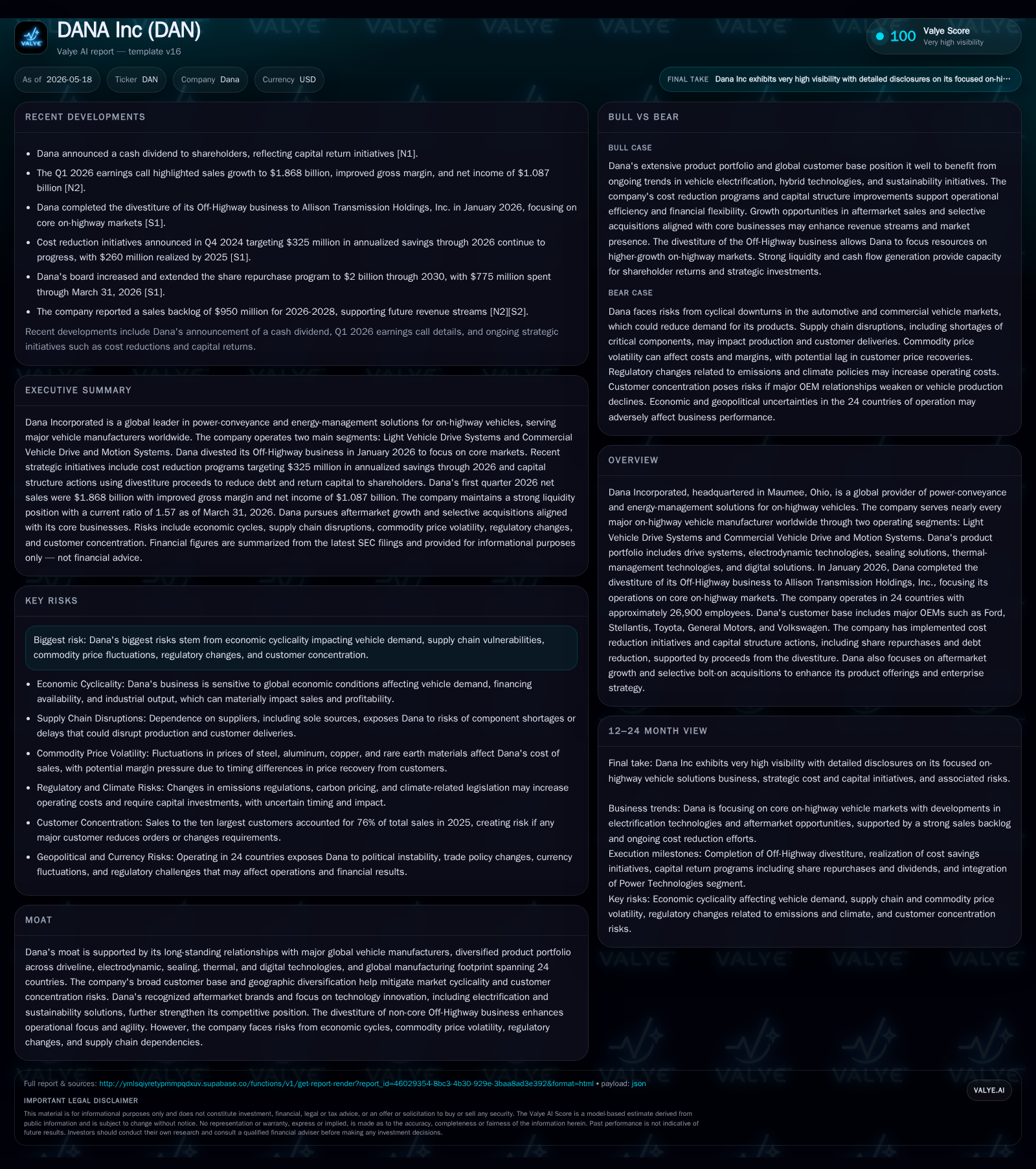
In Q1 2026, Dana Inc delivered segment EBITDA improvement in Commercial Vehicles despite volume headwinds, supported by effective pricing recovery, material cost savings, and operational efficiencies. The completion of the Off-Highway business divestiture streamlines Dana’s focus on core on-highway markets, sharpening competitive agility. While economic cyclicality and commodity pressures remain risks, ongoing cost reduction initiatives targeting $325 million annualized savings through 2026 provide a meaningful buffer to margin volatility in a shifting industry landscape.
Q1 2026 Operating Performance Highlights
Dana Incorporated's first quarter of 2026 reflects an incremental margin-driven improvement led primarily by its Commercial Vehicle segment. The segment’s EBITDA increased by $22 million compared to the same period last year despite a challenging volume environment that exerted a $4 million year-over-year earnings headwind at a decremental margin of approximately 17% [S2]. This demonstrates solid pricing power and operational leverage. Key drivers include net customer price adjustments alongside recovery of costs impacted by tariffs ($20 million combined uplift), enhanced material cost savings totaling $9 million, plus additional benefits from broader cost reduction initiatives contributing $3 million.
Cost of sales rose by $36 million year-over-year; however, this increase was more than offset on a rate basis with cost of sales as a percentage of sales decreasing by 240 basis points. The margin uplift owes to deliberate execution on managing raw material inputs and tariff impacts—a net mix of positive recovery actions mitigating $50 million in tariff-related pressures. Additional contributions came from operational efficiencies (lower corporate allocations included), reduced premium freight costs, fewer warranty expenses versus prior year levels, and favorable product mix effects [S2]. These offset inflationary pressures recognized at $24 million non-material inflation expense and higher electrification product spending of $6 million reflecting targeted R&D investments for future propulsion technologies.
The formal divestiture of Dana’s Off-Highway business completed in January 2026 marked a critical milestone in reshaping Dana as an on-highway focused supplier specializing exclusively in light and commercial vehicle markets worldwide. This sharpened operational strategy improves agility and resource allocation toward segments offering scale advantages and OEM alignment [S1], [S2].
Business Model and Product Portfolio Overview
Dana operates two primary segments serving the power-conveyance needs of on-highway vehicles: Light Vehicle Drive Systems (for passenger cars, SUVs, light trucks) and Commercial Vehicle Drive and Motion Systems (for medium/heavy trucks and buses). Its wide-ranging product line includes drivetrain components (axles, driveshafts), electrodynamic technologies (motors, controllers), sealing solutions (notably e-sealing for electric vehicles), thermal management products, and increasingly digital solutions supporting vehicle efficiency and electrification [S1].
The company generates revenue mainly from OEM contracts for new vehicle platforms alongside aftermarket sales supporting maintenance cycles. Pricing mechanics depend heavily on contract terms inclusive of raw material surcharges to offset commodity volatility. Volume variations track closely with OEM production schedules influenced by economic cycles.
The January 2026 divestiture of the Off-Highway unit—previously focused on construction, mining, agricultural vehicles—reflects Dana’s strategic decision to consolidate around core competencies in more standardized on-highway sectors where it enjoys more extensive customer penetration globally [S1]. The integration completed earlier (Q1 2025) merged the Power Technologies segment into Light Vehicle (OEM-facing) and Commercial Vehicle (aftermarket-focused) segments enhancing market responsiveness [S1].
Geographically Dana operates manufacturing facilities across 24 countries employing approximately 26,900 people as of end-2025. Its client roster includes large global OEMs such as Ford, General Motors, Toyota, Stellantis, and Volkswagen which underscores both scale advantages but also concentration risk within the automotive value chain [S1], [F1].
Competitive Position and Industry Dynamics
Dana sustains a defensible competitive position via its diversified product portfolio across multiple drivetrain technologies paired with deep long-standing relationships with major global OEMs. Its broad geographic footprint supports both demand diversification across regions as well as supply chain flexibility critical amid recent trade environment volatility.
The company exhibits pricing power anchored in contract structures allowing pass-through of increases related to tariffs or commodity shifts while pushing continuous efficiency gains [S2]. However, material inflation remains a notable headwind seen already in Q1 with increments due to commodity price increases ($8 million) partially offset by active cost control programs
Compared with peers who may have exposure to off-highway or less scalable niche markets, Dana’s focused presence in light and commercial vehicles positions it well to capitalize on OEM platform consolidations and new emissions-driven electrification mandates though lagging adoption rates necessitate calibrated investment strategies [S1], [N2].
Broader industry cyclicality is an omnipresent risk factor as vehicle build rates fluctuate with macroeconomic health impacting production volumes directly influencing Dana’s top-line revenue [S1]. Operational scale following restructuring phases aids Dana's resilience but competition from tier-one suppliers including BorgWarner or Meritor requires ongoing innovation particularly in electrification systems.
Strategic Growth Drivers
Several strategic levers underpin Dana's path forward:
- Electrification Penetration: While EV uptake remains gradual thus far prompting prudent alignment of engineering spend per recent disclosures [S1], progression into motors, inverters, controllers, e-sealing fabrics foundation for longer-term growth.
- Commercial Vehicle Momentum: Improved profitability shown by EBITDA gains despite flat-to-lower volume signals measured success managing decremental margins using price-cost offsets—commercial vehicles remain core growth pillar reinforced by aftermarket integration [S2].
- Cost Reduction Initiatives: Implemented since late 2024 aiming for annualized savings totaling $325 million through end-2026 provide sustainable margin cushioning against input pressure variability; cumulative delivery already at ~$260 million entering current fiscal year with remaining savings slated for realization during 2026 [S1], [S2].
- Operational Efficiency: Consolidation of Power Technologies segment into Light Vehicle/Commercial segments streamlines go-to-market operations improving customer service effectiveness reducing overhead allocations enhancing incremental margin profiles.
- Aftermarket Growth Potential: The integration into Commercial Vehicles segment enables leveraging recognized brands for component replacements providing recurring revenue streams detached from volatile OEM build cycles.
These factors coalesce into measurable KPIs such as quarterly EBITDA lift despite volumes inversion demonstrating tightened execution discipline essential amid economically sensitive end market dynamics.
Risks and Constraints to Consider
Dana faces several notable risks:
- Economic Cyclicality: Demand sensitivity tied closely to macroeconomic variables including employment trends credit availability directly affects OEM production schedules impacting volume-driven revenue fluctuations [S1].
- Commodity Price Volatility: Raw material costs remain susceptible to fluctuation affecting input prices; despite contractual mitigations residual sensitivity persists particularly amid tariff uncertainty contributing tens of millions annually [S2].
- Regulatory Environment: Progressive tightening of emissions regulations globally demands ongoing R&D investment especially relating to electrification technologies posing execution timing risks given delayed market adoption adjusted engineering expenses accordingly [S1].
- Customer Concentration: Reliance on several large global OEMs exposes Dana to client-specific demand shifts or insolvencies which could materially impact financial results.
- Supply Chain Disruptions: Pandemic recoveries notwithstanding potential new health crises or geopolitical events could impair component availability risking production continuity.
- Margin Pressure Limits: Inflationary trends including wage pressures or unanticipated tariff escalations may constrain ability to maintain incremental margins despite ongoing cost reduction programs.
Overall these risks interrelate amplifying sensitivity requiring vigilant operational flexibility especially during transitional industry phases brought about by electrification shifts.
Looking Ahead: Key Milestones and Market Signals
Looking forward through 2026 the following are key focal points:
- Continued realization of cost saving initiatives targeting remaining incremental $65 million annualized benefit supporting margin expansion efforts.
- Monitoring quarterly earnings release cadence will be essential given ongoing input price fluctuations—tariff changes or commodity price swings—especially relative to price-cost recovery effectiveness.
- Tracking pace of electrification product penetration within OEM platforms providing early signals on technology adoption rate translating into new revenue streams over medium term.
- Aftermarket segment growth metrics post-Off-Highway divestiture reflecting ability to leverage brand equity driving recurring revenues less dependent on capital-intensive OEM cycle timing.
- Any shifts or new developments related to regulatory standards or carbon pricing mechanisms which could materially influence R&D priorities or cost structures.
These milestones will deliver clarity regarding sustained margin sustainability alongside volumetric performance amid industry headwinds.
Financial Position and Capital Allocation Summary
At March 31, 2026 Dana maintains approximately $477 million in cash & cash equivalents with current assets standing at roughly $3.24 billion against current liabilities near $2.07 billion yielding a stable current ratio around 1.57 indicative of solid near-term liquidity coverage [F1], [S2].
Importantly proceeds from the January completion of the Off-Highway business divestiture were strategically deployed toward debt reduction efforts improving leverage profile notably against outstanding notes maturing between November 2027 through February 2032 [S2]. Tender offers extinguished over $800 million face value of senior notes at par plus accrued interest representing proactive capital structure management decreasing gross debt load while enabling targeted shareholder returns simultaneously.
It avoids speculation beyond disclosed corporate statements or SEC-documented facts.
Disclaimer: This is research-only, informational analysis and not investment advice. It may include AI-generated interpretation and general industry context. Always verify important details using primary sources.

Comments