
Sustainability to Strategy: Analyzing Darling Ingredients’ Growth Transformations and Capital Deployment
Darling Ingredients combines extensive global operations with evolving financial strategies amid profitability pressures.
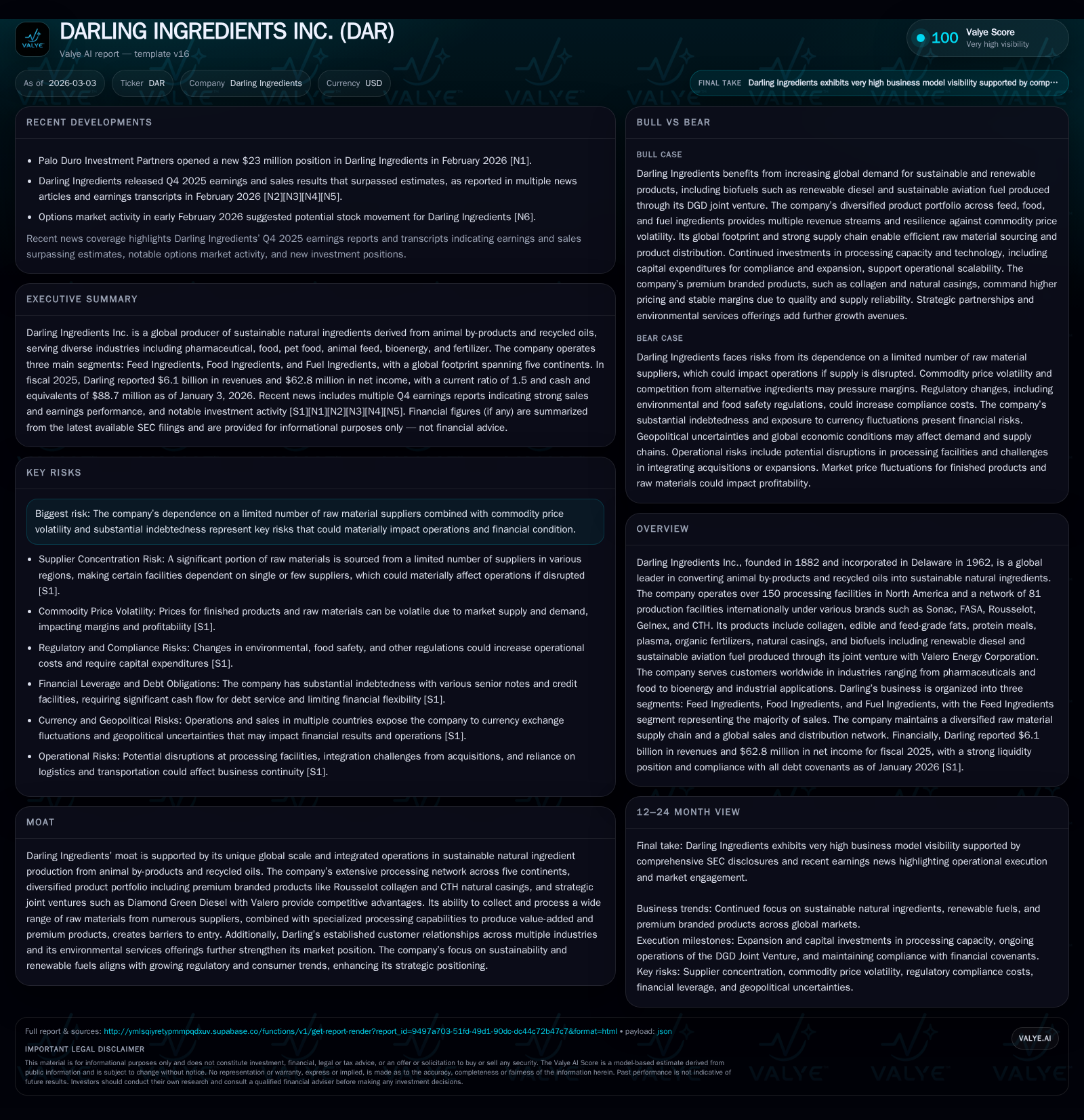
Darling Ingredients Inc. has expanded its revenue consistently while facing significant pressure on its operating and net income margins, driven by increased scale in sustainable natural ingredient production. The company's diversified segments across Feed, Food, and Fuel Ingredients leverage a broad global footprint and strategic joint ventures, notably with Valero Energy. However, rising input costs, commodity price volatility, and substantial indebtedness have compressed profits and challenged returns. Capital deployment favors reinvestment to support asset growth and joint ventures over immediate shareholder returns, underscoring the tension between sustaining expansion and managing financial leverage.
Legacy of Growth: Historical Performance and Business Drivers Through FY2025
Darling Ingredients reported a notable growth trajectory in FY2025 with revenues increasing by 7.4% year-over-year as detailed in their filings [F1][S1]. This top-line expansion underscores the company’s ability to scale its operations by leveraging an extensive network of over 150 processing facilities in North America complemented by a further 81 internationally under established brands such as Sonac, FASA, Rousselot for collagen products, Gelnex, and CTH for natural casings [S1]. These assets allow Darling to convert animal by-products and recycled oils into diversified sustainable natural ingredients.
Despite this revenue growth, operating income plunged by approximately 41.6%, down to $273 million, while net income declined by 77.5%, settling near $62.8 million [F1]. This divergence between rising sales volumes and shrinking profitability paints a picture of margin pressure that could be linked to escalating input costs or shifts in selling prices due to competitive dynamics within their feedstock procurement and product markets (such as bleachable fancy tallow or meat and bone meal) [N1][F1]. The historical context reveals that recent growth has been quantity-driven rather than margin-accretive.
Historical performance (annual)
| FY | Net ($mm) | CFO ($mm) | OpInc ($mm) | Capex ($mm) | Net YoY |
|---|---|---|---|---|---|
| 2025 | 63 | 1060 | 273 | 380 | -77.5% |
| 2024 | 279 | 839 | 468 | 332 | -56.9% |
| 2023 | 648 | 899 | 950 | 555 | -12.2% |
| 2022 | 738 | 814 | 1029 | 391 |
Source: SEC companyfacts cache [F1].
Capital returns and efficiency (annual)
| FY | Buybacks ($mm) | FCF ($mm) | ROE% |
|---|---|---|---|
| 2025 | 35 | 679 | 1.3 |
| 2024 | 34 | 507 | 6.4 |
| 2023 | 53 | 344 | 14.1 |
| 2022 | 126 | 422 | 19.4 |
Source: SEC companyfacts cache [F1].
Figures are rounded; exact revenue figures for FY2025 are not explicitly disclosed but growth percentage is cited [F1].
Operational Footprint and Product Segments as Catalysts for Expansion
Darling’s operations integrate three primary segments: Feed Ingredients, Food Ingredients, and Fuel Ingredients [S8]. The Feed segment includes protein meals such as meat and bone meal (MBM), poultry meal (PM), fats like bleachable fancy tallow (BFT), poultry grease (PG), yellow grease (YG), bakery by-products (BBP), plasma products, hides, plus branded derivatives.
The Food segment leverages premium branded collagen via Rousselot alongside natural casings through CTH — serving pet food manufacturers requiring stringent safety certifications and pharmaceutical applications demanding specialized ingredients.
The Fuel Ingredients segment focuses on collecting used cooking oils, animal fats, recycled oils processed into feedstocks for agriculture-based biofuels like renewable diesel and Sustainable Aviation Fuel (SAF). Darling’s partnership with Valero Energy in the Diamond Green Diesel joint venture positions it strategically within the renewable fuels market amid growing demand tied to regulatory mandates targeting greenhouse gas reductions [S1][N2].
This product breadth combined with geographic diversity across five continents provides purchasing power to source diverse feedstocks — enhancing resilience against localized supply disruptions [S8]. Logistics integration including proprietary fleets optimizes inbound raw material transport alongside exports while managing working capital demands particular to specialized products such as collagen which require higher inventories due to manufacturing cycles [S22].
Profitability Erosion Underlying Recent Results
Despite top-line momentum driven by expanding capacity utilization globally, operating margins deteriorated sharply in FY2025 with operating income down over forty percent year-over-year; net income declined even more steeply reflecting ongoing cost pressures beyond commodity price volatility alone [N1][N2][F1]. Margin compression likely stems from elevated feedstock costs exacerbated by inflation particularly impacting fats categories like BFT or PG — combined with competitive pressures from alternative agricultural ingredients such as corn or soybean meal substituting finished products in some markets [S19].
Additionally, scaling of fuel ingredient businesses may involve transition costs or diluted margins temporarily affecting consolidated profitability until operational efficiencies mature [N2]. This margin squeeze contrasts strongly against revenue growth reflecting volume-driven throughput rather than margin improvement.
Outlook: Strategic Growth Opportunities Amid Industry Dynamics
Management expresses confidence in future expansion driven by scaling renewable fuel capacities through DGD joint ventures alongside opportunities from heightened regulatory emphasis on sustainable sourcing affecting animal feed production streams globally [N1][N3]. Accelerating adoption of renewable diesel and SAF supported by government incentives around decarbonization represents a key growth driver.
Expansion prospects also include environmental services such as grease trap collections providing ancillary revenue stability linked closely to core feedstock sourcing activities — indicating incremental vertical integration benefits.
Regulatory developments remain a watchpoint given supplier concentration risks plus evolving compliance frameworks for food safety possibly requiring additional capital investments or operational adjustments that could limit rapid capacity additions [N3][S11][S21].
Financial Health: Debt Structure, Liquidity, and Leverage Considerations
Darling carries substantial indebtedness through multi-tranche senior secured credit arrangements totaling approximately $2.9 billion including a fully drawn $900 million six-year term A facility maturing in mid-2031 plus revolving credit borrowings near $601 million as of January 2026 year-end [S4][S6][S14]. Senior notes totaling roughly $2.37 billion comprise fixed-rate obligations ranging from about 4.5% to 6%, denominated partly in U.S. dollars and euros; foreign exchange fluctuations have increased reported debt levels due to euro weakening relative to USD.
The company remains compliant with all financial covenants under loan agreements providing some flexibility; liquidity is supported by unrestricted cash of approximately $88 million alongside about $1.32 billion available under revolving commitments ensuring near-term operational funding sufficiency [S4][S6][S7][S9]. Interest expense exposure includes variable rate borrowings tied to SOFR or Euribor benchmarks subject to step-ups based on leverage ratios — creating sensitivity to macro interest rate trends.
Capital deployment balances scheduled debt amortizations against maintenance capex totaling roughly $380 million in FY2025 focused primarily on capacity expansions supporting fuels-related growth vectors plus regulatory-driven upgrades governing food safety standards worldwide [F1][S26].
Capital Allocation: Shareholder Returns vs Investment Priorities
Capital allocation favors reinvestment into assets rather than immediate shareholder returns; share repurchases totaled approximately $35 million in fiscal year 2025 compared with elevated capital expenditures near $380 million indicating management’s strategic priority on long-term infrastructure expansion over buybacks or dividend increases currently [F1][S10].
This approach aligns with industry norms among companies scaling innovative biofuel projects where upfront capex commitments weigh heavily against current earnings growth potential suppressing return metrics like ROE which stands near an estimated 1.3% reflecting earnings margin pressures coupled with equity base expansion over recent years [F1].
Modest buybacks preserve balance sheet flexibility enabling redeployment into opportunistic acquisitions or joint venture expansions exemplified by recent binding offers related to acquisitions valued above $114 million reinforcing ongoing inorganic growth appetite within core feed sectors complementing organic scalability efforts pursued simultaneously by management teams today [S23].
Risks Spotlight: Commodity Volatility, Supply Dependencies & Regulatory Challenges
Key risks include significant supplier concentration where top raw material providers represent up to nearly half of total processed inputs regionally posing operational continuity risks if deliveries are curtailed due to business disruption or legislative changes impacting disposal methods for animal-derived waste streams [S8][S11]. Commodity price volatility further destabilizes gross margin consistency given pricing linkages between finished product sales versus competing agricultural alternatives placing pressure on pricing pass-through capabilities.
Regulatory complexity is illustrated by protracted environmental litigation concerning historical contamination liabilities associated with former operations implicated within the Lower Passaic River Superfund clean-up incurring estimated remediation costs exceeding hundreds of millions though liability assessments remain contested; reserves approximating $86 million net of insurance recoveries are maintained prudently based on management judgment informed by regulatory correspondence outcomes publicly available [S11][S12][S18][S20].
Cybersecurity governance constitutes a key operational risk area managed proactively at the board level involving specialized IT personnel deploying incident response protocols highlighting heightened awareness around data protection critical within regulated pharmaceutical ingredient channels where breaches could severely impact reputation or customer contracts alike [S11].
Disclaimer: This report is prepared solely for informational purposes based on public filings dated March 3, 2026 ([F1],[S#]) and referenced news articles ([N#]). It does not constitute investment advice or recommendations. Readers should independently verify data before making any financial decisions.
Disclaimer: This is research-only, informational analysis and not investment advice. It may include AI-generated interpretation and general industry context. Always verify important details using primary sources.

Comments