
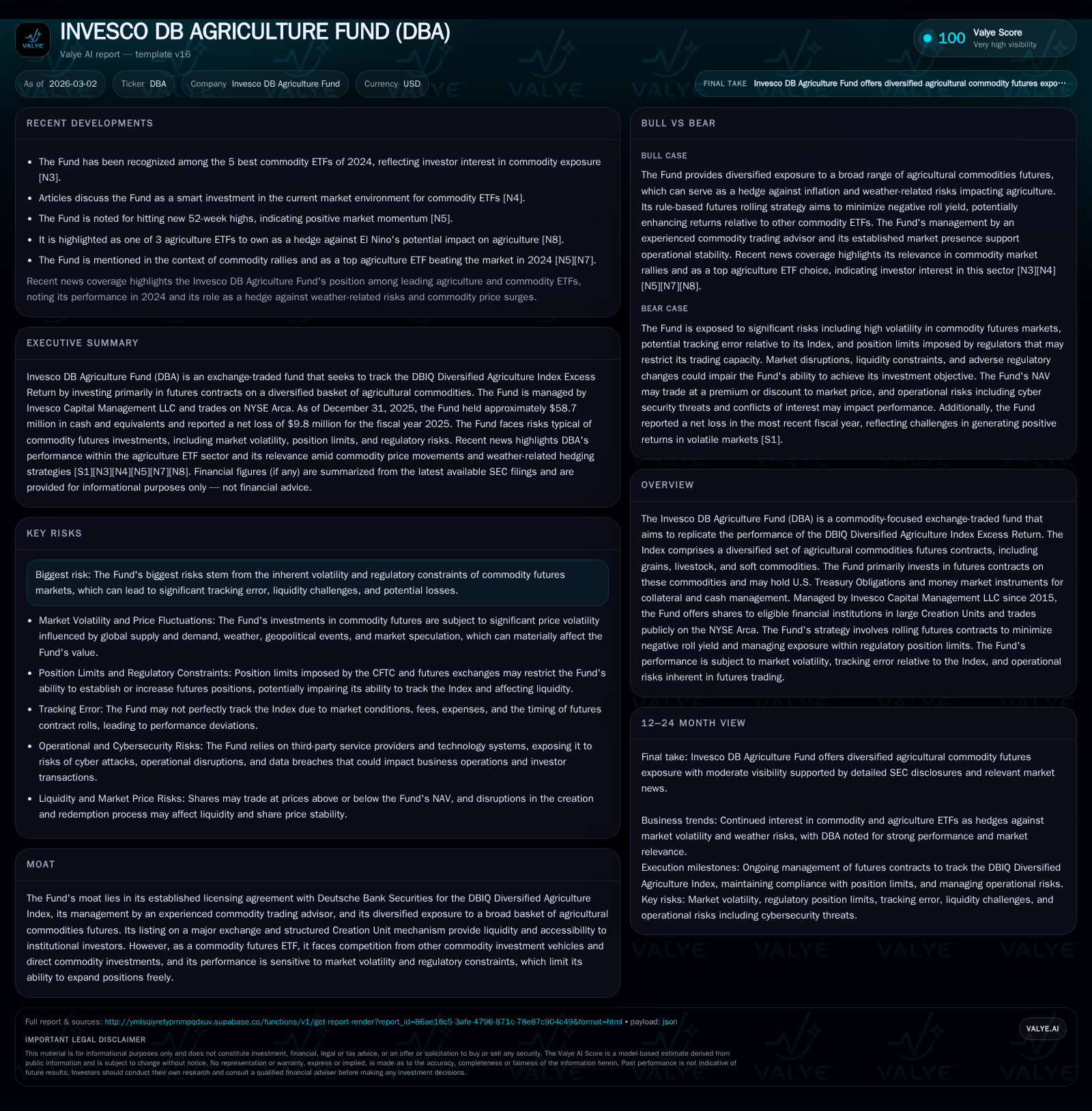
INVESCO DB Agriculture Fund Faces Volatility and Tracking Challenges Amid Futures Market Constraints
Invesco DB Agriculture Fund's performance reflects operational complexity amid commodity futures volatility and regulatory limits.
The Invesco DB Agriculture Fund (DBA) has experienced significant swings in financial performance, including a notable decline in operating income and a shift to net losses in the latest fiscal year. Its core strategy of replicating the DBIQ Diversified Agriculture Index through agricultural commodity futures is complicated by CFTC-imposed position limits and market volatility, which introduce tracking errors and liquidity challenges. Capital allocation reveals sustained buyback activity despite negative profitability, highlighting potential sustainability risks amid regulatory and market operating constraints. Future growth depends heavily on evolving commodity market dynamics and regulatory developments, with careful monitoring needed on position limit changes and external geopolitical risks.
From Growth to Losses: Invesco DB Agriculture Fund’s Recent Financial Performance
Over the four most recent fiscal years ending FY2025, the Invesco DB Agriculture Fund has displayed pronounced volatility in its financial metrics reflective of underlying commodity market swings. Operating income improved substantially from $7.25 million in FY2022 to peak at about $35.76 million in FY2023 before retreating to $26.37 million in FY2025—a 16.3% decrease from FY2024 [F1]. Net income revealed even more dramatic swings: from a negative $67.97 million loss in FY2022 to a robust $210.39 million gain in FY2024, before plunging into a net loss of $9.83 million by FY2025 [F1]. This represents a staggering 104.7% year-over-year reduction.
Operating cash flow (CFO) mirrored these trends with an extreme swing from negative $138.6 million in FY2022 to positive $448.5 million by FY2023 but then sharply contracting 71.8% down to approximately $38.7 million by FY2025 [F1]. These wide fluctuations are emblematic of the Fund's high sensitivity to price volatility across agricultural futures markets and challenges maintaining tracking fidelity against its benchmark index.
Historical performance (annual)
| FY | Net ($mm) | CFO ($mm) | OpInc ($mm) | Net YoY |
|---|---|---|---|---|
| 2025 | -10 | 39 | 26 | -104.7% |
| 2024 | 210 | 137 | 32 | +247.3% |
| 2023 | 61 | 448 | 36 | +189.1% |
| 2022 | -68 | -139 | 7 |
Source: SEC companyfacts cache [F1].
Capital returns and efficiency (annual)
| FY | Div ($mm) | Buybacks ($mm) | ROE% |
|---|---|---|---|
| 2025 | 26 | 203 | -1.4 |
| 2024 | 32 | 245 | 26.7 |
| 2023 | 34 | 543 | 8.6 |
| 2022 | 6 | 1416 | -6.3 |
Source: SEC companyfacts cache [F1].
Note: Figures rounded; YoY percentages calculated where data permits [F1]
Navigating Commodity Futures: Investment Strategy and Index Alignment
The Fund seeks to track changes in the DBIQ Diversified Agriculture Index Excess Return™ through investments primarily in futures contracts across thirteen agricultural commodities including grains like corn and wheat as well as livestock such as lean hogs [S1]. It employs active rolling strategies designed to mitigate negative roll yield associated with expiring front-month futures.
Collateral assets include U.S. Treasury Obligations along with money market mutual funds and T-Bill ETFs—some affiliated—which serve margin requirements and cash liquidity management purposes [S1][S20]. The Managing Owner implements systematic approaches considering contract expirations and margin calls aiming for efficient index replication despite volatile market conditions.
Intraday pricing discrepancies arise due to differing trading hours between NYSE Arca shares and underlying futures markets impacting NAV calculations [S1].
Regulatory Position Limits Impacting Trading Capacity
The Commodity Futures Trading Commission (CFTC) enforces position limits on commodity futures contracts within the Index Commodities basket to prevent excessive speculation or manipulation [S1][S15]. These constraints limit contract sizes per commodity which can restrict the Fund's ability to fully rebalance or expand positions during index reconstitutions or trading opportunities.
When near or at these limits, the Managing Owner may invest in alternative correlated futures outside the immediate Index composition as a compliance measure [S20]. Additional internal risk limits set by clearing brokers (FCMs) further influence trade size restrictions independent of regulatory caps [S8]. Introducing new clearing brokers could alleviate constraints but would increase transaction costs and operational complexity.
Market Volatility Risks Rooted in Agricultural Futures
Agricultural commodity prices are influenced by complex factors including global supply-demand shifts; weather events; government policies; speculative flows; geopolitical conflicts such as Russia-Ukraine; and technical market dynamics [S3][S12][S22]. Such factors contribute to heightened price volatility increasing tracking error risks.
Disrupted markets can experience illiquidity making it difficult for the Fund to liquidate positions at desired prices potentially magnifying losses [S17]. Temporary distortions caused by forced liquidations or regulatory interventions may also adversely affect returns beyond spot price movements [S16].
These risks manifest as variable bid-ask spreads on index contracts held by the Fund as well as premiums or discounts relative to NAV during intraday trading on NYSE Arca [S19].
Capital Allocation: Buybacks Amid Profitability Pressures
Despite posting a net loss of approximately $9.83 million in FY2025 [F1], the Fund maintained substantial share repurchases totaling roughly $203 million that year—down modestly from prior years but still significant relative to earnings challenges [F1]. Dividend distributions were approximately $25.9 million in FY2025.
Operating cash flow fell sharply over two-thirds year-over-year from about $137 million in FY2024 down to roughly $39 million last fiscal year [F1], indicating pressure on free cash generation amid volatile markets.
This pattern underscores potential sustainability concerns regarding capital returns if losses persist or cash flows remain constrained without resorting to asset sales or external funding sources.
Collateral holdings of short-duration U.S. Treasuries support liquidity for margin needs providing operational stability despite earnings fluctuations [S20].
Structural Conflicts of Interest and Management Considerations
The Managing Owner holds roles including commodity pool operator and trading advisor while selecting affiliated money market funds and T-Bill ETFs used for collateral purposes—which may present conflicts if affiliated instruments yield lower dividends than alternatives [S9][S25].
Compensation structures involving Commodity Brokers could create incentives misaligned with shareholder interests affecting execution quality or pricing [S9]. Cybersecurity risks tied to third-party service providers including administrators and clearinghouses pose operational vulnerabilities potentially impacting trading continuity or NAV accuracy [S10][S24].
While business continuity plans exist addressing these risks there are inherent limitations given evolving cyber threats.
Outlook: Growth Drivers Amid Operational Constraints
Future performance depends largely on favorable agricultural commodity price movements reflecting supply-demand fundamentals balanced against persistent roll yield headwinds inherent in futures-based replication.
Regulatory changes tightening aggregation exemptions or reducing position limits could further constrain exposure sizing while increasing rebalancing costs [S8][S15][S27]. Investor preference might shift toward vehicles offering direct physical commodity exposure or active management mitigating downside risks.
Macro risks including ongoing geopolitical conflicts affecting key export regions remain critical uncertainties influencing volatility and liquidity conditions.
Milestones and Factors for Monitoring Going Forward
Investors should monitor SEC filings for updates on compliance frameworks or governance changes potentially affecting operations. Adjustments in clearing broker risk tolerance could impact trading capacity requiring new counterparty arrangements with cost implications. Cybersecurity policy enhancements among service providers remain vital given systemic operational dependencies. Emerging legislative initiatives targeting position limit aggregation rules may alter speculative volume allowances influencing ETF replication efficiency. Commodity market developments driven by weather extremes or trade policy shifts will remain key external drivers shaping returns trajectories.
This analysis relies exclusively on publicly filed financial statements and regulatory disclosures up to March 2nd, 2026 ([F1],[S1]-[S28]). It refrains from extrapolation beyond sourced information aiming at delivering rigorous insight into financial performance drivers and operational risks specific to Invesco DB Agriculture Fund's ETF structure within regulated commodity futures markets.
Disclaimer: This is research-only, informational analysis and not investment advice. It may include AI-generated interpretation and general industry context. Always verify important details using primary sources.

Comments