
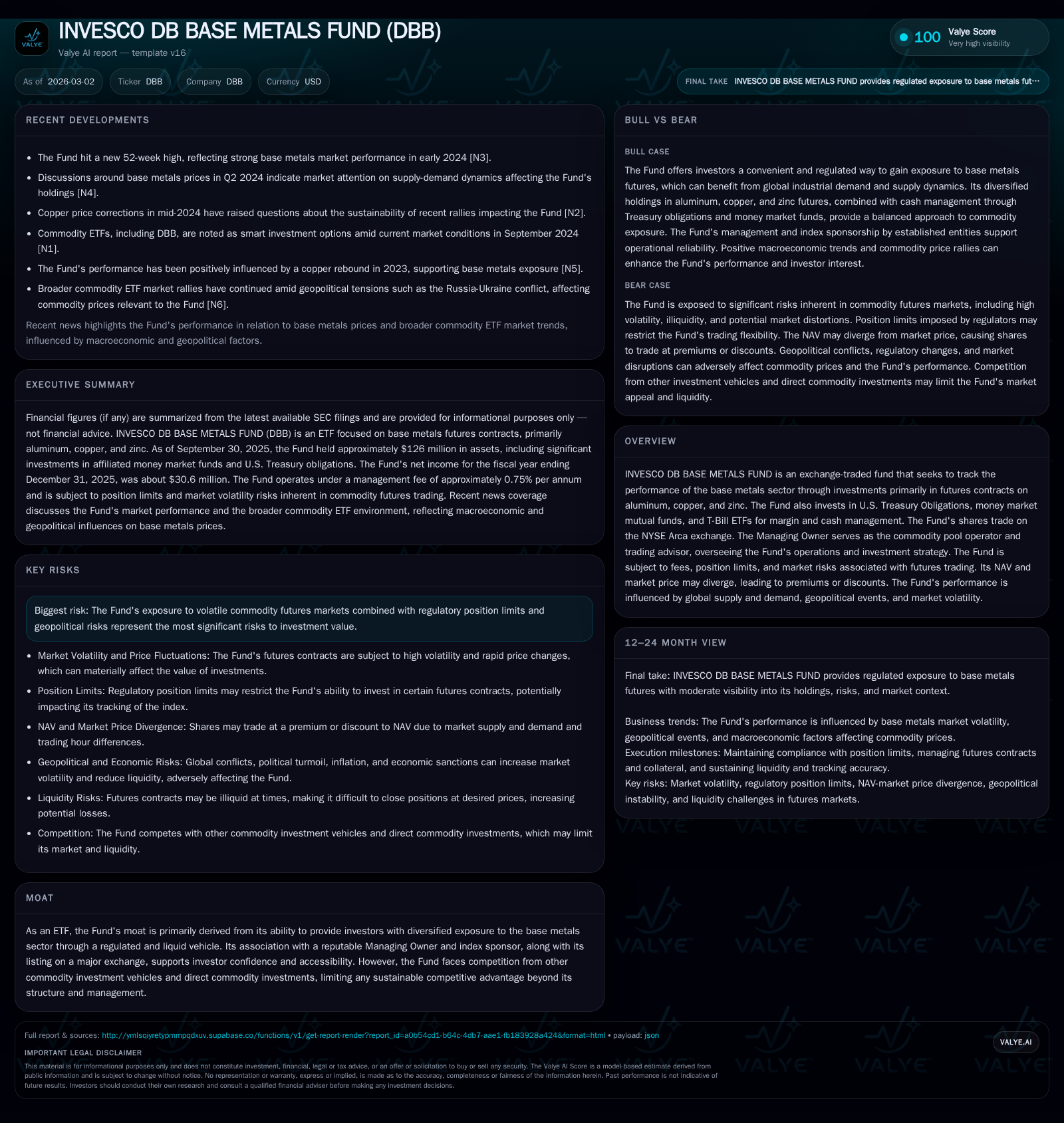
INVESCO DB BASE METALS FUND Exposes Volatile Base Metals Dynamics Through Futures Trading
DBB’s financial trajectory reveals the complexities of tracking base metals through futures amidst regulatory and operational risks.
The Invesco DB Base Metals Fund (DBB) offers investors a regulated pathway to access the volatile base metals sector via futures contracts on aluminum, copper, and zinc. Historical performance underscores pronounced earnings volatility driven by commodity price fluctuations and futures market dynamics. Regulatory constraints on position limits, paired with operational dependencies on commodity brokers and custodians, impose growth ceilings and execution risk. Capital allocation reflects significant share repurchases alongside dividends, aligned with fluctuating net income and operating cash flow patterns. Going forward, investors should focus on tracking error trends, geopolitical developments affecting metals demand and supply, and regulatory adjustments that may alter DBB’s ability to replicate index exposure effectively.
Historic Performance Trends Driven by Futures Market Exposure
The Invesco DB Base Metals Fund (DBB) operates under a mandate to track base metals sector performance primarily via futures contracts on aluminum, copper, and zinc. This structure inherently exposes the fund's earnings to significant volatility aligned with underlying commodity prices.
Examining recent fiscal years through disclosed financials [F1], DBB's operating income fell to $4.05 million in FY2025 from $5.85 million in FY2024—a decline of approximately 30.9%. Contrarily, net income dramatically surged from $7.48 million to over $30.6 million (+309.4%) during the same period. This divergence highlights how realized and unrealized gains on futures contracts—impacted by daily market swings—can produce large disparities between operational results and bottom-line returns.
Operating cash flow (CFO) reversed sharply from positive $16.7 million in FY2024 to negative $55.7 million in FY2025 (-433%), signaling substantial cash movements related to futures settlements and margin requirements. The fund’s equity stood at $202.5 million at FY2025-end, up from $112.7 million a year earlier.
This performance pattern illustrates the intrinsic impact of mark-to-market accounting on futures holdings where gains/losses recognized may be timing-driven rather than indicative of long-term economic profit.
Historical performance (annual)
| FY | Net ($mm) | CFO ($mm) | OpInc ($mm) | Net YoY |
|---|---|---|---|---|
| 2025 | 31 | -56 | 4 | +309.4% |
| 2024 | 7 | 17 | 6 | +224.0% |
| 2023 | -6 | 96 | 10 | +90.9% |
| 2022 | -66 | 197 | 3 |
Source: SEC companyfacts cache [F1].
Capital returns and efficiency (annual)
| FY | Div ($mm) | Buybacks ($mm) | ROE% |
|---|---|---|---|
| 2025 | 5 | 59 | 15.1 |
| 2024 | 6 | 154 | 6.6 |
| 2023 | 9 | 196 | -5.0 |
| 2022 | 2 | 446 | -29.4 |
Source: SEC companyfacts cache [F1].
Table: INVESCO DB BASE METALS FUND Historical Financial Summary [F1]
Commodity Market Drivers Shaping Past Results
DBB's futures contracts are based on London Metal Exchange (LME) Grade A metal prices for aluminum, copper,and zinc—the trio constituting its index commodities as per the most recent prospectus [S1]. The prices of these metals are highly sensitive to global supply-demand dynamics including production shifts by major mining countries and industrial activity fluctuations.
Geopolitical tensions have added complexity; conflicts affecting logistics or trade restrictions can tighten metal availability leading to acute price fluctuations impacting DBB’s NAV instantaneously via associated futures revaluation. The LME's contract specification with daily settlement mechanics involves mark-to-market processes that translate metal price changes directly into unrealized gains or losses within the fund's statements [S1].
Additional distortions can stem from regulatory actions or sudden market illiquidity affecting futures trading volumes or causing basis risk where spot price moves diverge temporarily from futures prices.
These multifaceted influences on commodities prices underpin DBB's portfolio valuation swings explaining its earnings pattern volatility.
Futures Position Limits and Regulatory Impact on Growth Potential
The Commodity Futures Trading Commission (CFTC) along with relevant futures exchanges impose position limits constraining the maximum number of contracts any entity may hold to prevent excess speculation or market manipulation [S3]. For DBB targeting broad exposure to base metals through LME-linked futures contracts this regulatory ceiling can directly cap its ability to enlarge holdings when investor inflows rise.
As DBB approaches such position thresholds it must seek alternative means either by trading correlated but non-index contracts or scaling inflows down until redemptions free capacity [S1][S3]. This mechanism restricts creation/redemption unit issuance which may induce mismatch between fund shares outstanding and underlying assets.
Consequently this can exacerbate discrepancies between the Fund’s NAV and its market price producing persistent premiums or discounts—an important risk considering ETFs compete partly on tight bid-ask spreads and price fidelity relative to NAV.
Regulatory limits thus form a structural growth constraint affecting asset accumulation velocity and tracking fidelity.[S3]
Operational Constraints Including Custodial and Brokerage Risks
DBB deposits required margin collateral predominantly in cash equivalents such as U.S. Treasury Obligations and T-Bill ETFs with its designated Commodity Broker—as allowed within CFTC margin rules—and holds residual assets with an independent Custodian [S4][S6]. This bifurcated custody framework introduces operational dependency risks.
Margin accounts maintained at the Commodity Broker cover maintenance margin requirements tied to open futures positions; unrealized gains/losses factor into overall broker account equity calculation [S4]. The brokerage agreement permits net settlement across all contract types mitigating counterparty exposure but a failure or distress event could delay asset access or require forced liquidation of Treasury securities held as collateral.
Caretaking cash management incurs interest earned on excess cash but obliges interest expense on overdraft balances creating minor asymmetries affecting net returns [S6]. Temporary negative balances highlight liquidity management needs.
Maintenance margin requirements demand active monitoring under volatile conditions imposing renewed funding obligations; failure triggers forced contract closures risking realized losses against equity.
Operational risks tied to custody arrangements remain important for understanding execution risk profiles and potential temporary disruptions factorable into valuation adjustments.[S4][S6]
Capital Allocation History: Dividends and Buybacks Aligned With Earnings Cycles
DBB has engaged capital discipline balancing dividend payouts with sizable share repurchases reflective of its earnings cycle evolution [F1][S7]. Dividend distributions declined modestly from $5.8 million in FY2024 to roughly $4.9 million in FY2025 amid rising profitability indicating a conservative payout posture congruent with volatile income streams.
Notable share buybacks aggregated approximately $59 million during FY2025 compared with $154 million in prior year suggesting active management intent to optimize shareholder value despite earnings variability.
Equity expanded markedly from $112.7 million at end-FY2024 to around $202.5 million end-FY2025 signaling net capital inflows or accumulated income retention fueling asset growth.
Approximate return on equity calculated as net income divided by equity was about 15% for FY2025—reasonable given leveraged exposure yet underscoring inherent volatility given prior years' losses.[F1]
Overall capital allocation decisions align with managing earnings cyclicality while supporting liquidity needs intrinsic to fund operation dynamics.[F1][S7]
Future Outlook: Tracking Error Challenges Amid Volatility and Regulatory Constraints
Maintaining close correlation with its underlying index remains challenging due to fluctuating metal prices coupled with operational constraints including position caps and settlement mechanics [S1]. Tracking error—variations between index performance and actual fund returns—is expected near term due largely to:
- Position limits precluding full replication during peak inflow periods;
- Premiums or discounts emerging from constrained creation/redemption unit arbitrage;
- Execution timing differences inherent in futures settlements;
- Variability induced by rollover costs when adjusting contract maturities amid contango/backwardation scenarios;
- Volatility shocks stemming from geopolitical or macroeconomic events disrupting base metals markets.
DBB’s disclosures emphasize these risks explicitly cautioning investors regarding periodic deviations despite structural hedging efforts.[S1]
Key Monitoring Areas for Investors Ahead
Without formal issuer forecasts publicized investors should keenly observe several dynamics influencing DBB’s near-term trajectory:
- Trends in NAV versus market price differentials indicating premium/discount pressures;
- Updates or changes in CFTC or exchange position limit regulations potentially altering investment scope;
- Geopolitical developments impacting mining regions which could disrupt metals supply affecting futures pricing;
- Liquidity status reports concerning the Commodity Broker & Custodian arrangement emphasizing availability of margin collateral;
- Changes in global industrial demand reflecting infrastructure activity spikes driving metal price momentum;
- Indicator metrics derived by the Managing Owner such as implied volatility indexes or base metals inventory data foreshadowing market transitions.
These metrics collectively frame an analytical lens enabling sophisticated stakeholders to gauge evolving risk-return tradeoffs within this specialized commodity ETF construct.[S1][S3][S4][S5][S6]
This report compiles analysis strictly anchored in SEC filings and factual financial data without extrapolating speculative forecasts or investment recommendations. It provides institutional-level insight into the financial performance patterns combined with operational idiosyncrasies shaping the Invesco DB Base Metals Fund's ongoing development within regulated commodity futures trading frameworks.
Disclaimer: This is research-only, informational analysis and not investment advice. It may include AI-generated interpretation and general industry context. Always verify important details using primary sources.

Comments