
Invesco DB Oil Fund (DBO) Confronts Volatile Crude Oil Futures and Structural Index Changes
DBO's recent net losses and index methodology revisions underscore risks tied to crude oil futures volatility and liquidity constraints.
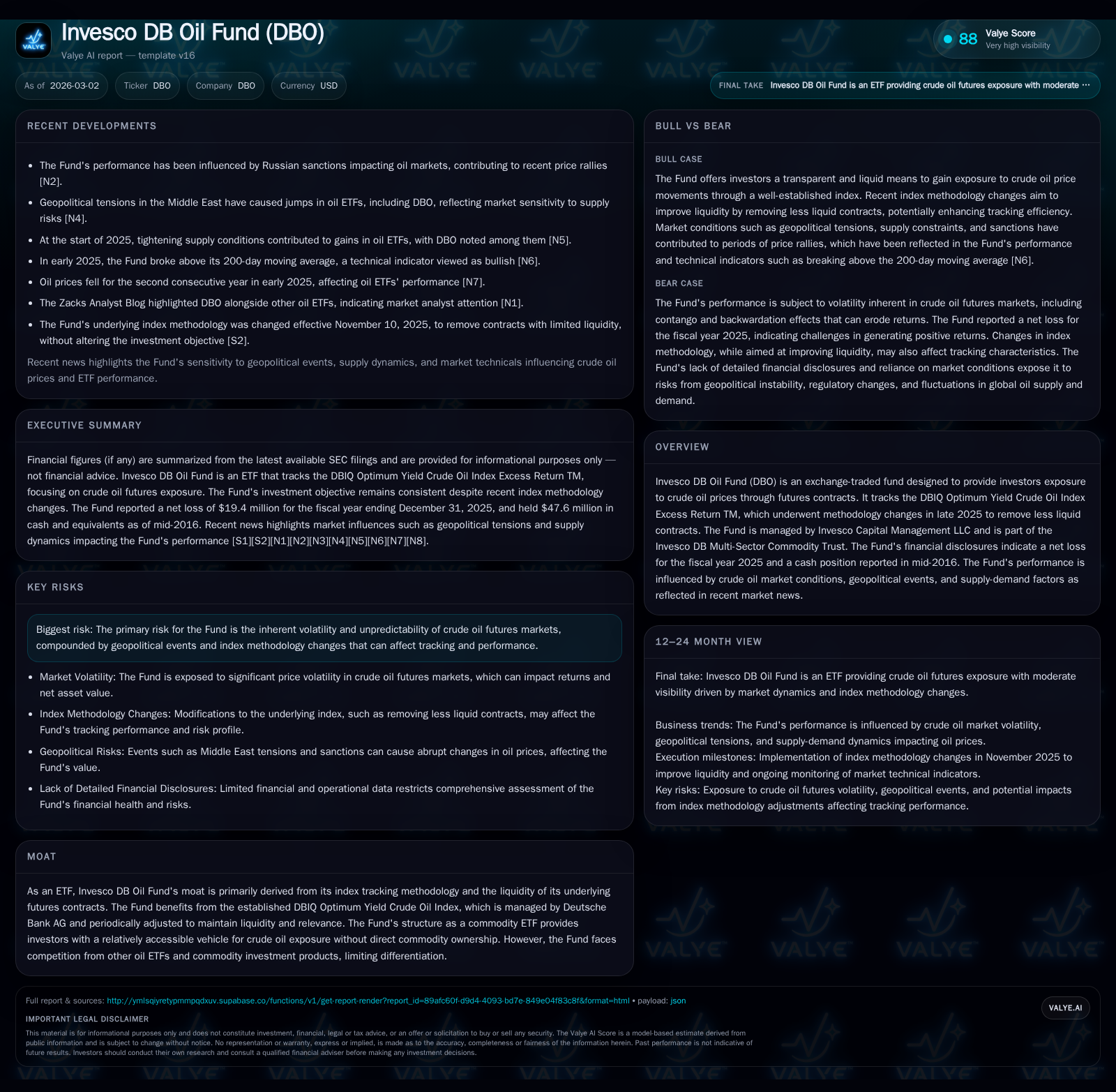
Invesco DB Oil Fund (DBO) provides exposure to crude oil prices via futures contracts tied to the DBIQ Optimum Yield Crude Oil Index. The Fund experienced a net loss in fiscal 2025 after several years of fluctuating profitability, driven largely by crude oil market volatility and changes in its underlying index methodology aimed at removing less liquid contracts. Despite a sizable equity base, the Fund’s operating cash flow turned negative in 2025, reflecting ongoing challenges in the commodity futures landscape. The Fund’s future performance hinges on crude oil price trajectories, geopolitical influences, and how effective the new index adjustments will be in mitigating liquidity risks.
Overview of Invesco DB Oil Fund
The Invesco DB Oil Fund (ticker: DBO) is an exchange-traded fund designed to provide investors with exposure to crude oil prices through derivatives—specifically futures contracts. It seeks to track the performance of the DBIQ Optimum Yield Crude Oil Index Excess Return TM, an index managed by Deutsche Bank AG that optimizes contract selection for liquidity and yield considerations. The Fund is part of the broader Invesco DB Multi-Sector Commodity Trust managed by Invesco Capital Management LLC.
This ETF represents a pathway for market participants who want an indirect investment into oil prices without physically holding barrels or direct commodity ownership. However, this structure inherently inherits the complexities and risks associated with commodity futures trading such as contango or backwardation effects, liquidity variations across contract maturities, and significant geopolitical impact on crude oil markets.
Historical Financial Performance
Over the past four fiscal years ending December 31, there has been considerable oscillation in DBO's profitability and cash flows:
Historical performance (annual)
| FY | Net ($mm) | CFO ($mm) | OpInc ($mm) | Net YoY |
|---|---|---|---|---|
| 2025 | -19 | -13 | 7 | -199.1% |
| 2024 | 20 | 53 | 10 | +237.7% |
| 2023 | -14 | 45 | 11 | -118.4% |
| 2022 | 77 | 208 | 2 |
Source: SEC companyfacts cache [F1].
Capital returns and efficiency (annual)
| FY | Div ($mm) | Buybacks ($mm) | ROE% |
|---|---|---|---|
| 2025 | 7 | 124 | -9.5 |
| 2024 | 10 | 110 | 9.2 |
| 2023 | 11 | 210 | -5.8 |
| 2022 | 2 | 295 | 25.5 |
Source: SEC companyfacts cache [F1].
The table above summarizes reported operating income (OpInc), net income (Net), operating cash flows (CFO), dividends paid (Div), and buyback volumes through fiscal year ends as reported [F1]. Notably:
- Net income swung sharply from a substantial $77 million gain in FY22 to a $14 million loss in FY23 before recovering into positive territory in FY24 and then regressing into a significant $19 million loss position again in FY25.
- Operating income followed a broadly declining trend post-2023 peak.
- Operating cash flow experienced extreme volatility with very strong inflows through FY22-24 but turning negative in FY25.
- Despite losses in FY25, dividends were maintained at over $7 million while share repurchases remained robust at $124 million.
These fluctuations underscore the high sensitivity of the Fund’s returns to the volatile nature of crude oil futures prices and roll yield dynamics.
Drivers of Past Performance
The performance swings primarily reflect movements in global crude oil markets influenced by supply-demand imbalances and geopolitical events affecting production disruptions or economic demand conditions. The Fund’s indirect exposure via futures means it also contends with futures curve shapes — contango can erode returns as rolling contracts becomes costly whereas backwardation tends to be accretive.
Additionally:
- The underlying index methodology itself influences realized returns through optimization algorithms that select among multiple crude futures maturities aiming for the best rolling yield while maintaining liquidity.
- Before November 2025 changes were implemented to remove less liquid contracts from the index [S9], some portion of underperformance may have stemmed from illiquidity premiums or inefficient contract rolls.
Recent Structural Index Changes
On November 10th, 2025 [S9], Deutsche Bank AG revised the methodology of DBIQ Optimum Yield Crude Oil Index Excess Return benchmarked by DBO to eliminate contracts demonstrating limited liquidity. This pivot reflects growing concerns about market depth as well as transaction cost implications associated with rolling smaller-volume futures contracts amidst evolving market conditions.
While these modifications aim to enhance tracking precision and reduce negative roll impacts stemming from thinly traded maturities:
- They potentially narrow the universe of eligible contracts covered by the index,
- And might reduce some diversification benefits embedded in prior contract selection flexibility.
Importantly these changes do not affect DBO’s stated investment objective but may shift performance drivers going forward.
Future Growth Prospects and Constraints
Growth for DBO as an investment vehicle depends largely on broader investor appetite for commodities exposure via ETFs amid energy market cycles:
- Sustained or rising crude oil prices could stimulate inflows given DBO’s objective alignment,
- Increased volatility or geopolitical instability often invites tactical allocation shifts favoring commodity-linked instruments,
- Regulatory changes impacting commodity derivatives could alter cost structures or accessibility,
- Conversely prolonged periods of contango or narrowing spreads may suppress fund returns compared to spot prices,
- Competition from other oil-related ETFs offering different strategies or cost advantages can cap asset accumulation potential.
Further adjustments by Deutsche Bank AG or shifts towards alternative weighting methodologies could impact product relevance and tracking effectiveness beyond current reforms documented [S9].
Financial Forecasts and Key Milestones to Watch
There is no direct company guidance available within regulatory disclosures regarding future revenue or profitability targets [S1][S2]. Thus stakeholders should monitor:
- Quarterly updates on net asset values relative to crude oil price movements,
- Efficacy of new index rules reflected in rolling yield improvements,
- Changes in dividend payments indicating cash flow sufficiency,
- Investor sentiment captured through fund flows,
- Broader economic indicators influencing energy demand such as global manufacturing data or OPEC supply decisions.
Any unexpected regulatory interventions on commodity trading venues or margin requirements would also materially affect operational dynamics [S3][S4][S5][S6][S7].
Capital Allocation and Returns Analysis
DBO’s capital allocation appears focused on shareholder returns despite variable earnings:
- Share repurchases totaled around $124 million in FY25 after strong repurchase activity previously [F1], signaling confidence by management/owners in long-term value despite near-term losses.
- Dividends were consistently paid each year including during loss periods indicating use of distributable reserves or cash flows from derivative settlements rather than reliance solely on earnings.
- Operating cash flow deterioration into negative territory (-$13.2 million) during FY25 marks a cautionary note regarding sustainability of current payout levels absent recovery [F1].
- An approximate ROE calculation reveals around -9.5% for FY25 due mostly to negative net income against sizable equity base (~$204 million) [F1].
Overall these factors highlight structural challenges converting volatile pre-tax results into consistent profitability though strong equity buffers provide resilience.
Risks Summary
Key risks outlined repeatedly across SEC filings include [S3][S4][S5]:
- Volatility inherent in crude oil futures markets leading to unpredictable returns,
- Geopolitical conflicts disrupting supply chains,
- Contango/backwardation impacts causing negative roll yields,
- Index methodology changes potentially reducing eligible contract universes,
- Regulatory developments affecting commodity derivatives trading structure or costs,
- Market competition limiting fund asset growth amidst alternative energy investment trends.
Given this risk profile investors must remain cognizant that DBO's value fluctuates not only with underlying commodity prices but also specific derivatives market mechanisms and structural index features.
Conclusion
Invesco DB Oil Fund occupies a complex niche providing liquid access to crude oil price exposure via optimized futures contracts through an established index platform undergoing tactical refinement for liquidity enhancement. Its recent financial trajectory illustrates sharp swings driven by external commodity price shocks combined with internal structural evolution. While still supported by robust equity capital and active capital return programs such as dividends and buybacks amid challenging conditions,the fund’s medium-term prospects hinge critically on how effectively it navigates volatile energy markets alongside evolving index construction safeguards. Market participants considering DBO must weigh its mechanistic exposures against macroeconomic drivers shaping global oil fundamentals.
This analysis is based on publicly filed disclosures up to March 2nd, 2026 and does not constitute investment advice or recommendations. It aims solely at providing an informed perspective on Invesco DB Oil Fund’s financial trends and structural considerations relevant for institutional research purposes.
Disclaimer: This is research-only, informational analysis and not investment advice. It may include AI-generated interpretation and general industry context. Always verify important details using primary sources.

Comments