
Invesco DB Precious Metals Fund Confronts Volatile Futures Dynamics and Position Limit Constraints
The Fund’s specialized precious metals futures strategy navigates market volatility, regulatory limits, and tracking complexities.
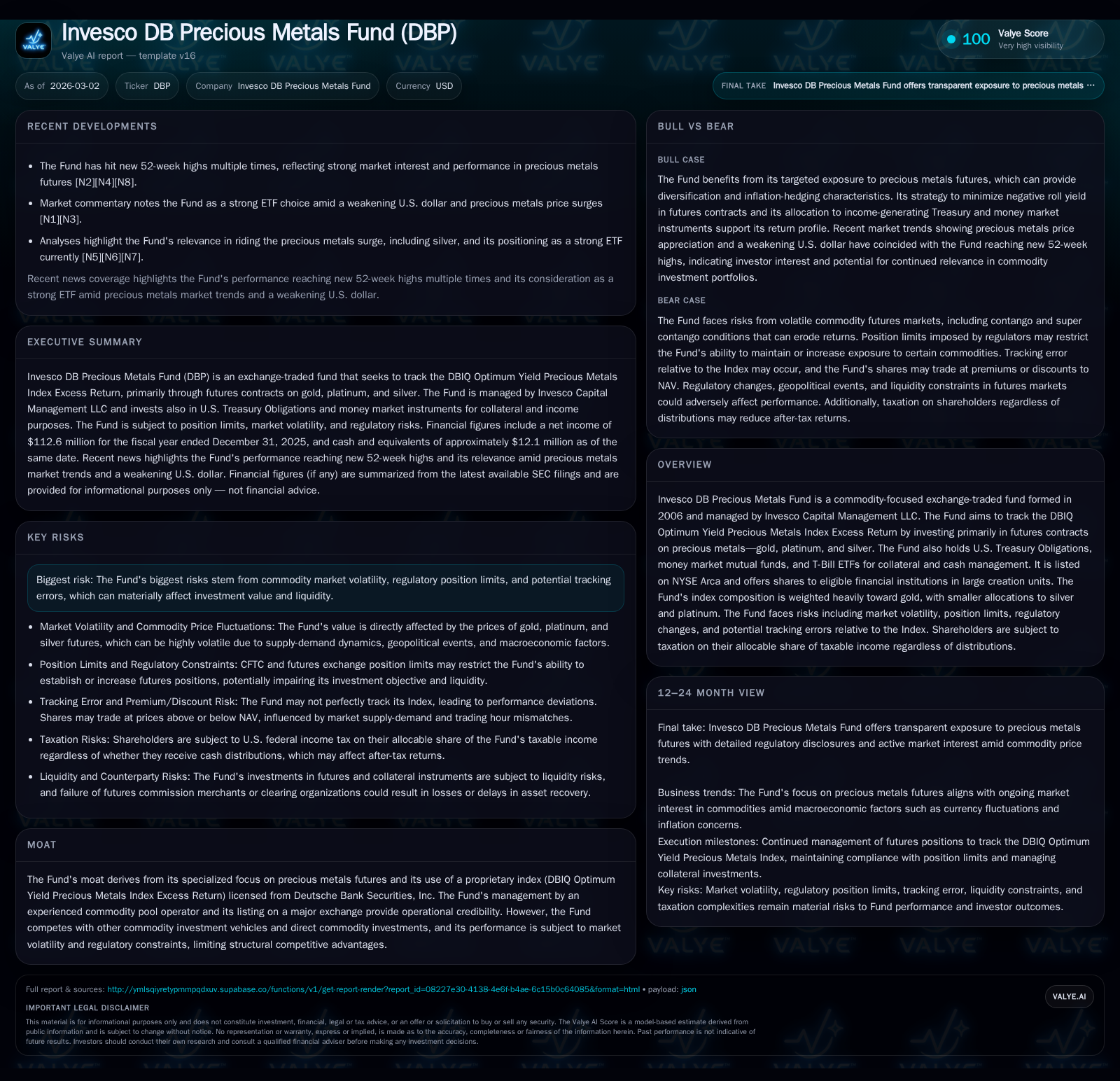
Invesco DB Precious Metals Fund (DBP), launched in 2006 and managed by Invesco Capital Management LLC, targets exposure to gold, silver, and platinum through futures contracts linked to the DBIQ Optimum Yield Precious Metals Index Excess Return. Past performance shows significant growth in net income and equity alongside operating income volatility. Future growth is closely tied to precious metals price movements, regulatory position limits on futures trading, and the potential for tracking errors. Returns have improved dramatically with a rising ROE, supported by active capital returns through dividends and buybacks. Regulatory compliance, position limits, and potential market disruptions remain critical risk factors impacting fund operations and investor outcomes.
Overview of Invesco DB Precious Metals Fund
Invesco DB Precious Metals Fund (ticker: DBP) was established in 2006 as a separate series of Invesco DB Multi-Sector Commodity Trust. The Fund’s core objective is to track the DBIQ Optimum Yield Precious Metals Index Excess Return by investing predominately in futures contracts tied to key precious metals—gold, silver and platinum. The index composition emphasizes gold due to its global economic importance, complemented by smaller allocations to silver and platinum as reflected since November 2025 [S1], [S25].
Managed by Invesco Capital Management LLC since early 2015, the Fund operates as a commodity pool with its creation units traded on NYSE Arca. Its structure leverages collateral investments including U.S. Treasury Obligations with maturities up to one year, affiliated or non-affiliated money market mutual funds, and T-Bill ETFs for margin and liquidity management [S1], [S25].
Historical Financial Performance
The Fund’s financials have demonstrated pronounced variability reflective of futures trading dynamics combined with general macroeconomic influences on precious metals pricing:
Historical performance (annual)
| FY | Net ($mm) | CFO ($mm) | OpInc ($mm) | Net YoY |
|---|---|---|---|---|
| 2025 | 113 | 11 | 6 | +210.4% |
| 2024 | 36 | 28 | 7 | +216.5% |
| 2023 | 11 | -27 | 7 | +440.6% |
| 2022 | -3 | 0 | 1 |
Source: SEC companyfacts cache [F1].
Capital returns and efficiency (annual)
| FY | Div ($mm) | Buybacks ($mm) | ROE% |
|---|---|---|---|
| 2025 | 6 | 49 | 43.7 |
| 2024 | 7 | 56 | 23.4 |
| 2023 | 7 | 79 | 7.8 |
| 2022 | 1 | 47 | -3.1 |
Source: SEC companyfacts cache [F1].
Revenue-related figures stem primarily from futures trading gains/losses rather than traditional sales turnover.
Notably:
- Operating income declined modestly (-6.5%) from FY24 to FY25 reflecting fluctuating futures market conditions;
- Net income surged +210% YoY between FY24-FY25 indicative of strong precious metals price appreciation during this period [F1];
- Operating cash flow shows high volatility with a sharp drop (-61.2% YoY) in FY25 compared to FY24 due to timing effects of margin calls and settlements intrinsic to futures-based strategies;
- Equity advanced robustly (+66%) in FY25 driven by cumulative retained earnings;
- Consistent dividend payouts exceeding $6 million annually illustrate shareholder return policy stability;
- Share repurchases remain material (nearly $50 million in FY25), reflecting active capital allocation to enhance per-share metrics.
Estimated return on equity for FY25 stands around 43.7%, underscoring efficient utilization of shareholders’ equity amid commodities-driven profitability [F1].
Investment Strategy and Market Dynamics
DBP offers exposure uniquely through futures contracts on precious metals rather than physical holdings. This futures-based approach enables leveraged participation but inherently entails volatility and risks associated with contract roll yields and margin calls [S1]. The proprietary DBIQ Optimum Yield Index incorporates production volume metrics alongside liquidity criteria for constituent weighting—ensuring that the three-year Total Dollar Volume Average informs commodity allocation thresholds ranging roughly from minimums near 5% per metal [S20].
The Fund must operate within CFTC-imposed position limits which can constrain maximum permissible holdings for single commodities—a vital consideration given the dominance of gold weighting within the portfolio [S12]. If limits are approached or breached:
- The fund may diversify into other correlated commodities or substitute futures contracts,
- Liquidity may tighten,
- Tracking deviation versus the benchmark may widen,
- Creation/redemption mechanics for shares could become impaired affecting premium/discount dynamics.
These regulatory constraints represent a structural cap on scalable growth tied directly to the regulatory environment governing commodity futures trading [S12], [S26].
Risks Affecting Performance
DBP bears a concentrated set of risks that materially influence returns:
- Market Volatility: Futures contracts traded exhibit high price swings driven by geopolitical tensions (e.g., Russia-Ukraine war; Israel-Hamas conflict), macroeconomic shifts such as interest rate changes or inflation expectations impacting investment flows into metals [S1], [S28];
- Position Limits: Regulatory limits potentially restrict investment scale or flexibility within specific precious metals markets leading to tracking error or liquidity issues;
- Tracking Error: Due to futures roll costs and collateral yield differences, performance does not perfectly mirror the underlying Index over time;
- Operational Risks: Conflicts between Managing Owner interests and shareholder outcomes exist given affiliated transactions involving money market funds; cybersecurity threats affect third party providers compromising business continuity; margin calls may require rapid funding reallocations that disrupt strategy execution [S8], [S11], [S21];
- Tax Exposure: Shareholders bear taxation on allocated income regardless of distribution receipt complicating after-tax investment returns especially for retail investors [S22];
- Share Liquidity Risks: Withdrawal of Authorized Participants can reduce creation unit activity limiting secondary market efficiency leading shares to deviate further from NAV [S23].
Outlook and Growth Prospects
Looking ahead:
- Precious metals markets remain sensitive to currency swings (notably USD weakness) which has recently propelled DBP shares towards new annual highs as reported recently in January ‘26—a sentiment tailwind potentially driving near-term inflows [N1], [N2];
- The Fund’s ability to grow assets under management is somewhat capped by position limits enforced by regulators;
- The continuing evolution of geopolitical tensions could amplify market volatility—offering trading opportunities yet magnifying risks;
- Operational enhancements around tracking precision offer limited upside compared with fundamental commodity price drivers;
- Investors should monitor regulatory developments related to position limits and clearing house reforms that might affect margin efficiencies.
No official company guidance or milestone announcements are available at this time; monitoring filings for any updates will be important from an operational standpoint.
Capital Allocation & Shareholder Returns
DBP has demonstrated a clear pattern of returning capital via dividends combined with sizeable repurchase programs:
- Dividends paid grew steadily from ~$0.5 million in FY22 toward over $6 million most recently (FY25), maintaining a consistent payout discipline aligned with generated returns [F1];
- Share buybacks remain substantial (over $49 million executed in FY25), signaling management focus on enhancing value per share amid volatile NAV fluctuations;
- Cash flow generation remains lumpy due to inherent nature of futures accounting but positive operating cash flow (over $10 million in FY25) indicates core liquidity strength supporting these distributions [F1];
- The Fund does not employ leverage beyond margining requirements intrinsic to futures positions reducing financial risk but limiting absolute return boosting potential.
Competitive Positioning & Structural Moat
The Fund’s moat resides primarily in its license of the proprietary DBIQ Optimum Yield Precious Metals Index Excess Return© developed by Deutsche Bank Securities—coupled with established operational credibility as an exchange-listed product managed by experienced commodity pool operators at Invesco Capital Management LLC. This combination facilitates access for institutional-sized authorized participants creating blocks on NYSE Arca while adhering to strict compliance standards.
However:
- Competition arises from other commodity ETF vehicles focusing on physical holdings or alternative indices;
- Direct investment alternatives such as bullion ownership or mining equities compete indirectly for investor capital;
- Position limit constraints erode scalability advantages unique managers sometimes obtain;
- Structural advantages do not insulate against macroeconomic shocks nor steep regulatory interventions.
Domain insight: Since precious metals indices tend heavily towards gold exposure (~80%+ typically), shifts in commodity preferences such as growing investor appetite for silver or platinum cyclical plays could affect relative fund demand dynamics.
Recent Developments & Market Perception
Recent media highlights noted that DBP shares hit new highs within their past year trading range concurrently with U.S. dollar weakening trends—a classic inverse relationship supporting bullion prices which underpin Index components ([N1], [N2]). Such correlation underscores DBP's role as an indirect hedge against USD depreciation —a strategic niche relevant amidst persistent inflation debates globally.
Summary & Investor Considerations
Invesco DB Precious Metals Fund represents a focused vehicle delivering exposure exclusively via precious metals futures contracts designed to replicate a specialized Deutsche Bank managed index. While historic performance uplifted net income substantially recently due mainly to favorable metal prices combined with disciplined capital returns through dividends and buybacks—tradeoffs include significant interim earnings volatility reflective of underlying commodity markets plus constraints posed by regulated position limits.
Investors should weigh:
- The merits of derivative-driven exposure vs physical metal ownership including susceptibility to tracking errors;
- Explicit ongoing risk factors detailed extensively around regulatory environment sensitivity;
- Structural benefits afforded by licensed index use alongside experienced commodity operator management;
- Tax treatment implications owning units that allocate taxable income regardless of cash flow distributions;
- Monitoring geopolitical and macroeconomic developments that dynamically influence precious metals valuations.
This analysis abstracts from the full complexities entailed but aims to encapsulate key financial benchmarks alongside operational nuances shaping DPB’s viability within commodities ETF landscape today.
Disclaimer: This report is prepared solely for informational purposes without offering investment advice or recommendations regarding purchase or sale decisions related to Invesco DB Precious Metals Fund shares. Readers should consult professional advisors prior to substantive actions based upon this analysis.
Disclaimer: This is research-only, informational analysis and not investment advice. It may include AI-generated interpretation and general industry context. Always verify important details using primary sources.

Comments