
DeFi Development Corp.: Solana Treasury Ambitions, Leverage Trade-Offs, and the Stakes of Validator-Driven Yield
DeFi Development Corp.’s pivot to managing a Solana-centric digital asset treasury has driven substantial reported income, but the model’s sustainability rests on volatile staking yields, market risk, and the company’s capital structure. The balance between validator operations, real estate platform diversification, and significant indebtedness will determine whether its strategy can withstand crypto market and regulatory shifts.
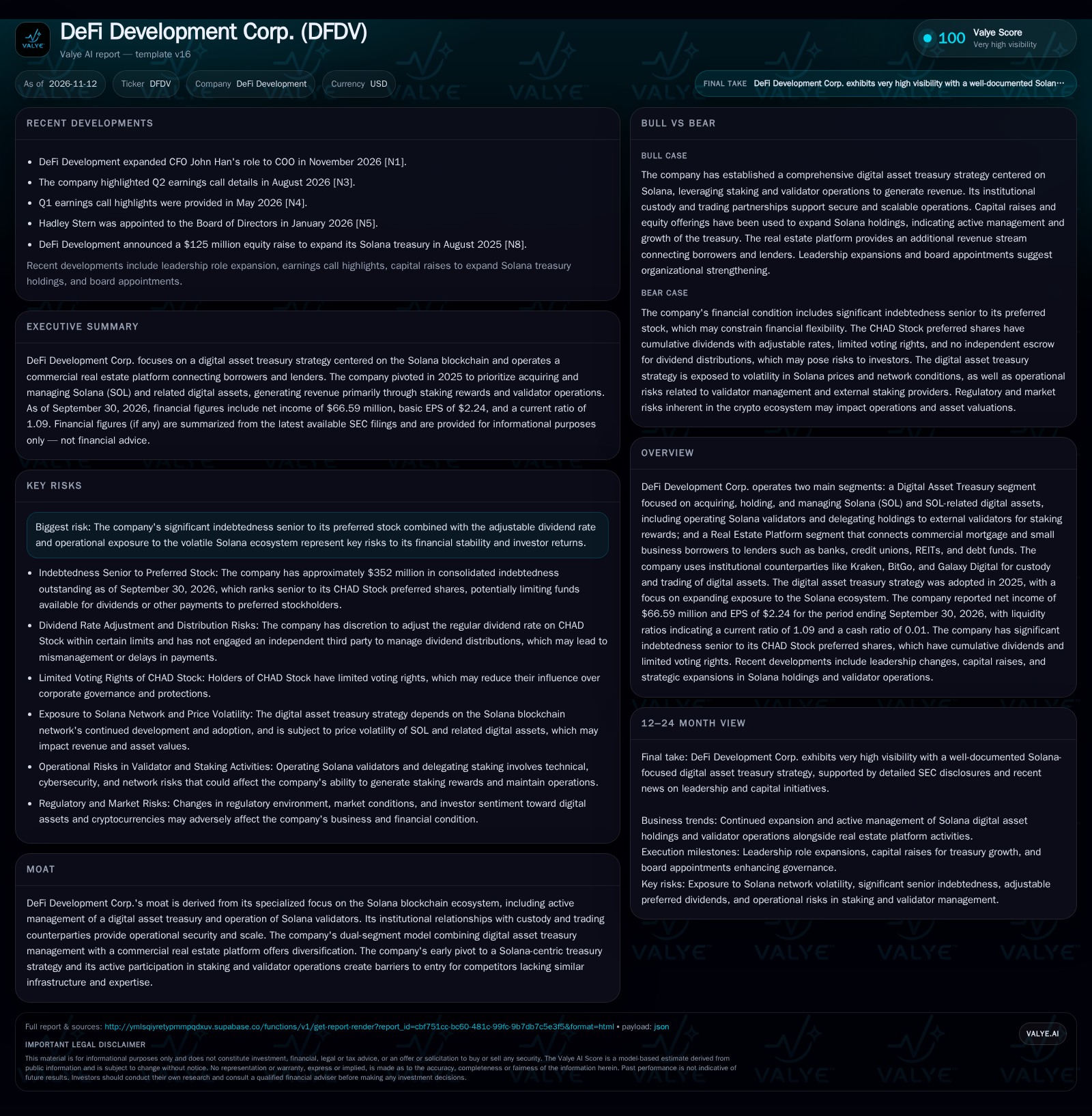
DeFi Development Corp. has reoriented around a Solana-focused digital asset treasury, generating income through staking and validator operations, while also running a commercial real estate lending platform. The company’s reported profitability is notable, but its capital structure—marked by sizable senior indebtedness and high-dividend preferred stock—creates both opportunity and risk. The core thesis hinges on the persistence of Solana’s network economics, the scalability of validator-driven rewards, and the ability to manage leverage amid crypto volatility and regulatory uncertainty. [S1] [S2]
DeFi Development Corp.’s transformation into a Solana-focused digital asset treasury operator has yielded eye-catching profitability, but the underlying business model is deeply intertwined with the mechanics and risks of blockchain staking, validator economics, and the volatile digital asset market. With more than $350 million in senior debt and high-yield preferred equity, the company’s ability to sustain and grow returns now depends as much on prudent capital management and the health of the Solana ecosystem as on its own execution. The interplay of validator rewards, leverage, and diversification through a commercial real estate platform sets up a complex risk-reward equation for investors and operators alike.
Recent Financial Performance and Strategic Shifts: What’s Changed at DeFi Development?
DeFi Development Corp. reported net income of $66.59 million and basic earnings per share of $2.24 for the period ending September 30, 2026, reflecting the impact of its strategic pivot toward a Solana-centric digital asset treasury. This profitability coincided with the expansion of its SOL holdings—funded in part by a $125 million equity raise announced in August 2025—and ongoing operation of Solana validators to generate staking rewards. The company reported cash and liquidity metrics for the period; these figures do not by themselves establish operating runway, investment capacity, financial flexibility, or financing capacity. The real estate platform, while still operational, is now secondary to the digital asset treasury in strategic focus. These facts underscore a business model that is capital-intensive, yield-driven, and highly sensitive to both crypto market dynamics and capital structure constraints. [S1] [S2] [N8]
How Staking, Validator Operations, and Capital Structure Shape Earnings Power
DeFi Development’s primary economic engine is the acquisition and management of Solana (SOL) and SOL-derivative assets, which are staked via both owned and delegated validators to earn protocol rewards. Staking yields in proof-of-stake blockchains like Solana can be attractive but are inherently variable, influenced by network inflation, validator performance, and overall chain participation rates. The company’s operating leverage is high: incremental SOL staked through company-run or third-party validators can generate outsized marginal returns, so long as network economics remain favorable and operational uptime is maintained.
However, the business also carries substantial fixed obligations. The $352 million in consolidated debt and the 13% cumulative dividend on CHAD Stock create a significant capital servicing burden.
The commercial real estate platform provides some diversification, connecting borrowers with lenders and potentially generating fee income. However, unless this segment scales meaningfully, it is unlikely to offset the core risks inherent in the digital asset treasury model.
Solana Ecosystem Focus: Barriers, Counterforces, and Substitution Risks
DeFi Development’s moat is predicated on early, concentrated investment in the Solana ecosystem, with the technical and operational infrastructure to run validators and manage significant SOL positions. Institutional custody and trading partnerships with firms like Kraken, BitGo, and Galaxy Digital enhance security and credibility, potentially lowering operational risk compared to less sophisticated peers.
Nonetheless, entry barriers in the validator and staking space are eroding as institutional-grade custody and white-label validator solutions proliferate. Many financial entities can now access SOL staking yields without building custom infrastructure, compressing potential margins and threatening differentiation. Substitution risk is material: if alternative proof-of-stake chains offer superior yields, security, or regulatory clarity, capital could migrate away from Solana, eroding the value of DeFi Development’s focused strategy.
Additionally, the real estate platform faces competition from a broad array of fintechs, banks, and digital lending marketplaces. Unless DeFi Development can create a compelling network effect or integrate digital asset financing functionality, this segment may struggle to deliver outsized returns or strategic differentiation.
What Could Unlock Outsized Returns? Sustained SOL Outperformance and Validator Scaling
A favorable scenario would see Solana’s market value and network activity continue to grow, with staking rewards remaining robust and validator economics improving through increased transaction throughput or network upgrades. In this environment, DeFi Development’s expanded SOL treasury and validator operations could generate compounding returns, supporting both debt service and preferred dividends while enabling further asset accumulation.
Confirmation of this scenario would require evidence such as: persistent or rising SOL staking yields; network upgrades that boost validator profitability or security; continued growth in DeFi activity on Solana; and the company’s ability to expand validator capacity or secure additional institutional partnerships. Additional upside could come from successful scaling of the real estate platform, especially if it integrates digital asset collateralization or blockchain-based lending rails.
Falsification would come from a sustained decline in SOL price and staking yields, operational setbacks in validator uptime or network participation, or deterioration in capital markets access (e.g., inability to refinance debt or raise equity at reasonable terms).
Sustaining Returns Amid Crypto Cyclicality and Fixed Financial Obligations
The most plausible forward trajectory is a business that remains highly sensitive to Solana’s price and staking economics, with periodic volatility in reported earnings as crypto markets fluctuate. Staking rewards and validator income may remain positive but could exhibit year-to-year variability, creating lumpy cash flows. The company’s fixed capital obligations—particularly debt service and cumulative preferred dividends—will consume a significant share of operating income, limiting flexibility.
The real estate platform provides some ballast, but unless it achieves breakout scale, it is unlikely to fundamentally alter the risk profile. Over time, DeFi Development may need to rebalance its asset mix, pursue additional capital raises, or explore hedging strategies to manage crypto volatility. This scenario would be confirmed by continued, albeit variable, net income; periodic equity or debt issuance; and a stable or gradually expanding validator footprint.
This path would be challenged if digital asset liquidity dries up, if regulatory changes restrict staking operations, or if competition compresses validator margins.
How Crypto Volatility and Capital Structure Could Undermine the Model
The adverse scenario is one where Solana experiences a severe price correction or technical setbacks, driving down the value of DeFi Development’s treasury and slashing staking rewards. If validator economics deteriorate—due to network attacks, slashing events, or underperformance—the company’s core revenue stream could collapse, potentially forcing asset sales at distressed prices to meet fixed obligations.
Given the reported cash ratio and heavy reliance on non-cash digital assets, a liquidity crunch could quickly escalate if counterparties restrict withdrawals or if market liquidity evaporates. The capital structure amplifies downside risk: $352 million in senior indebtedness and high-yield preferreds could leave little residual value for common shareholders in a stress scenario.
Downside confirmation would include a sharp drop in SOL price and network activity, negative net income, breaches of debt covenants, or missed preferred dividend payments. Regulatory shocks—such as new staking restrictions or adverse tax treatment—could further accelerate losses.
Milestones That Could Validate or Challenge DeFi Development’s Digital Asset Thesis
Sustained or rising SOL staking yields and the company’s disclosed validator uptime/performance metrics—if reported—would help validate the economic engine.
Changes in the reported value and composition of the digital asset treasury, especially the proportion held in liquid versus locked or staked assets, would clarify liquidity risk.
Evidence of successful scaling or integration of the real estate platform—such as reported revenue growth, new lending partnerships, or digital asset collateralization—would indicate diversification progress.
Updates on debt refinancing, additional equity raises, or changes to the capital structure would signal ongoing access to capital markets and management’s ability to manage leverage.
Regulatory disclosures or material developments related to blockchain staking, digital asset custody, or tax treatment would represent key exogenous risk factors.
A useful metric would be the company’s realized yield on digital asset holdings, net of validator operating costs, to assess true underlying profitability.
Disclaimer: This is research-only, informational analysis and not investment advice. It may include AI-generated interpretation and general industry context. Always verify important details using primary sources.

Comments