
Dover Corporation: Navigating Industrial Diversification Amid Digital Transformation and Market Cyclicality
Dover Corporation leverages a diversified industrial portfolio and digital innovation to drive operational resilience despite cyclical headwinds and debt challenges.
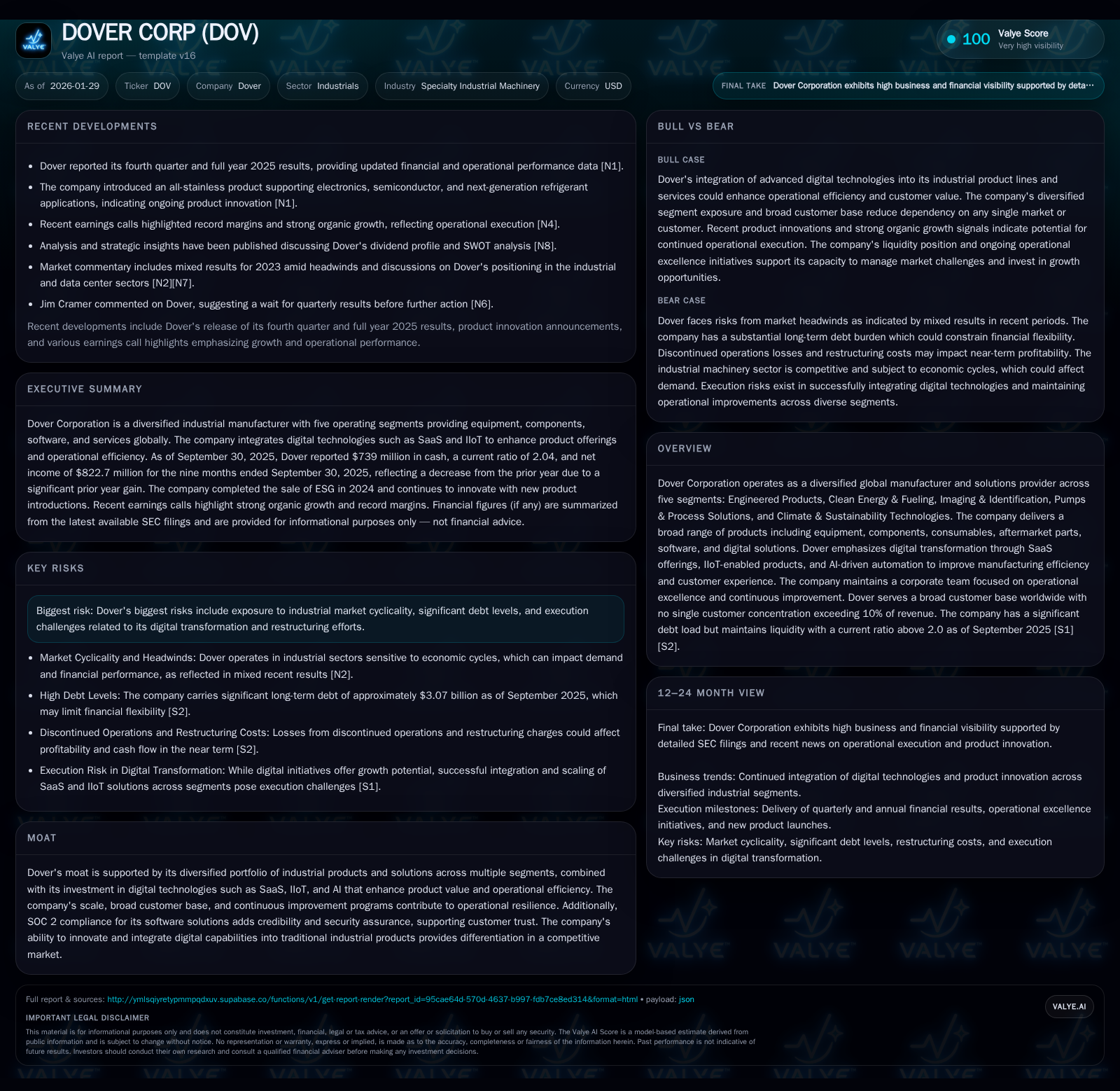
Dover Corporation operates a diversified portfolio across five industrial segments, integrating digital technologies such as SaaS, IIoT, and AI to enhance product offerings and operational efficiency. Recent earnings reports indicate record margins and strong organic growth, although some segments experienced revenue softness due to market cyclicality. The company maintains a solid liquidity position despite a significant debt load, supported by operational excellence initiatives. Competitive dynamics remain intense across specialty machinery markets, with Dover's digital transformation and broad customer base serving as key differentiators.
What Changed Recently
Dover Corporation’s latest quarterly earnings reports for Q3 and Q4 2025 revealed record operating margins and robust organic growth, underscoring the effectiveness of their operational excellence programs and digital transformation initiatives [N1][N2][N11]. Despite broad positive momentum, the Climate & Sustainability Technologies segment experienced a 5.2% revenue decline in Q3 2025, reflecting ongoing industrial market cyclicality [S8]. Strategic acquisitions continue to play a role, with Dover adding eight businesses in 2024, expanding its portfolio and technology base [S14]. Capital expenditures have been moderated yet remain dedicated to growth and innovation [S14]. These developments portray a company balancing growth and margin expansion amid challenging market conditions.
Business Model as a System
Dover operates as a diversified global manufacturer and solutions provider across five primary segments: Engineered Products, Clean Energy & Fueling, Imaging & Identification, Pumps & Process Solutions, and Climate & Sustainability Technologies [S1]. Each segment delivers a combination of equipment, components, consumables, aftermarket parts, software, and digital offerings, targeting a broad array of industrial customers worldwide. No single customer accounts for more than 10% of total revenue, reducing concentration risk [S1].
The company’s business model integrates traditional industrial manufacturing with a growing emphasis on digital solutions, including SaaS platforms, Industrial Internet of Things (IIoT) enabled products, and AI-driven automation tools to optimize manufacturing efficiency and enhance customer experience [S1]. This dual model serves to differentiate Dover from competitors by adding value beyond hardware sales through recurring software revenues and data-driven service offerings.
Supporting this multi-faceted model is a corporate team focused on operational excellence and continuous improvement, which drives margin expansion and productivity gains. Dover also pursues strategic acquisitions to complement organic growth and technology advancement, evidenced by recent business additions [S14]. Capital allocation balances between acquisitions, organic investment in productivity and product development, and debt management [S14][S10].
Industry Map & Competitive Battlefield
Dover operates within the specialty industrial machinery sector, a fragmented and competitive landscape comprising manufacturers focused on niche industrial equipment and technology solutions. Key competitors range from large diversified industrial conglomerates to smaller specialized players.
Competitive dynamics are shaped by factors such as product innovation, integration of digital technologies, customer service excellence, and geographic reach. Dover’s emphasis on digital transformation—including SaaS, IIoT, and AI—positions it to capture value in an industry increasingly focused on smart manufacturing and automation [S1]. Compliance with security standards like SOC 2 for software solutions bolsters customer trust in digital offerings.
Market cyclicality remains a persistent challenge, with demand in end-markets influenced by macroeconomic conditions, capital spending cycles, and sector-specific dynamics. Dover’s diversified segment exposure helps mitigate some cyclicality risks but does not eliminate sensitivity, as noted in the recent revenue softness in Climate & Sustainability Technologies [S8].
Acquisition strategy is a key competitive tool to gain scale, expand technology capabilities, and enter adjacencies. Dover’s recent acquisition of eight businesses in 2024 reflects active portfolio management to maintain competitiveness [S14].
Where the Economics Become Real
At the unit level, Dover’s economics hinge on a mix of product sales and recurring revenues from aftermarket parts and digital services. Margins benefit from operational excellence programs that drive manufacturing productivity and supply chain efficiencies, as well as from higher-margin digital offerings [N1][S1].
Capital expenditures have been adjusted downward from prior years but remain focused on supporting growth initiatives, productivity improvements, and new product launches, indicating disciplined capital allocation [S14].
Dover’s debt profile is significant, including long-term notes with interest rates ranging from 0.75% to 5.375%, maturing between 2026 and 2041, and revolving credit facilities expiring by 2028. Despite this leverage, the company maintains liquidity with a current ratio exceeding 2.0, supported by cash and equivalents and sound working capital management [S10][S12]. Interest coverage requirements are in place under credit agreements, imposing financial discipline [S10].
Revenue growth drivers include organic expansion in end-markets and digital transformation uptake, though offset partially by cyclical downturns in some segments. Margin expansion is supported by scale, digital integration, and continuous improvement initiatives [N1][S1].
Diligence Questions / Disconfirming Signals
- To what extent can Dover execute on its digital transformation agenda across all segments without disrupting legacy operations or incurring excessive costs?
- How sustainable are the recent record margins given ongoing industrial market cyclicality and potential inflationary pressures on costs?
- What is the risk profile related to Dover’s significant debt load, particularly as some notes mature in the near term (2026, 2027)?
- How effectively can Dover integrate acquisitions to drive synergy and avoid dilution of focus?
- Are there signs of customer hesitation or competitive displacement in key segments due to emerging technologies or alternative suppliers?
- How resilient is the company’s broad customer base amidst macroeconomic uncertainties and sector-specific downturns?
- Does the company’s focus on compliance and security for software solutions translate into meaningful competitive advantage or customer retention?
Disclaimer: This analysis is based on publicly available information and industry context as of early 2026. It is not investment advice and does not constitute a recommendation to buy or sell any securities. The presented information may evolve with new data or market conditions.

Comments