
Dover Corp: Navigating Specialty Industrial Machinery with Strategic Growth and Operational Discipline
Dover Corp leverages a diversified portfolio in specialty industrial machinery, underpinned by recurring revenue streams and strategic acquisitions amid industry cyclicality.
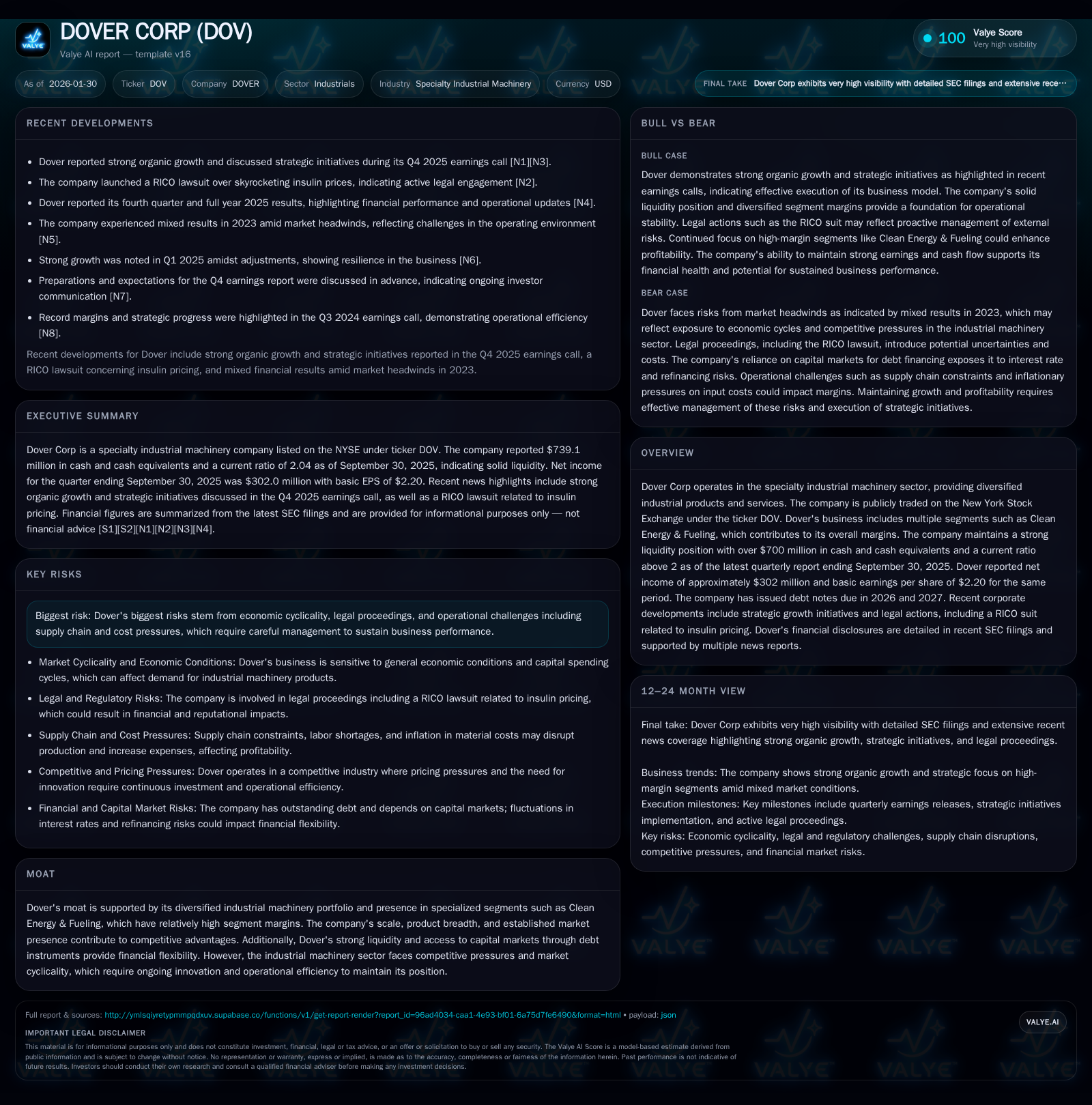
Dover Corp continues to demonstrate resilience through strong organic growth and record segment margins supported by its diversified industrial machinery portfolio. Recent earnings highlighted robust cash flow and a solid liquidity position, enabling ongoing capital deployment into acquisitions and innovation. The firm’s operations are balanced across multiple niche markets, with recurring revenue from consumables and services providing margin stability. However, cyclicality, evolving competitive pressures, and legal risks, including a recently filed RICO lawsuit, present ongoing challenges requiring vigilant management.
What changed recently
Dover Corp reported Q4 and full-year 2025 results marked by strong organic revenue growth and record segment margins, beating analyst expectations and fueling positive investor sentiment [N1][N3][N14]. The company emphasized strategic growth initiatives across its diversified specialty machinery segments, including Clean Energy & Fueling, which continues to deliver relatively high margins [N2]. Financially, Dover maintains a strong liquidity profile, with over $700 million in cash and equivalents and a current ratio exceeding 2, supporting both operational needs and acquisition funding [N4][S12].
Notably, Dover filed a RICO lawsuit addressing skyrocketing insulin prices, signaling a new legal front that could have financial and reputational implications [N10]. The company’s strategic capital allocation remains focused on disciplined acquisitions, having deployed $635 million in 2024 to acquire eight businesses, supplementing organic gains [S4]. Capital expenditures were reduced moderately year-over-year to $167.5 million in 2024, reflecting calibrated investments in growth and productivity [S4].
Business model as a system
Dover’s business model operates as a diversified industrial machinery platform spanning several specialized segments, including Clean Energy & Fueling, Imaging & Identification, Pumps & Process Solutions, and Climate & Sustainability Technologies. This segmentation enables tailored exposure to multiple niche markets with unique growth dynamics and margin profiles [S1][S3].
A significant feature is Dover’s recurring revenue stream, which encompasses parts, consumables, services, and software, accounting for roughly 36% of total revenue. This recurring portion stabilizes revenue volatility typical in capital equipment sales, supporting margin resilience [S1]. The company’s products derive ongoing demand from a large installed base, creating embedded customer relationships that drive aftermarket sales.
Dover emphasizes attractive niche markets characterized by proven long-term growth trends, mature but incrementally improving technologies, and favorable supplier and customer dynamics. The company’s scale and product breadth provide competitive advantages, with specialized engineering capabilities and customer loyalty underpinning its market positions [S1].
Capital deployment is dual-pronged: organic investments in R&D and productivity enhancements, alongside strategic acquisitions to broaden technological capabilities and market reach. Capital expenditures have been managed prudently, declining from $211 million in 2022 to $167.5 million in 2024, aligned with growth initiatives [S4]. Acquisitions have been a material contributor to growth, with Dover investing heavily in recent years to supplement organic momentum [S4][S6].
Financially, Dover maintains a conservative liquidity and capital structure profile, with cash and equivalents over $700 million and a current ratio above 2, supported by access to commercial paper markets and debt instruments maturing in 2026 and 2027 [S12][N4]. Dividend payments have grown modestly, reflecting stable cash flow generation [S13].
Industry map & competitive battlefield
Dover operates within the specialty industrial machinery sector, which is characterized by technology-driven product differentiation, high aftermarket revenue potential, and cyclical end markets. The company’s niche segments—such as Clean Energy & Fueling—are evolving rapidly due to sustainability trends and regulatory pressures, creating both opportunities and competitive pressures.
Competition is fragmented, with players ranging from large diversified industrial conglomerates to specialized equipment manufacturers. Dover’s scale and diversified portfolio provide some insulation against cyclical downturns, but the company must continuously innovate to maintain technological relevance and defend market share.
Globalization complicates the competitive landscape, with approximately 46% of revenue generated outside the U.S., exposing Dover to currency fluctuations, geopolitical risks, and differing regulatory regimes [S5]. Supply chain constraints and cost inflation remain industry-wide challenges, pressuring margins and requiring operational agility.
The company’s focus on recurring revenue segments and installed base monetization differentiates it from competitors overly reliant on new equipment sales. This recurring revenue stream tends to generate higher margins and more predictable cash flow, bolstering Dover’s financial stability [S1].
Where the economics become real
Unit economics hinge on several factors: initial equipment sales, aftermarket parts and consumables, and services. The installed base drives recurring revenue, which commands higher margins due to lower capital intensity and the captive customer relationship [S1]. Approximately 36% of revenue derives from these recurring streams, which likely contribute disproportionately to operating profit margins.
Segment margins vary, with Clean Energy & Fueling and Pumps & Process Solutions showing stronger profitability (segment earnings margins around 30%) compared to more cyclical or lower-margin segments [S7]. Pricing power is supported by technological differentiation and customer lock-in via consumables and services.
Capital allocation is critical. Acquisitions have been a key growth driver, but integrating these businesses while extracting synergies and maintaining margin discipline is a complex operational challenge [S4]. Capital expenditures support both growth and productivity improvements but have been moderated recently to preserve free cash flow.
Liquidity and capital structure support operational flexibility. With significant cash on hand and manageable debt maturities, Dover is positioned to fund acquisitions and sustain dividend growth, though economic cyclicality and legal contingencies remain risks [S12][N10].
Diligence questions / disconfirming signals
- How effectively can Dover integrate recent acquisitions to deliver expected synergies and avoid margin dilution?
- Given the cyclicality of industrial machinery, how resilient are Dover’s recurring revenue streams during economic downturns?
- What is the potential financial and reputational impact of the RICO lawsuit related to insulin pricing on Dover’s broader business?
- How exposed is Dover to supply chain disruptions and cost inflation, and what operational levers exist to mitigate these pressures?
- To what extent can Dover sustain margin expansion amid intensifying competition and evolving technological demands in niche markets?
- How will foreign currency and geopolitical risks affect the approximately 46% of revenue generated outside the U.S.?
- What are the risks associated with cybersecurity and data protection given Dover’s global operations and technology integration?
Conclusion
Dover Corp’s profile as a diversified specialty industrial machinery company positions it well within attractive niche markets supported by recurring revenues and strategic acquisitions. Recent earnings demonstrate strong operational execution and margin improvement, backed by solid liquidity and disciplined capital deployment. Nonetheless, the company operates in a challenging environment marked by economic cyclicality, supply chain constraints, competitive pressures, and emerging legal risks. Ongoing diligence on integration execution, margin sustainability, and risk management will be essential to understand Dover’s trajectory.
This analysis is based solely on publicly available information and does not constitute investment advice. Readers should conduct their own independent research or consult with professional advisors.
Disclaimer: This is research-only, informational analysis and not investment advice. It may include AI-generated interpretation and general industry context. Always verify important details using primary sources.

Comments