Neurocrine Biosciences: Pioneering Treatments in Neurology and Endocrinology Amidst Developmental Risks
Focused innovation and targeted commercialization underpin Neurocrine’s expanding footprint in rare neurological and endocrine diseases.
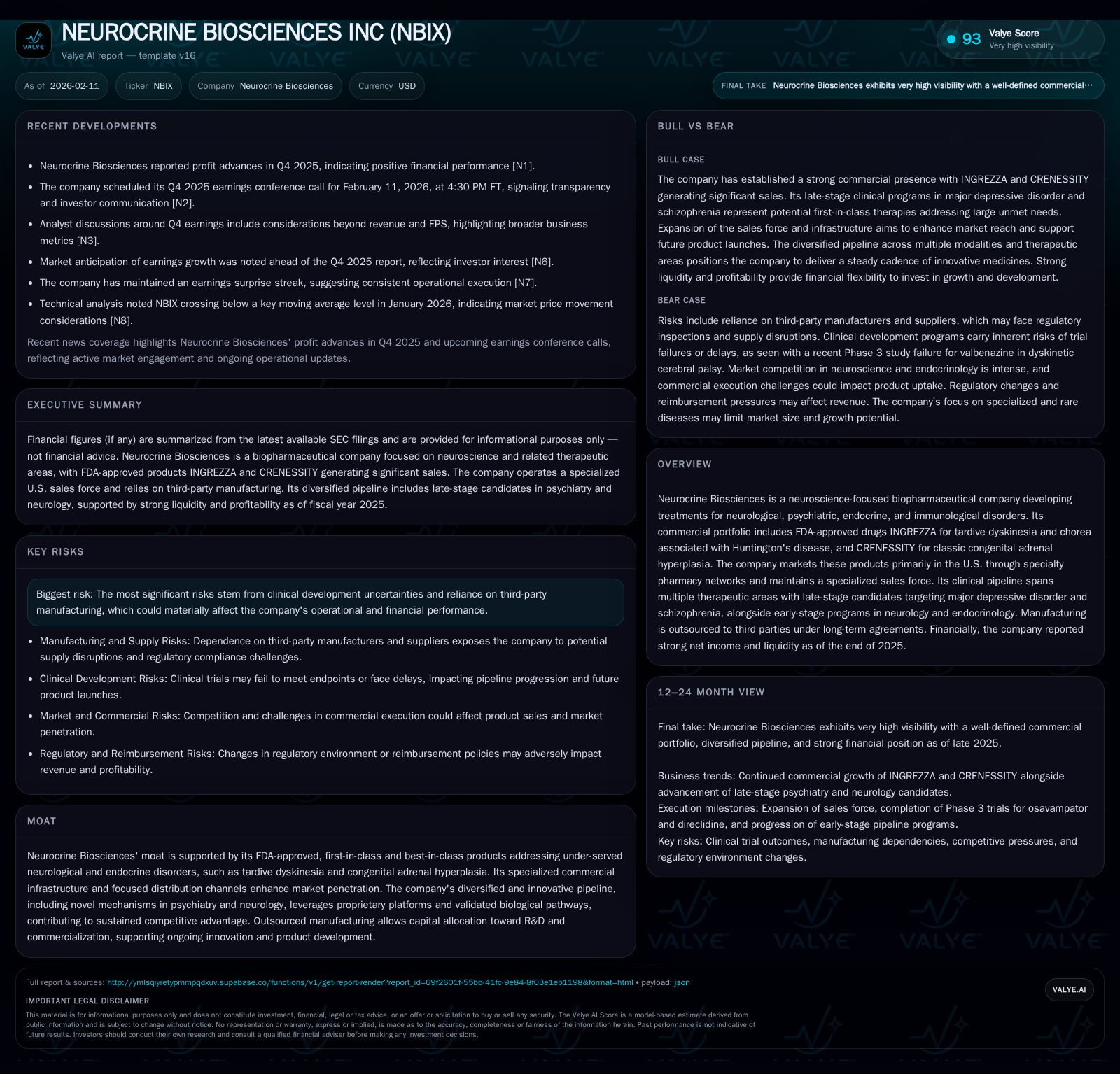
Neurocrine Biosciences deploys a mission-driven strategy centered on treating under-served neurological, psychiatric, and endocrine disorders. Its flagship drugs INGREZZA and CRENESSITY demonstrate strong commercial performance fueled by specialty-focused sales and distribution models. The company’s robust pipeline advances late-stage candidates for major depressive disorder and schizophrenia, while financial health provides solid support for ongoing R&D investments. However, reliance on third-party manufacturing and clinical trial uncertainties represent meaningful operational risks that require active management.
Mission-Driven Innovation: Relieving Neurological and Endocrine Burdens
Neurocrine Biosciences positions itself uniquely within biopharma with an unwavering dedication to addressing significant unmet needs in neurological, psychiatric, endocrine, and immunological disorders [S1]. The company’s declared purpose—relieving suffering for populations frequently overlooked by mainstream drug development—manifests across its focused product portfolio and research efforts. This is not merely an abstract mission statement; it reflects a strategic commitment to tackle complex diseases such as tardive dyskinesia (TD), Huntington’s disease-related chorea, and congenital adrenal hyperplasia (CAH) through novel mechanisms of action.
TD alone affects an estimated 800,000 Americans, while nearly 90% of Huntington’s disease patients develop chorea symptoms [S1]. Meanwhile, CAH impacts at least 20,000 people nationwide. These sizable patient populations underscore both the social imperative and commercial rationale driving Neurocrine's innovation engine. By choosing to develop first-in-class or best-in-class agents targeting these conditions, the company stakes a claim on therapeutic areas historically sparse in effective treatments.
The significance of this approach lies not only in compassionate care but also creating scientific differentiation in crowded biotech landscapes. Neurocrine emphasizes advancing understanding of vesicular monoamine transporter 2 (VMAT2) biology—a pathway integral to their leading compounds—and applying insights across new indications [S1]. This blend of targeted science with clear patient-centric goals forms the cornerstone of their moat.
Key takeaway: Neurocrine Biosciences aligns cutting-edge neuroscience research with an ethical mission targeting underserved disorders, carving a distinctive niche that underpins its innovation strategy.
Flagship Products Driving Market Leadership: INGREZZA and CRENESSITY
At the heart of Neurocrine’s commercial success lie two FDA-approved therapeutics: INGREZZA (valbenazine) and CRENESSITY (crinecerfont). INGREZZA serves as the first FDA-approved treatment for TD since its initial U.S. launch in 2017 and received expanded approval for chorea associated with Huntington's disease in August 2023 [S1]. Its therapeutic effect targets VMAT2 inhibition, mitigating involuntary movements that drastically impair quality of life.
Financially, INGREZZA remains a powerhouse — generating $2.51 billion in net product sales during 2025 alone—a steady increase from $2.31 billion in 2024 and $1.84 billion in 2023 [S1][F1]. These robust numbers reflect both growing prescription volumes driven by consistent patient demand and strategic pricing measures balanced against market access investments.
CRENESSITY marks an important expansion into endocrinology following its December 2024 FDA approval as a treatment for classic CAH [S1]. Despite being relatively nascent commercially, it secured $301 million in net product sales for its first full calendar year [S1][F1], signaling promising market acceptance given the rare disease context.
These products benefit enormously from focused specialty pharmacy distribution models—INGREZZA dispensed through limited U.S.-based specialty providers with controlled supply chains; CRENESSITY offered exclusively through a single specialized distributor due to its rarity profile [S1]. Furthermore, Neurocrine supports these channels with an approximately 600-strong specialized sales force skilled across neurology, psychiatry, rare diseases, and long-term care sectors [S1].
In October 2025, recognizing growing demand dynamics, the company announced plans to expand these sales teams even further by Q1 2026 with the goal of maximizing market penetration [S1]. This disciplined go-to-market approach bolsters pricing power amidst evolving payer landscapes while ensuring high-touch patient engagement.
Key takeaway: INGREZZA’s sustained blockbuster status alongside CRENESSITY’s rapid uptake illustrate Neurocrine's capacity to translate clinical breakthroughs into substantial commercial leadership within niche therapeutic segments.
Pipeline Ambitions: From Late-Stage Trials to Next-Gen Therapeutics
Looking beyond marketed drugs, Neurocrine’s pipeline embodies strategic breadth anchored by late-stage assets targeting major neuropsychiatric disorders such as schizophrenia and major depressive disorder (MDD). Notably, direclidine (NBI-1117568), a next-generation compound modulating NMDA receptor activity implicated in psychosis pathophysiology, entered an extensive Phase 3 program encompassing acute efficacy studies in hospitalized schizophrenia patients alongside long-term safety assessments [S1]. Additionally, Phase 2 exploration is underway for bipolar mania indications.
Osavampator (NBI-1065845), another Phase 3 focus candidate, pursues MDD treatment through glutamatergic modulation designed to address inadequacies of conventional antidepressants [S1]. These programs highlight a diversified portfolio extending VMAT2-centered paradigms into complementary neurobiology avenues.
Early-stage research complements this activity with investigative agents like NBI-1065890—a selective VMAT2 inhibitor—in Phase 2 trials for TD patients aiming to refine efficacy or tolerability profiles relative to valbenazine [S1]. Furthermore, efforts persist toward endocrinological innovation exemplified by NBIP-01435 targeting corticotropin-releasing factor receptors via subcutaneous injection modalities.
Collectively, this rich developmental pipeline aligns with the company's ambition to sustain competitive advantage by integrating proprietary biological insights with varied therapeutic modalities—small molecules, peptides, antibodies, gene therapies—that reflect contemporary biotech trends without deviating from core neuroscience expertise [S1].
Key takeaway: Neurocrine leverages scientific depth and modality diversity across psychiatry and endocrinology pipelines, reinforcing its position as an innovator committed to addressing both prevalent mental health conditions and rare diseases.
Commercial Strategy: Focused Specialty Sales and Distribution Channels
Neurocrine’s commercialization model relies heavily on curated specialty pharmacy partnerships coupled with an expert salesforce tailored specifically to the unique demands of neurological and rare endocrine diseases [S1]. This combination facilitates tight control over supply chain integrity while enabling nuanced educational outreach necessary for complex patient populations requiring ongoing clinical monitoring.
The limited distribution strategy mitigates generic competition impact by constraining unauthorized channel proliferation. It simultaneously allows premium pricing afforded by demonstrated clinical benefits combined with reimbursement navigated through payers familiar with specialty pharma dynamics. Moreover, specialty pharmacists provide critical adherence support services that improve real-world outcomes—an increasingly important metric influencing formulary positioning.
By continually expanding sales capabilities—with approximately 600 representatives covering neurology-related specialties as of year-end 2025—the company aims to deepen engagement among neurologists, psychiatrists, endocrinologists, long-term care providers, and specialty pharmacies alike [S1]. The planned expansion finalized by early 2026 underscores management's commitment toward scaling commercial resources aligned tightly with pipeline maturation timelines.
Key takeaway: A proprietary commercial infrastructure combining specialized distribution with a knowledgeable field force sustains market leadership by fostering payer relationships and enhancing patient access amidst potential biosimilar encroachment risks.
Financial Strength Underpinning Growth and R&D Investment
From a fiscal perspective, Neurocrine demonstrates solid financial footing highlighted by a $478.6 million net income reported for full-year 2025 supported by strong revenue growth primarily from INGREZZA and CRENESSITY sales [F1][S1][N8]. The company holds approximately $713 million cash and cash equivalents alongside current assets totaling about $2.52 billion versus current liabilities near $743 million—yielding a healthy current ratio near 3.39 indicative of liquidity designed to fund ongoing operations comfortably [F1].
These resources underpin aggressive reinvestment into research activities fueling the pipeline as well as measured capital return strategies evidenced by substantial share repurchase authorizations totaling up to $800 million spanning late-2024 through 2025 programs completed or underway [S1]. Such repurchases signal confidence from management about valuation alongside intentions to optimize capital structure while maintaining flexibility around innovation spend.
This balance between growth orientation via R&D expenditure—focusing on late-phase clinical trials—and prudent capital allocation supports sustainability amid competitive pressures that characterize biotechnology markets generally [N8].
Key takeaway: Neurocrine’s robust profitability combined with sound liquidity offers financial resilience enabling continued investment in transformative science alongside strategic shareholder value initiatives.
Navigating Manufacturing Dependencies and Clinical Development Challenges
Despite clear strengths in pipeline innovation and commercialization prowess, operational vulnerabilities persist notably around outsourcing manufacturing functions critical to drug production.[S1][S2] Reliance on third-party manufacturers subjects Neurocrine to supply chain risks including capacity constraints or quality compliance deviations that could disrupt product availability or inflate costs unexpectedly.
Additionally inevitable clinical development uncertainties pose material downside risks given typical high attrition rates characteristic of central nervous system disorders drug discovery.[S1] Delays or failures in pivotal trials such as those ongoing for direclidine or osavampator could impair anticipated revenue streams extrapolated from successful launches.
To mitigate these exposures management maintains contractual agreements with long-term manufacturing partners ensuring prioritized capacity access whenever possible.[valye_report_excerpt] Simultaneously disciplined trial design coupled with adaptive study protocols strives to optimize probability of success while proactively managing regulatory dialogue.[S1]
Key takeaway: While third-party manufacturing dependencies introduce complexity alongside inherent clinical trial risk factors typical within biotech sectors, proactive mitigation approaches remain essential components of operational risk management frameworks at Neurocrine.
Recent Performance & Market Sentiment: Earnings Beat and Analyst Expectations
In Q4 2025 reporting released February 11th along with the associated earnings call ([N1],[N8]), Neurocrine outperformed consensus estimates driven largely by ongoing strength in INGREZZA prescriptions paired with initial revenue contributions from CRENESSITY adoption. Profit margins improved amid favorable cost management despite increased investment behind expanding commercialization efforts supporting forecasted future growth.[N8]
Conversely technical trading patterns capture caution; shares crossing below key moving averages earlier this year denote hesitancy possibly linked to broader macro volatility or valuation recalibration given evolving pipeline milestones horizons ([N9]). Market participants appear balancing enthusiasm over demonstrated top-line delivery against inherent risks related to late-stage data outcomes yet undisclosed fully publicly.[N7],[N6]
Analysts maintain cautiously constructive sentiment emphasizing potential upside contingent upon successful Phase 3 readouts anticipated over upcoming quarters along with realization of expanded market access strategies principally targeting Medicare beneficiary coverage improvements noted recently ([N2]).
Key takeaway: Neurocrine’s latest earnings persistence amidst investor circumspection captures the delicate equilibrium biotech firms must navigate between demonstrated commercial traction and uncertainty embedded within developmental timelines.
Forward Outlook: Balancing Expansion with Risk Management
Looking ahead into mid-to-late 2026 horizon,[S1],[valye_report_excerpt],[N4],[N6] management explicitly plans accelerated hiring completing sales team growth by end Q1 aimed at maximizing reach across existing approved indications plus forthcoming opportunities derived from clinical progressions. Continued dedication toward understanding VMAT2 biology remains central theme guiding therapeutic expansion potentially offering incremental new indications or combination regimens enhancing competitive defensibility.
Nevertheless vigilance concerning clinical trial results remains paramount given potential binary outcomes radically impacting valuation trajectories common within biotech sector narratives.[S1] Persistent monitoring around vendor manufacturing capacity reliability forms another crucial facet warranting attention since any disruption could defer revenue recognition cycles jeopardizing short-term financial targets.
Strategic agility combining rigorous science-driven innovation alongside disciplined commercial execution shall determine how well Neurocrine capitalizes on current momentum while mitigating hazards intertwined inevitably within pharmaceutical development landscapes.[valye_report_excerpt]
Key takeaway: The forward pathway integrates methodical commercial scaling paired with measured risk oversight as Neurocrine seeks sustainable growth amid intrinsic industry challenges inherent to novel CNS/endocrine therapeutics development.
Disclaimer: This analysis is based on publicly available information as of February 11, 2026. It does not constitute investment advice or recommendations but aims solely at providing a detailed examination of Neurocrine Biosciences’ business operations within its industry context.
Disclaimer: This is research-only, informational analysis and not investment advice. It may include AI-generated interpretation and general industry context. Always verify important details using primary sources.

Comments