
Eagle Financial Services: Navigating the Regional Bank Landscape with Diversified Loan Exposure
Eagle Financial Services remains a regionally focused bank balancing loan portfolio diversification and credit quality amid earnings pressures.
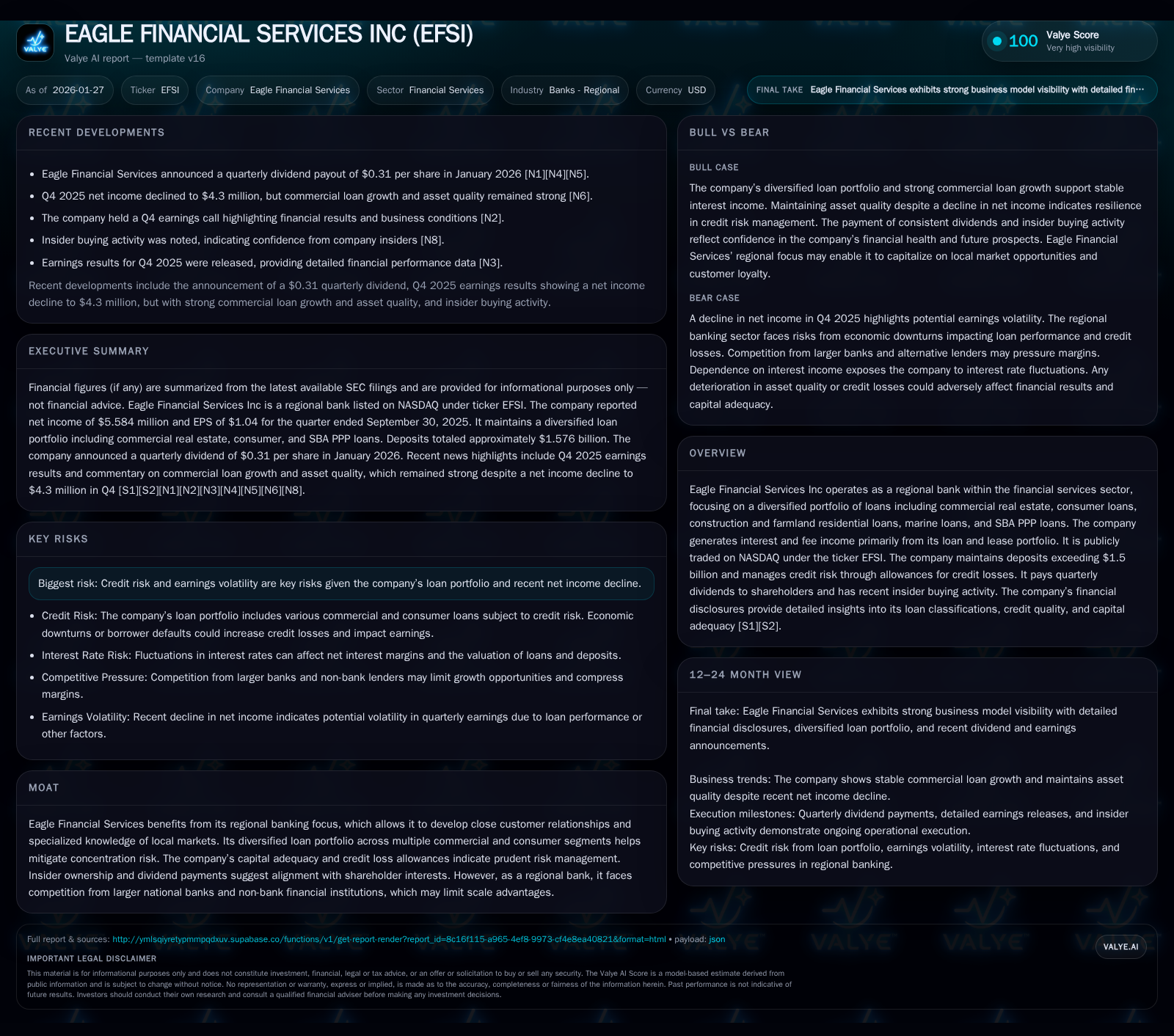
Eagle Financial Services Inc operates as a regional bank with a diversified loan portfolio spanning commercial real estate, consumer, construction, and specialized loans like marine and SBA PPP. Recent quarterly results revealed a net income decline despite stable commercial loan growth and asset quality. The company’s business model centers on interest and fee income from loans and leases, supported by prudent credit loss allowances and capital adequacy measures. Competition from larger banks and non-bank lenders poses strategic challenges, while insider buying and dividend payouts indicate management’s alignment with shareholders.
What Changed Recently
Eagle Financial Services reported its Q4 2025 earnings with a net income of $4.3 million, falling short of analyst expectations and marking a decline compared to prior quarters [N3][N9]. Despite this earnings setback, the company saw continued growth in its commercial loan segment and preserved strong asset quality metrics. The earnings call highlighted cautious optimism around loan growth opportunities but acknowledged pressures from a challenging credit environment and margin compression [N2]. Additionally, the company declared a quarterly dividend of $0.31 per share, consistent with prior payouts, reflecting stable capital management and shareholder value focus [N5][N6]. Insider buying activity was notable, with executives acquiring over $500,000 worth of stock, suggesting management’s confidence in the company’s strategic positioning despite earnings headwinds [N11][N12].
Business Model as a System
Eagle Financial Services operates primarily as a regional bank, generating revenue through interest and fee income derived from a diversified loan and lease portfolio. The company’s loan types include commercial real estate, consumer loans, construction loans, farmland residential loans, marine loans, and SBA Paycheck Protection Program (PPP) loans, creating a balanced exposure across various economic sectors [S1][S2]. This diversification mitigates the risk inherent in any single segment, though the company remains sensitive to regional economic cycles.
Deposits exceeding $1.5 billion serve as the main funding source, providing liquidity for loan originations and balance sheet growth [S1]. The bank maintains an allowance for credit losses amounting to over $11 million, which is a critical risk management tool to absorb potential loan defaults [S11]. The allowance level and provisioning are calibrated to anticipated credit losses, supported by ongoing loan portfolio surveillance.
Interest income from loans and leases formed a substantial portion of total revenue, recorded at approximately $81.8 million in recent reporting periods [S6]. Fee income supplements interest revenue, enhancing profitability. Capital adequacy is maintained within regulatory and internal policy thresholds, enabling the bank to pay dividends and invest in growth opportunities.
Operationally, Eagle Financial Services leverages its regional focus to cultivate close customer relationships and specialized knowledge of local markets. This approach supports tailored loan underwriting and credit monitoring, which are central to controlling credit risk and maintaining asset quality.
Industry Map & Competitive Battlefield
As a regional bank, Eagle Financial Services occupies a competitive niche between large national banking institutions and smaller community banks or non-bank lenders. Larger banks benefit from scale, technology investments, and broader product offerings, which can pressure regional banks on pricing and customer acquisition. Conversely, non-bank financial services and fintech firms increasingly encroach on traditional banking functions, particularly in consumer and small business lending.
Eagle’s diversified loan portfolio and regional expertise represent competitive advantages in serving local commercial and consumer clients who value relationship banking. However, the bank faces constant challenges in maintaining loan growth and margins amid tightening credit conditions and rising interest rates.
Regional banks like Eagle typically compete on service, underwriting agility, and local market knowledge rather than solely on pricing. This positioning requires continuous investment in credit risk management and customer engagement to avoid disintermediation.
Where the Economics Become Real
The core economic driver for Eagle Financial Services is net interest margin, generated by the spread between interest earned on loans and interest paid on deposits and borrowings. Maintaining favorable margins depends on effective loan pricing, cost of funds management, and portfolio credit quality.
Loan portfolio diversification tempers concentration risk but requires expertise across multiple underwriting and monitoring disciplines, increasing operational complexity. Credit risk provisions, which stood at $11.2 million as allowance for credit losses, act as a buffer for loan defaults but directly impact net income and capital [S11].
Liquidity is anchored by over $1.5 billion in deposits, which are generally a lower-cost funding source compared to wholesale borrowings. The bank’s capital adequacy allows it to sustain dividend payments and pursue measured growth without overextending risk appetite.
Earnings volatility remains a tangible risk due to economic cycles affecting borrower creditworthiness and loan demand. The recent net income decline despite positive loan growth illustrates the sensitivity to these factors [N9].
Operationally, the cost structure must balance scale limitations with the need for robust credit analysis and customer service capabilities. Technology investments and process efficiencies are critical for sustaining margins in a competitive environment.
Diligence Questions / Disconfirming Signals
- What specific factors contributed to the Q4 2025 earnings miss despite commercial loan growth — was it increased credit costs, margin compression, or other operating expenses? [N3][N9]
- How is Eagle managing its loan portfolio composition in light of economic uncertainties, especially segments like commercial real estate and construction which can be cyclically sensitive? [S1][S2]
- Are the current allowance levels for credit losses adequate given evolving credit trends, and what scenarios could lead to material deterioration in asset quality? [S11]
- How sustainable is the dividend payout in light of recent earnings volatility and capital requirements? [N5][N6]
- What is the competitive impact from non-bank lenders and fintech platforms in Eagle’s primary markets, and how is the company responding strategically? [Analysis]
- To what extent does Eagle leverage technology to improve operational efficiency and customer acquisition relative to larger competitors? [Analysis]
- What are the implications of insider buying for management’s view of company prospects, and could this contrast with broader market sentiment? [N11][N12]
This analysis is based on publicly available information as of early 2026 and does not constitute investment advice. Financial figures are drawn from company disclosures and recent news reports, with no forward-looking projections implied. Readers should consider this as a comprehensive operational and strategic overview rather than a valuation or recommendation.
Disclaimer: This is research-only, informational analysis and not investment advice. It may include AI-generated interpretation and general industry context. Always verify important details using primary sources.

Comments