
Encompass Health's Scale and Operational Excellence Drive Consistent Growth Amid Regulatory Complexities
Encompass Health Corp leverages its leading inpatient rehabilitation network and disciplined capital allocation to sustain growth while navigating reimbursement and regulatory challenges.
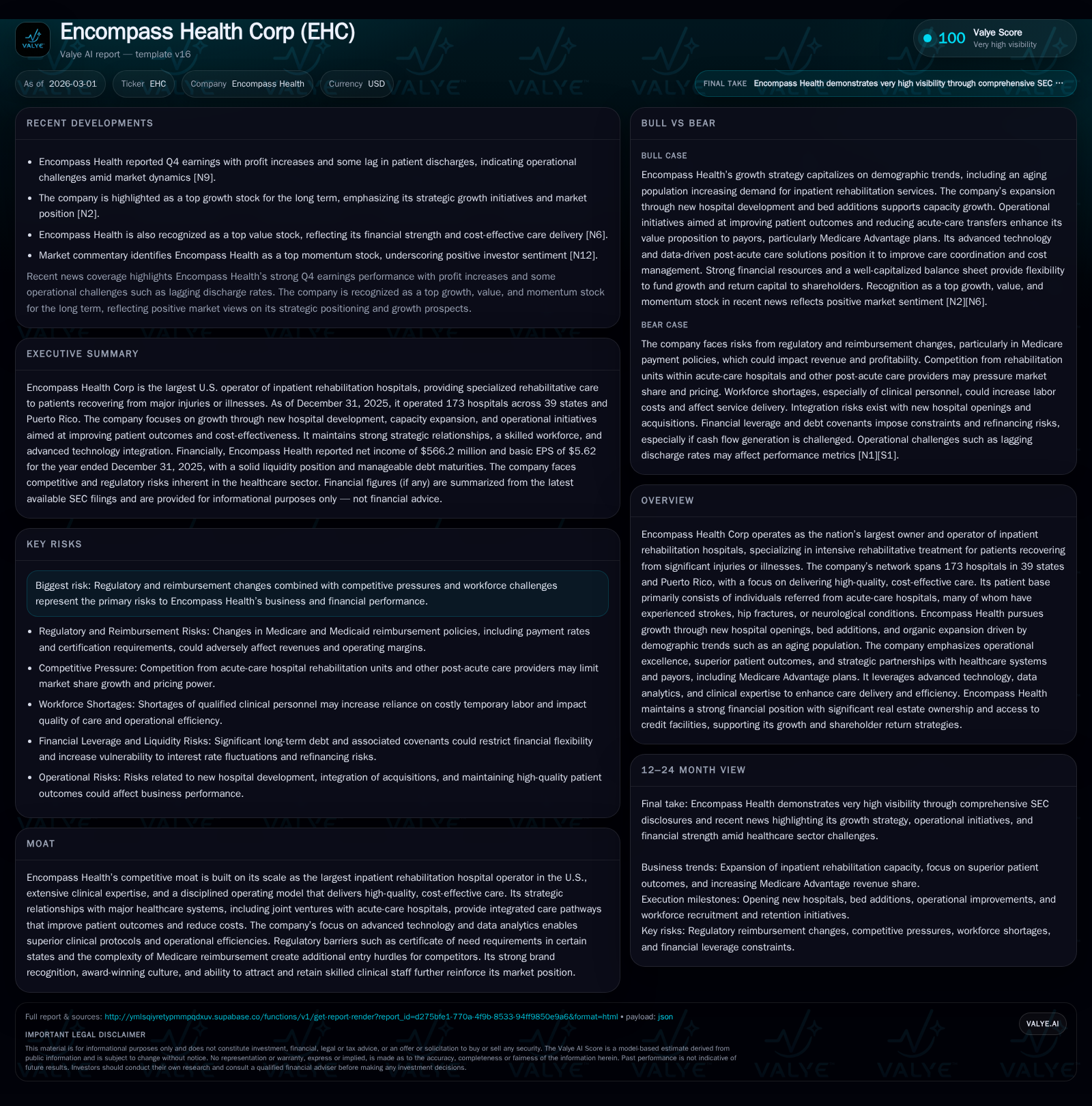
Encompass Health Corp, the largest U.S. operator of inpatient rehabilitation hospitals, has demonstrated steady revenue and earnings growth supported by hospital expansions, operational efficiencies, and strategic partnerships. The company's extensive network and clinical expertise underpin a defensible market position in a highly fragmented industry. Looking ahead, growth opportunities stem from demographic trends and capacity additions, though reimbursement pressures and workforce challenges remain key risks. Robust cash flow generation facilitates capital investments and shareholder returns, balancing growth with financial discipline.
Company Overview
Encompass Health Corporation (NYSE: EHC) operates the largest network of inpatient rehabilitation hospitals in the United States. With a presence spanning 173 hospitals across 39 states plus Puerto Rico at the end of 2025, Encompass focuses on intensive rehabilitative care for patients recovering from significant injuries or illnesses such as strokes, hip fractures, and neurological conditions. Nearly all patients (92%) are admitted via physician referrals from acute-care hospitals following severe events requiring specialized inpatient therapy services [S1].
The company pursues a strategy grounded in scale-driven clinical expertise, operational excellence, strategic partnerships (including many joint ventures with leading acute-care providers), and advanced technology integration. This approach yields high-quality outcomes efficiently while addressing the evolving demands of payors like Medicare Advantage plans. Encompass' award-winning culture supports staff retention—critical given clinical labor intensity—and contributes to its market leadership position [S6][S18].
Historical Performance
Encompass Health has delivered consistent top-line growth combined with expanding profitability over recent years:
Historical performance (annual)
| FY | Net ($mm) | Net YoY |
|---|---|---|
| 2025 | 566 | +24.2% |
| 2024 | 456 | +29.5% |
| 2023 | 352 | +293.7% |
| 2022 | 89 |
Source: SEC companyfacts cache [F1].
Capital returns and efficiency (annual)
| FY | Div ($mm) | Buybacks ($mm) | ROE% |
|---|---|---|---|
| 2025 | 71 | 158 | 23.2 |
| 2024 | 63 | 31 | 22.0 |
| 2023 | 60 | 21.4 | |
| 2022 | 99 | 0 | 6.8 |
Source: SEC companyfacts cache [F1].
Note: Revenue data is detailed for recent years per SEC filings; operating income is available through FY2022 only; net income shows strong doubling over three years demonstrating margin improvement [F1][S1].
Growth was primarily driven by geographic expansion—with six new hospitals added between 2023 and 2025—and incremental bed licensing that increased total licensed beds from approximately 10,778 in 2023 to over 11,465 by end-2025. Discharges grew substantially as well (from about 229k patients in FY23 to over 263k in FY25), enhancing volume-driven revenue growth [S1]. Prefabricated construction techniques enable efficient build-outs reducing time-to-market for new capacity additions [S7].
Operationally, the company’s disciplined cost structure alongside clinical protocol standardization led to notable margin expansion. Net income surged markedly by over sixfold from FY22 levels to $566 million by FY25—a signal of both leveraging growth investments and controlling operational expenses amid rising cost pressures [F1].
Growth Prospects
Looking ahead, Encompass Health’s growth will likely continue to be propelled by:
- Demographic tailwinds: The aging U.S. population drives increased demand for post-acute rehabilitative care following acute events like strokes or fractures requiring institutional therapy.
- De novo hospital development & bed expansions: The company remains committed to opening new inpatient rehabilitation facilities each year alongside capacity increases at existing sites to capture unmet local demand [S22].
- Improved payer mix: Ongoing contract enhancements with Medicare Advantage plans reflect recognition of Encompass’ superior patient outcomes such as higher community discharge rates and shorter lengths of stay versus competitors [S18][N6][N7].
- Clinical innovation: Investments in post-acute data analytics platforms and AI-enabled predictive tools amplify therapy effectiveness while improving operational efficiency.
- Strategic partnerships: Joint ventures with large health systems sustain integrated care pathways that improve referral flows from acute care hospitals—which account for the lion’s share of discharges—and support performance-based reimbursement models [S6][S18].
However, several headwinds could moderate this growth trajectory:
- Regulatory risk: CMS reimbursement cuts or freezes driven by evolving federal healthcare reforms and productivity adjustments could limit revenue per patient episode despite volume gains [S10].
- Workforce challenges: Recruiting and retaining highly skilled clinicians amid tight labor markets remain ongoing obstacles impacting capacity utilization [S18][N6].
- Competitive pressures: While Encompass leads by scale, numerous smaller regional providers compete aggressively on price or niche specialties; also acute-care hospital rehabilitation units constitute tough direct competitors due to integrated referral control [S6].
- Litigation & compliance exposures: Federal investigations under the False Claims Act remain a perennial risk; though prior matters concluded without admission of wrongdoing coupled with strong compliance programs mitigating recurrence likelihoods [S14][S19].
Monitoring discharge volumes relative to estimates will be important near term given Q4 earnings commentary showing some softness despite revenue beats [N6][N7][N8]. Legislative changes such as the One Big Beautiful Bill Act affecting Medicaid financing may also impact future reimbursement dynamics [S1].
Capital Allocation & Financial Strength
Encompass Health demonstrates balanced capital deployment that supports both growth investments and shareholder returns:
- Cash flows: Operating cash flows have been robust historically—over $700 million annually since FY20—against capital expenditures consistently ramping from roughly $372 million in FY19 to around $565 million in FY22 to fund new hospital openings plus expansions [F1]. Estimated free cash flow remains healthy at approximately $141 million in the latest fiscal year.
- Dividend policy: Dividends paid have been stable around $60–$70 million annually with modest increases reflecting earnings strength but cautious reinvestment preferences consistent with leveraging cycles [F1].
- Share repurchases: Notably accelerated buybacks surfaced in FY25 ($158 million), a material increase compared to prior minimal buyback activity suggesting confidence in capital structure flexibility [F1][S25].
- Leverage profile: Total long-term debt stood at about $2.2 billion at year-end 2025 including current portion but comfortably manageable within covenants requiring leverage ratio maintenance monitored closely per credit agreements; no major maturities loom before 2028 reducing refinancing risk amid rising interest rate environment [S4][S9][S11][S17][S20][S29].
- Liquidity: Approximately $82 million cash equivalents plus about $824 million availability remain on a revolver credit facility offering ample short-term liquidity buffer against economic uncertainties or investment opportunities [F1][S17].
This allocation framework reflects a prudent approach sustaining cash reinvestment into core business capabilities while delivering periodic capital back to shareholders to enhance total return.
Competitive Moat Analysis
Encompass Health’s moat emanates chiefly from:
- Its unmatched scale as the nation’s largest inpatient rehabilitation hospital operator (173 facilities vs fragmented peers). This scale affords bargaining leverage with payors alongside economies of centralized administration.
- Extensive clinical expertise coupled with rigorous standardization across hospitals driving superior patient outcomes documented by certifications for disease-specific care areas such as stroke rehabilitation across nearly all hospitals (~149 certified locations) ensuring high quality benchmarks [S6][S18].
- Joint venture arrangements embed Encompass intimately within referring acute-care ecosystems solidifying referral channels which constitute ~92% patient intake sources making it difficult for competitors lacking such networks to compete meaningfully.
- Technology-driven data analytics underpin protocol optimization enabling continuous performance improvements reducing lengths of stay or readmission rates vital under value-based reimbursement frameworks.
- Regulatory barriers like certificate-of-need requirements restrict market entry where applicable enabling incumbents regulatory protection limiting new competition while managing Medicare reimbursement complexities prudently.
While competitors include numerous local rehab providers as well as sophisticated acute-care hospital units owning rehab beds internally posing competitive threats especially regionally; Encompass’ integrated operating model maintains lead but competitive vigilance remains critical going forward given shifting healthcare delivery landscapes [S6].
Risks Summary
Primary risks identified that could materially impact operations or financial performance include:
- Potential cuts or slowdowns in Medicare reimbursement updates driven by legislative changes or government actions including mandatory sequestration reductions lasting near-term until mid next decade diminishing revenue growth potential relative to cost inflation pressures ([e.g., ACA reform implications], productivity adjustments).
- Workforce recruitment/retention issues amidst national healthcare labor shortages impacting ability to staff newly opened beds or maintain service levels.
- Litigation exposures particularly related to False Claims Act cases where current or future qui tam complaints may surface leading to costly investigations or settlements notwithstanding previous resolutions encouraging sustained compliance vigilance.
- Increasing regulatory complexity around price transparency rules increasing administrative burdens potentially affecting referral patterns or payor negotiations.
- Economic factor sensitivity including interest rate hikes increasing debt servicing cost or potential covenant breaches necessitating lender waivers impacting financial flexibility.
The company actively monitors these risk dimensions deploying mitigation strategies including compliance programs, proactive governmental engagement, operational efficiencies enhancements plus strategic partnerships supporting stable referral pipelines mitigating downside risks while pursuing long-term sustainable growth avenues [S10][S14][S19][S21].
Forward Looking Considerations (Analysis)
With no explicit published guidance currently available beyond general disclosure priorities related to capacity growth targets and operational initiatives ([see SEC MD&A]), key forthcoming milestones include quarterly discharge volumes relative to expectations given recent Q4 softness reports; confirmation of continued Medicare Advantage reimbursement uplift trends; updates on legislative impacts including OBBBA provisions implementation effects; monitoring regulatory audit developments especially around price transparency enforcement; workforce stabilization progress potentially influencing utilization metrics; and tracking capital deployment efficacy maintaining free cash flow generation supportive of shareholder return sustainability.[N6,N7,N8,S22,S25]
Additionally, strong execution on technology-driven clinical protocols combined with innovative post-acute solutions utilizing AI advances could provide incremental competitive advantage amplification supporting profitable scaling trajectories.[S7,S18]
Conclusion
Encompass Health Corp stands out as a dominant player in the inpatient rehabilitation sector leveraging unparalleled scale assets owned over three quarters alongside robust clinical capabilities buttressed by strategic alliances enabling integrated care coordination across the post-acute continuum. Historical results validate profitable growth through disciplined execution raising confidence in ongoing expansion supplemented by demographic tailwinds despite headwinds from regulatory uncertainties and workforce constraints. Judicious capital management evidenced by reinforced balance sheet strength affords optionality for measured shareholder distributions while investing appropriately for future capacity. The company’s moat rooted in brand reputation, certification-driven outcome superiority, data analytics integration, and regulatory complexity provides meaningful barriers supporting sustained leadership within a fragmented industry environment fraught with competitive fragmentation amid evolving reimbursement models. Nonetheless vigilance towards risks inherent in healthcare regulation dynamics—including potential cost-containment legislation—and litigation exposure is warranted since rapid changes could reshape operating conditions materially. Overall Encompass Health exemplifies healthcare infrastructure-oriented enterprise successfully combining scale economics with quality-centric operations navigating complex federal/state regulatory milieu delivering consistent value creation potential fundamental for stakeholders focused on stable healthcare services ecosystems.
This analysis is based solely on publicly available information including SEC filings as of February 26, 2026 ([F1],[S#]) plus relevant news coverage ([N#]). It does not provide investment advice or recommendations.
Disclaimer: This is research-only, informational analysis and not investment advice. It may include AI-generated interpretation and general industry context. Always verify important details using primary sources.

Comments