
Ehave Acquires AI Headhunter IP Amid Ongoing Operating Losses and Liquidity Challenges
Ehave expands its mental health tech platform with acquisition of AI recruitment assets while facing continued financial strain.
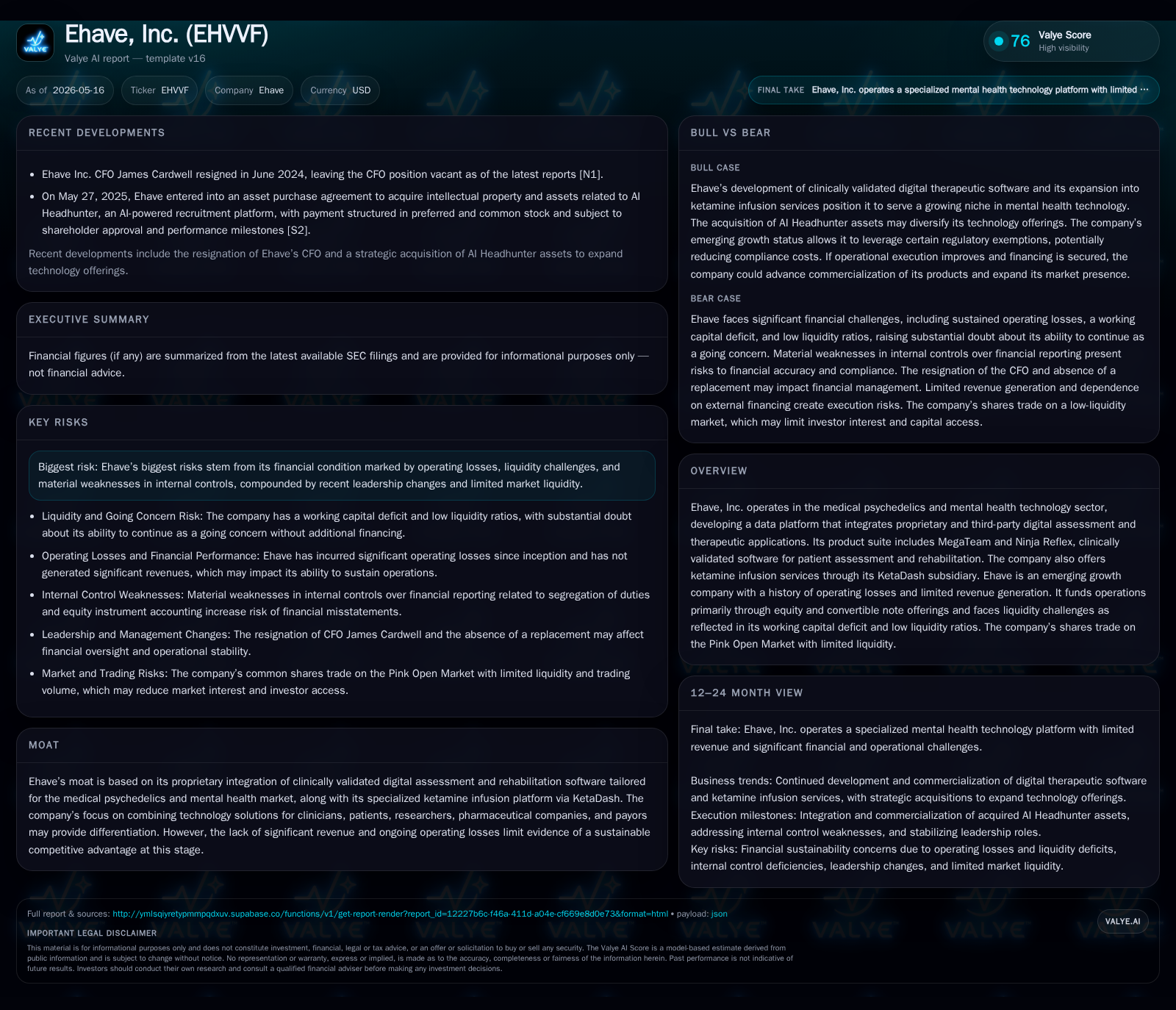
In mid-2025, Ehave, Inc. acquired intellectual property and operational assets related to AI Headhunter, signaling a strategic push into AI-enabled recruitment technology complementary to its medical psychedelics and mental health platform. Despite this expansion, the company remains an early-stage digital therapeutics and healthcare services provider grappling with persistent operating losses, a working capital deficit, and internal control weaknesses. Its product lineup includes clinically validated digital assessment tools MegaTeam and Ninja Reflex and ketamine infusion services through KetaDash. Growth depends on successful commercialization of these offerings and effective capital raising amid a constrained liquidity environment.
Recent Operating Update: Strategic Acquisition in AI Recruitment
On May 27, 2025, Ehave entered into an asset purchase agreement to acquire intellectual property and related assets from Klizo Ventures Inc. pertaining to AI Headhunter, an artificial intelligence-powered recruitment platform (www.aiheadhunter.com) [S2]. This transaction included source code, branding, documentation, user accounts, customer contracts, and comprehensive operational assets. The deal consideration comprised Series A Convertible Preferred Stock valued at $2.7 million alongside 100 million common shares, with potential earnouts tied to future revenue and customer milestones up to $7 million in preferred stock. This move represents Ehave's strategic extension beyond its core mental health data platform into AI-powered recruitment technology.
This acquisition may provide synergies by leveraging AI capabilities aligned with Ehave’s existing software platforms—MegaTeam and Ninja Reflex—that enable clinically validated patient assessments and rehabilitation solutions. Integration of advanced data analytics from AI Headhunter could enhance patient engagement models or widen the user ecosystem through expanded B2B functions specifically tailored for clinicians, researchers, or payors [S1]. Nevertheless, this diversification risks further stretching limited managerial bandwidth during overarching liquidity stresses.
Business Model Overview: Digital Therapeutics Integrated with Ketamine Infusion Services
Ehave develops a medical psychedelics and mental health data platform integrating proprietary digital assessment tools (MegaTeam and Ninja Reflex) that are clinically validated for patient engagement in rehabilitation contexts. Additionally, it adapts third-party validated digital applications aiming at enhancing therapeutic outcomes through improved engagement and data-driven treatment modeling [S1]. These software solutions address multi-faceted stakeholders: clinicians seeking reliable assessment tools; patients requiring engaging therapy interfaces; researchers analyzing outcomes; pharmaceutical companies exploring drug development augmentation; and payors looking for measurable value evidence.
Complementing its digital offerings is KetaDash—a subsidiary specializing in enabling licensed practitioners to deliver ketamine infusion treatments remotely in patients’ homes [S1]. This service delivery model targets growing demand in psychedelic-assisted therapies while enhancing accessibility outside traditional clinical settings.
Revenue generation is anticipated from both software licensing/subscription fees associated with digital applications and service revenues from ketamine infusion offerings. However, as an emerging growth company under the JOBS Act, Ehave is still pre-revenue or minimally generating revenue from commercial sales [S1,S8]. Its model relies on scaling product adoption while securing regulatory clearances for clinical validation claims.
Industry Structure and Competitive Positioning
Ehave operates at the intersection of the nascent but rapidly evolving medical psychedelics sector combined with digital mental health technologies—areas characterized by high innovation rates but regulatory uncertainties. Within this space, competitors include mental health software companies offering teletherapy platforms (though these often lack psychedelic focus), other specialized digital therapeutics developers targeting cognitive rehabilitation, and emerging ketamine therapy service providers.
Ehave’s moat lies primarily in its integrative approach combining software platforms validated for clinical use with a parallel healthcare delivery mechanism (KetaDash) focused on ketamine infusions. This dual approach could facilitate a more seamless patient care continuum from digital diagnostics/rehabilitation to pharmacologic intervention management.
However, competition is intense due to increasing entrants in both behavioral health apps and psychedelic treatment facilitation firms. Furthermore, the lack of significant revenue traction limits evidentiary support for sustainable competitive advantage presently. The company’s reliance on third-party validation partnerships also introduces dependency risk.
Growth Drivers
Key growth drivers include:
- Commercialization of MegaTeam and Ninja Reflex: Scaling usage among clinicians as trusted assessment/rehab tools will drive subscription licensing revenue; clinical validation status supports differentiation.
- Expansion of KetaDash Ketamine Services: Growing acceptance of ketamine infusion therapy coupled with patient preference for home-based treatment offers a scalable service angle.
- New Product Integrations: Leveraging the acquired AI Headhunter technology may open new client segments or enhance machine learning capabilities within existing platforms.
- Strategic Collaborations: Partnerships with research institutions and pharmaceutical companies can validate platform efficacy and open revenue opportunities via clinical trials or drug development support.
These growth vectors rely heavily on continued R&D investment alongside effective market education about psychedelic-assisted therapies' benefits. Adoption rates by healthcare providers will depend on reimbursement structures evolving favorably around these novel modalities [S1,S4].
Risks and Constraints
Significant risks facing Ehave are:
- Financial Sustainability: Persistent net losses totaling approximately $40.7 million accumulated deficit by end-2025 strongly underscore the challenge of funding ongoing operations without dilutive equity raises or debt capacity which currently appears limited given working capital deficits [F1], [S8]; working capital ratio stands critically low around 0.08.
- Internal Control Weaknesses: Reported material weaknesses in accounting controls could impair reliable financial reporting or delay disclosures potentially impacting investor confidence [S15,S22].
- Market Liquidity: Shares trade on Pink Open Market with limited liquidity reducing market access for investors or price discovery efficiency [S15].
- Regulatory Uncertainties: The evolving regulatory frameworks around psychedelics treatments pose compliance risks that can affect speed-to-market or increase cost burdens.
- Execution Complexity: Integrating newly acquired IP while scaling core product lines amid constrained resources may stretch management capabilities leading to strategic execution risks.
- Competitive Pressures: Early emergence of competing clinical-grade digital therapeutics platforms or ketamine providers potentially eroding market share if superior efficacy or cost advantages emerge elsewhere.
What to Watch Next
Primary catalysts that will provide forward-looking insights include:
Financial Profile Summary
Historical performance (annual)
Capital returns and efficiency (annual)
Ehave’s financials illustrate an early-stage growth enterprise heavily investing in R&D activities yet unable to generate meaningful revenues currently [F1], [S8]:
The extreme working capital deficit underlines immediate liquidity stress requiring capital injection for continuity past late 2026 absent operational inflection points. General & administrative expenses increased significantly (+32%) largely driven by amortization charges linked to intangible assets (including recent acquisitions), consulting fees, marketing expenses and loss realizations from debt-to-equity conversions [S8]. Financing activities reflected modest note payable proceeds partially offset by repayments during year ending December 31, 2025 [S4].
Management underscores going concern uncertainties citing substantial doubt about ability to continue without successful commercialization or additional financing [S11]. There are no contractual obligations constraining cash flow beyond existing commitments as per disclosures [S1,S9].
Conclusion
Ehave showcases a specialized play within the emerging medical psychedelics digital health space combining software assessments with ketamine infusion services—a combination that could capture synergies across diagnostic/therapeutic delivery channels if successfully commercialized at scale. The May 2025 strategic acquisition adding AI Headhunter IP signals an ambition toward technology diversification incorporating artificial intelligence capabilities potentially relevant to workforce augmentation within healthcare networks.
Nonetheless, this vision faces structural challenges: limited revenue traction after several years despite consistent investment; a precarious liquidity position underscored by heavy operating losses; material internal control deficiencies; plus market access constraints linked to its OTC Pink Market listing status all temper near-term prospects. Growth plausibility hinges critically on execution across three fronts—commercial adoption of flagship platforms MegaTeam/Ninja Reflex; expansion of KetaDash’s ketamine services; successful monetization of acquired AI assets—while securing sufficient financing under shareholder dilution pressures.
Investors following Ehave should closely monitor quarterly progress updates against these milestones along with balance sheet strengthening measures given reported cash runway constraints entering mid-2026. Internal governance improvements addressing audit findings would also be pertinent signals toward operational maturity essential for sustainable long-term value creation.
This analysis is based solely on publicly filed materials as referenced above without offering investment advice.
Disclaimer: This is research-only, informational analysis and not investment advice. It may include AI-generated interpretation and general industry context. Always verify important details using primary sources.

Comments