
Ehave Expands AI Platform Amid Persistent Losses and Liquidity Challenges
Recent acquisition of AI Headhunter assets aims to diversify Ehave’s mental health tech offerings amid continued operating deficits.
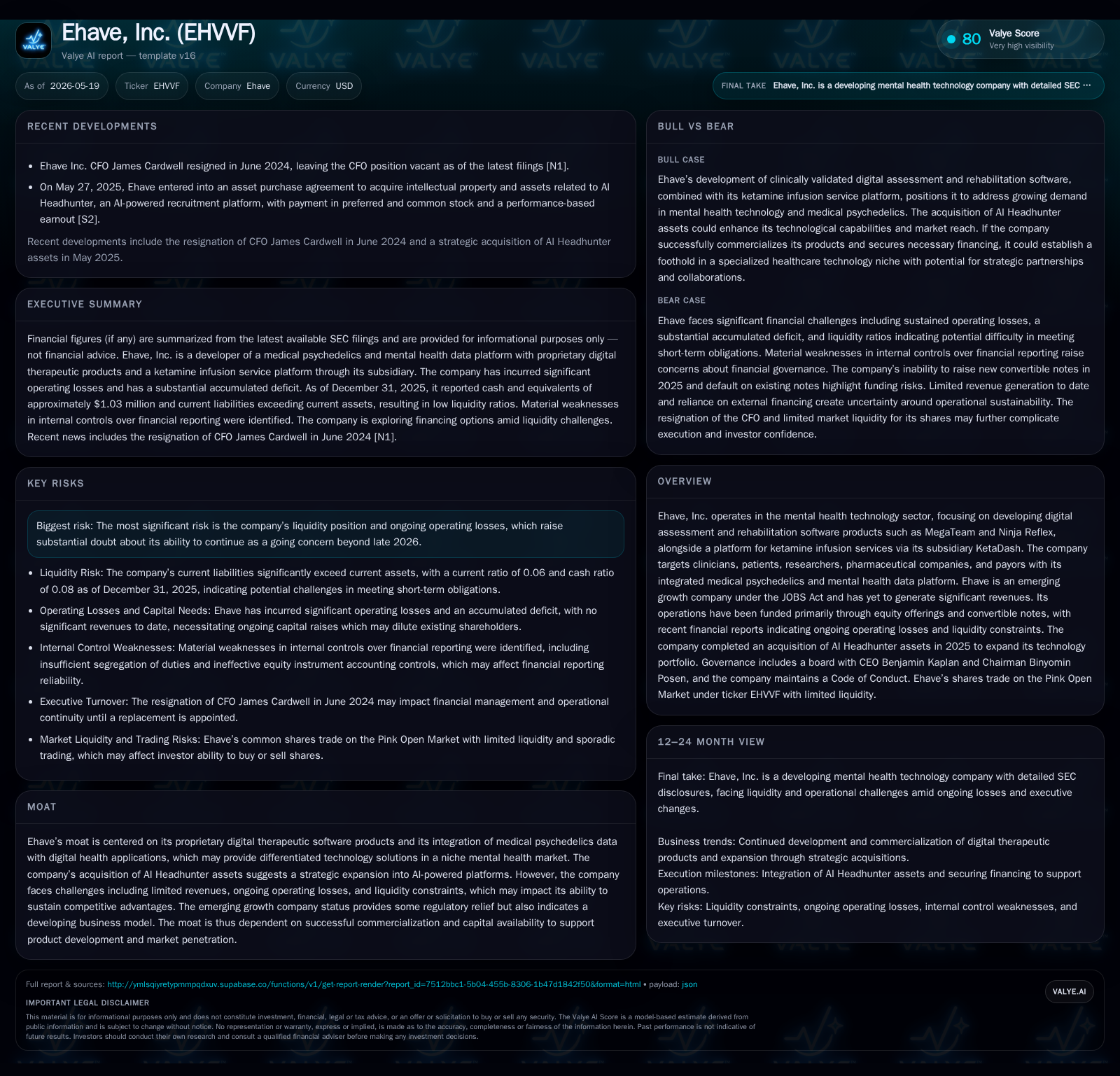
Ehave, Inc. remains a developmental stage company focused on digital mental health therapeutics and medical psychedelics data integration. The June 2025 acquisition of AI Headhunter, an AI-powered recruitment platform, marks a strategic pivot towards incorporating artificial intelligence capabilities, potentially broadening its technology scope. Despite these efforts, Ehave continues to grapple with sustained operating losses and severe liquidity constraints, raising substantial doubt about its ability to continue as a going concern beyond late 2026. Growth hinges on successful commercialization of its MegaTeam and Ninja Reflex products, alongside KetaDash’s ketamine infusion services platform.
Recent Operating Update
Ehave’s latest material development was the May 27, 2025 asset purchase agreement acquiring intellectual property and operational assets related to AI Headhunter—a recruitment platform leveraging artificial intelligence technology [S2]. This transaction involved issuing convertible preferred stock valued at $2.7 million plus common shares totaling 100 million shares, accompanied by an earnout arrangement up to $7 million based on revenue milestones tied to the acquired assets. Klizo Ventures Inc., the seller, will own more than 5% of Ehave’s outstanding shares post-transaction. This move marks a notable strategic expansion from purely mental health software into adjacent AI-powered platforms potentially augmenting data analytics capabilities within human capital domains.[S2]
The company’s annual report for the fiscal year ending December 31, 2025 reiterates no significant revenues realized yet but highlights continued operational expenses incurred in support of its core digital therapeutic products MegaTeam and Ninja Reflex plus the KetaDash ketamine infusion home healthcare platform [S1], [S8]. With accumulated deficits nearing $41 million by year-end 2025 and net losses escalating by over 36% compared to prior years (net loss $2.48M in FY25 vs $2.11M prior year) the financial position remains fragile. The working capital deficit exceeds $12 million reflecting low current assets against substantial current liabilities nearing $13.15 million [F1]. The current ratio at approximately 0.06 confirms acute liquidity constraints.[F1]
Further complicating operations are documented material weaknesses in internal controls—specifically inadequate staff segregation of duties affecting reliability of consolidated financial statement preparation and equity instrument classification issues—highlighted in management evaluations over the period ending 2025-12-31 [S22]. Management plans to rely on increasing accounting personnel and consultant support to resolve these control gaps.
Business Model Overview
Ehave generates value primarily through providing clinically validated digital assessment and rehabilitation software for mental health applications (MegaTeam and Ninja Reflex). These platforms serve clinicians aiming for patient engagement via digital tools that measure cognitive function and facilitate behavioral rehabilitation exercises or assessments.[S1]
Alongside software sales or licensing models (not currently generating significant revenue), Ehave operates KetaDash—a subsidiary delivering a medical service platform enabling supervised ketamine infusions administered at patient homes [S1]. This model targets clinicians needing infrastructure for novel psychedelic treatments which have growing interest among mental health practitioners and pharmaceutical stakeholders.
Monetization strategies encompass direct sales/licenses to practitioners or institutions, subscription or usage-based fees related to software deployment, partnership arrangements with researchers or pharma firms leveraging aggregated data insights from therapeutic usage, as well as service fees via KetaDash for treatment facilitation [S1]. Revenue volume depends on digital user adoption rates, recurring active users per platform tier (patient adherence), clinical validation driving institutional acceptance, expansion of psychedelics therapy adoption globally, reimbursement progress from payors recognizing psychedelic-assisted therapies under evolving regulatory frameworks.
Margins remain negative due primarily to R&D investments focusing on product development, regulatory compliance efforts, marketing expenses required for awareness-building in niche mental health segments where switching costs are variable but patient engagement tech must differentiate significantly compared with general wellness apps.
The recent acquisition diversifies offerings beyond mental health software into AI-based recruitment tools which may complement internal data analytics capabilities enabling enhanced customer insights or novel service verticals particularly around talent sourcing specialized in healthcare technology sectors.[S2]
Industry Structure & Competitive Position
Ehave operates at the intersection of mental health technology automation and emerging medical psychedelics markets—a complex landscape characterized by incremental regulatory acceptance but significant uncertainty regarding reimbursement frameworks.[S1]
Peers vary from large established digital therapeutics firms with broad behavioral health solutions (e.g., Pear Therapeutics) focusing on FDA-approved prescription digital therapeutics to smaller innovators developing niche cognitive assessment tools or psychedelic therapy service providers expanding outpatient delivery models.
Competition also comes from conventional mental healthcare delivery amplified by telehealth incumbents such as Teladoc Health who increasingly integrate behavioral health services albeit without dedicated psychedelics data platforms.
Ehave’s moat rests on its integration of proprietary digitally engaging rehabilitation platforms coupled with dedicated infrastructure for psychedelics treatment administration through KetaDash—a unique positioning relative to many pure software vendors or pure service providers.[S1] However, this differentiation hinges critically on successful commercialization pathways beginning with market traction in clinical settings supported by rigorous validation given the nascent acceptance of medical psychedelics treatments outside research contexts.
The AI Headhunter acquisition potentially extends competitive positioning through proprietary AI capabilities enabling enhanced recruitment targeting in specialized healthcare/technology segments—this may facilitate faster talent acquisition vital for scaling operations or provide complementary SaaS revenue streams pending successful integration [S2]
Growth Drivers
- Medical Psychedelics Adoption: Rising clinical interest in ketamine-infused therapy as second-line treatments for depression/anxiety disorders directly supports KetaDash’s growth potential. Increasing clinician acceptance along with payor recognition can drive volume growth in home infusion services.
- Digital Therapeutic Validation: Continued clinical validation and deployment of MegaTeam/Ninja Reflex software enhance credibility among healthcare providers encouraging broader institutional licensing or subscription uptake.
- AI Platform Integration: Leveraging acquired AI Headhunter technology may unlock new revenue avenues either through standalone recruitment SaaS offerings or integrated analytics adding value across existing products.
- Regulatory Progress: Advancements permitting clearer reimbursement pathways or federal/state approvals for medical psychedelics could materially expand addressable markets.
- Research Partnerships: Engagements with pharmaceutical companies and academic institutions utilizing Ehave’s data platform can yield collaborative revenue opportunities while enhancing product features based on cutting-edge clinical inputs.
Risks & Constraints
- Liquidity Risk: Current working capital shortfall (~$12M) combined with negative cash flow trends threaten sustained operations absent prompt capital raises; defaulted convertible notes further complicate financing options [F1], [S8].
- Commercial Execution: Transitioning from development-stage products to scalable commercial success requires effective sales channels amidst limited current revenues.
- Regulatory Uncertainty: Psychedelic therapies face shifting legal landscapes which could delay or restrict market access affecting KetaDash uptake.
- Product Adoption: Patient engagement levels with digital therapeutics can be volatile; lack of significant switching costs makes retention challenging.
- Operational Control Weaknesses: Existing material internal control deficiencies increase risks of financial misstatements or compliance failures [S22].
- Integration Risks: Assimilation of AI Headhunter assets necessitates effective technical alignment; failure may dilute focus or drain resources.
- Capital Dilution: Additional equity raises required are expected; potential dilution may deter investor interest impacting valuation.
What To Watch Next
Key indicators reflecting progress include demonstration of revenue inflows tied explicitly to the AI Headhunter integration earnouts milestones; early customer signups/pilot deployments for MegaTeam/Ninja Reflex; growth metrics from KetaDash infusion services utilization; updates on funding rounds addressing liquidity gaps; any clinical trial results advancing validation claims; improvements in internal controls remediation timeline; regulatory news impacting psychedelics frameworks possibly opening insurance coverage avenues.
Financial Profile Summary
Historical performance (annual)
Capital returns and efficiency (annual)
As per fiscal year ended December 31, 2025 data:[F1],[S8]:
- Net loss amounted to approximately $2.48 million.
- Operating income remained negative near -$3.3 million showing worsening trend YoY (-31.6%).
- Operating cash flow continued negative at approximately -$264K reflecting burn rate beyond revenue capability.
- Cash balances stood below $1 million at year-end while current liabilities surged above $13 million leading to a severely impaired liquidity profile (current ratio ~0.06).
- Accumulated deficit exceeded $40 million highlighting persistent losses since inception.
- Convertible note default status further complicates balance sheet quality.
This fragile financial footing underscores the urgency for capital raises alongside measured execution to achieve sustainable commercial footing.
Disclaimer: This analysis is provided solely for informational purposes based on publicly available disclosures without making any investment research views or predictions regarding security performance.
Disclaimer: This is research-only, informational analysis and not investment advice. It may include AI-generated interpretation and general industry context. Always verify important details using primary sources.

Comments