
Elme Communities’ $1.6B Portfolio Sale and Wind-Down Define 2025 Financial Outcomes
The Maryland-based REIT’s strategic liquidation reshaped its asset base and financial trajectory.
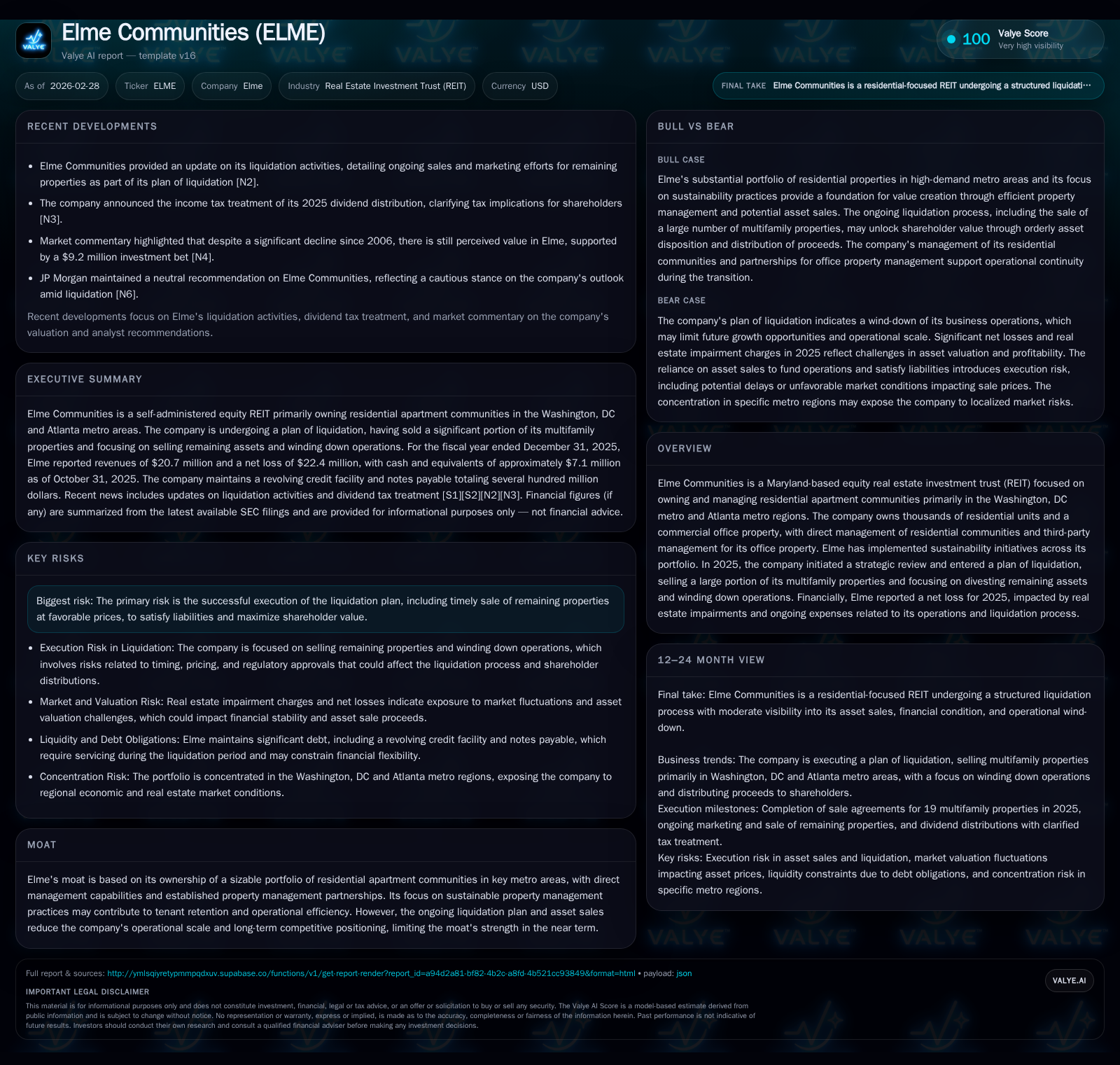
Elme Communities, focused on residential apartments in the DC and Atlanta metro areas, initiated a major portfolio sale and plan of liquidation in 2025. This pivot led to a sharp decline in revenue and operating income as asset sales accelerated while the company wound down operations. Despite reporting a net loss for 2025, Elme generated positive operating cash flow, supported by asset disposals and ongoing property operations. The company expects to complete the sale of remaining properties by mid-2026 with distributions to shareholders following the liquidation process. Capital allocation has concentrated on dividends and managing debt obligations amid the wind-down.
Overview and Historical Performance
Elme Communities operates as a self-administered equity REIT principally owning residential apartment communities concentrated in the Washington, DC metro area and Atlanta metro region. Historically, it managed thousands of residential units alongside some commercial office space under both direct and third-party management arrangements [S1][S12]. The company has emphasized sustainability initiatives at its assets, benchmarking energy use and environmental standards such as LEED certifications.
Over recent years prior to 2025, Elme's top-line showed modest growth: revenue increased from $55.6 million in 2022 to nearly $61.3 million in 2024 [F1]. Operating profitability fluctuated significantly, with operating income turning negative in several years due to impairments and market dynamics [F1]. Net income consistently registered losses, although relatively contained before the sharp deterioration seen in 2025.
Historical performance (annual)
| FY | Rev ($mm) | Net ($mm) | CFO ($mm) | OpInc ($mm) | Rev YoY | Net YoY |
|---|---|---|---|---|---|---|
| 2025 | 21 | -22 | 62 | -122 | -66.3% | -643.2% |
| 2024 | 61 | -3 | 95 | 23 | +4.1% | +2.9% |
| 2023 | 59 | -3 | 85 | -23 | +5.9% | +12.1% |
| 2022 | 56 | -4 | 73 | -2 |
Source: SEC companyfacts cache [F1].
Capital returns and efficiency (annual)
| FY | Div ($mm) | ROE% |
|---|---|---|
| 2025 | 64 | -2.1 |
| 2024 | 64 | -0.3 |
| 2023 | 64 | -0.3 |
| 2022 | 59 | -0.3 |
Source: SEC companyfacts cache [F1].
Revenue reflects multifamily rentals plus office leasing; operating income volatility largely tied to non-cash impairments related to changing market values preceding the liquidation plan [F1][S1]. Dividends remained steady until suspension of reinvestment programs amid liquidation [S17].
Liquidation Plan and Strategic Shift
In early 2025, Elme’s Board initiated a formal strategic review that concluded with approval of a Plan of Sale and Liquidation approved by shareholders in October [S1][S13]. The company contracted the bulk sale of nineteen multifamily assets for approximately $1.6 billion, completed in November [S13]. This transformative transaction pivoted Elme from an actively managed REIT toward an orderly wind-down.
Following the transaction, Elme maintained ownership of ten properties secured under a $520 million senior secured term loan facility with Goldman Sachs Bank USA [S13]. Several assets have since been sold or placed under contract with anticipated closings by mid-2026 [S10][N2]. Concurrently, Elme suspended its dividend reinvestment program reflecting the shift away from growth capital deployment [S17].
Financial Impact of Asset Sales
The portfolio disposal precipitated a drastic decline in revenue—from $61 million plus annually down to roughly $20 million—reflecting loss of rental streams as properties exited the portfolio [F1][S1]. Operating income plummeted into deep negative territory largely due to substantial real estate impairments totaling over $110 million plus substantial liquidation-related expenses [F1][S8]. These non-cash charges overshadowed core operations causing reported losses despite continued positive net operating income on remaining properties.
Net income for the full year was a loss of $22 million on lower revenues but moderated relative to operating loss due to some non-operating gains such as land easements levers recorded previously [F1][S8]. Operating cash flow remained positive at approximately $62 million (albeit down from prior periods), thanks mainly to cash collected from ongoing rents on sold or retained assets offsetting operational expenditures [F1][S11].
Capital expenditures contracted sharply as investment shifted from expansion or repositioning toward asset preservation and preparing remaining holdings for sale; capex is estimated below historical peaks seen before liquidation initiation [F1].
Liquidity and Debt Structure
To support liquidity during this transition phase, Elme secured a revolving credit facility with up to $500 million availability maturing in July 2028 subject to extension options [S5][S6]. As of September quarter-end before final year closing, borrowings stood at approximately $186 million against this facility leaving substantial unused capacity for operating needs and required capital investments during disposition activities.
The aforementioned secured term loan backed by ten remaining properties serves as primary financing for these assets pending their sale; repayments are tied directly to proceeds from property sales conveying a waterfall structure prioritizing lender security interests [S13][S9]. Interest rates reflect fixed-rate swaps locking cost near mid-4% levels minimizing variability risk through loan maturity dates early in 2026 [S4].
Capital Allocation and Returns
Throughout the wind-down process, Elme maintained dividend payments totaling roughly $63.7 million for fiscal year 2025 despite operational losses signaling commitment to shareholder returns through liquidating distributions [F1]. This included a special liquidating distribution paid January 7, 2026 at $14.67 per share following approval of liquidation plans [S15].
With core operational losses negative ROE approximated -2% given net losses relative to equity base near $1 billion reported end-2024 prior to heavy asset sales thereof [F1]. The company has not engaged in share repurchases during this period given liquidity constraints focusing capital on dividends and debt servicing commitments.
Future Prospects and What To Watch
With mid-year calendar targets set for selling all remaining apartment communities and winding down operations entirely including corporate dissolution according to U.S tax code provisions governing REIT liquidations, Elme’s near-term outlook centers entirely on execution risk linked to timing and pricing of remaining dispositions [N2][S15].
Successful completion would potentially unlock meaningful residual distributions for shareholders post-expenses and liability settlements but is contingent on stable real estate markets especially given post-pandemic shifts in rental demand dynamics across primary Washington DC residences versus secondary Atlanta exposure.
Potential negative scenarios include protracted marketing cycles extending beyond two-year liquidation window subjecting Elme to transfer residual assets into liquidating trusts or conversion entities possibly complicating shareholder returns or triggering lower valuation realizations.
Additionally, pending lawsuits alleging proxy statement misrepresentations illustrate litigation risk common around extraordinary corporate actions that could delay final closure or impose material costs impacting distributable funds.[S25]
Summary
Elme Communities’ transformation in calendar year 2025 marked an abrupt transition from growth-focused REIT operations toward systematic portfolio divestiture and corporate wind-down via an approved Plan of Sale and Liquidation alongside multi-billion-dollar asset sales primarily across its residential multifamily holdings.
Financial metrics reflected this reshaping: revenue fell heavily as inventory reduced; impairments drove operating income negative reversing earlier profitability trends; yet positive cash flows were sustained reflecting strong operational control amid transition; dividends were preserved delivering significant liquidating distributions.
Going forward, execution against aggressive asset sale calendars will determine ultimate value returned amid balancing outstanding debt obligations while managing potential legal contingencies tied closely with stakeholders’ interests during this significant corporate chapter.
This analysis is based exclusively on publicly available filings as of February 27, 2026, news reports dated through early February 2026, and verified financial data drawn directly from SEC documentation without predictive assertions or investment recommendations.
Disclaimer: This is research-only, informational analysis and not investment advice. It may include AI-generated interpretation and general industry context. Always verify important details using primary sources.

Comments