
Enliven Therapeutics’ Financial Strains Highlight Risks in Advancing ELVN-001 Clinical Trials
Clinical-stage focus on ELVN-001 for CML drives operational losses and capital needs amid regulatory uncertainties.
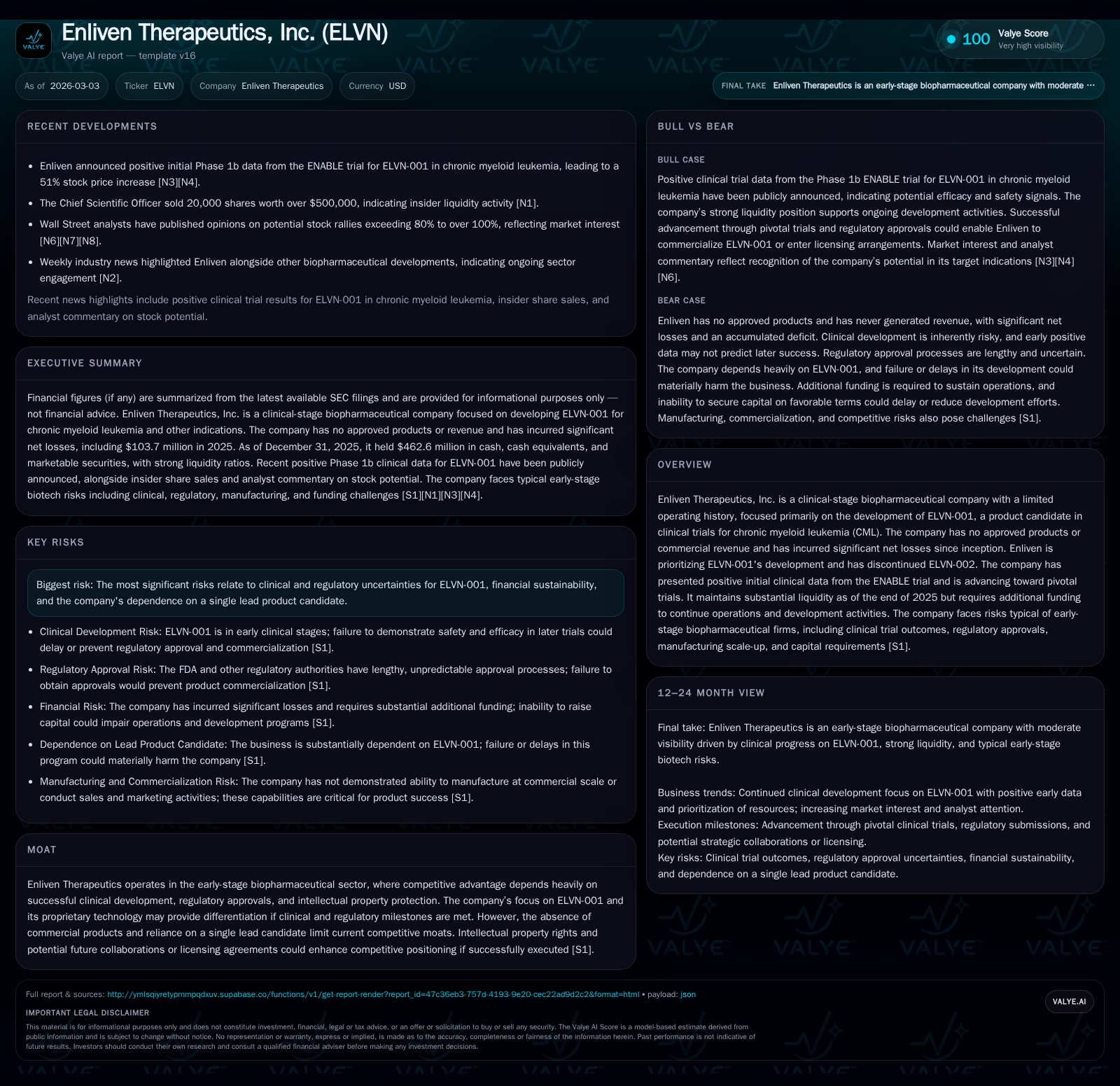
Enliven Therapeutics has concentrated its development efforts on ELVN-001, a clinical-stage candidate targeting chronic myeloid leukemia, resulting in no commercial products or revenues to date. The company’s historical and recent financials reflect rising net losses and negative cash flows, substantially funded by equity raises. While initial clinical data from the ENABLE trial supports progression toward pivotal studies, financial sustainability and regulatory challenges pose critical risks. Investors should watch for clinical milestones, capital raises, and regulatory feedback to evaluate future viability.
Company Background and Focus
Enliven Therapeutics is a clinical-stage biopharmaceutical company focused primarily on advancing ELVN-001, its lead drug candidate targeting chronic myeloid leukemia (CML). The company currently has no approved products or commercial revenues and has concentrated its limited resources on this molecule after discontinuing its prior candidate ELVN-002. Enliven’s operating history is relatively short with significant net losses incurred since inception [S1].
Historical Financial Performance
The fiscal year ended December 31, 2025, saw Enliven report an operating loss of approximately $120 million, a 14.4% increase compared to the prior year’s operating loss of about $104.6 million. Net losses widened by 16.5% year-over-year to roughly $104 million. Operating cash flows remained negative at approximately -$70 million in 2025, showing a slight improvement from the previous year. Capital expenditures were minimal at $158,000 for the year, reflecting a focus on clinical development rather than infrastructure expansion [F1].
Historical performance (annual)
| FY | Net ($mm) | CFO ($mm) | OpInc ($mm) | Capex ($) | Net YoY |
|---|---|---|---|---|---|
| 2025 | -104 | -70 | -120 | 158000 | -16.5% |
| 2024 | -89 | -73 | -105 | 44000 | -24.4% |
| 2023 | -72 | -61 | -84 | 149000 | -4910.8% |
| 2022 | 1 | -36 | 1 | 363000 |
Source: SEC companyfacts cache [F1].
Capital returns and efficiency (annual)
| FY | FCF ($mm) | ROE% |
|---|---|---|
| 2025 | -70 | -22.6 |
| 2024 | -73 | -28.7 |
| 2023 | -61 | -29.1 |
| 2022 | -36 | 1.7 |
Source: SEC companyfacts cache [F1].
Revenue remains zero due to lack of commercialized products.
At the end of FY2025, Enliven held nearly $99 million in cash and equivalents with current assets totaling roughly $475 million versus current liabilities near $17 million. This results in a strong current ratio above 28x indicative of robust liquidity mainly supported by equity financing efforts [F1,S14].
Capital Structure and Funding Strategies
Enliven relies heavily on equity financings to fund operations. Through December 31, 2025, it raised approximately $38.6 million net from an "at-the-market" offering program. Additionally, private placements and public offerings since early 2024 have generated aggregate proceeds approaching $306 million net of issuance costs. The company does not report any committed debt facilities or long-term debt obligations as of the latest filings [S14]. This equity-driven capital strategy underscores dependence on favorable market conditions given ongoing negative cash flows.
Development Pipeline and Future Growth Prospects
Following the discontinuation of other programs such as ELVN-002, Enliven’s pipeline centers exclusively on ELVN-001. Initial positive data from the ENABLE clinical trial support safety and efficacy profiles necessary to design pivotal studies aimed at regulatory approval primarily for CML indications [S1].
Future growth is contingent on successful completion of these pivotal trials and eventual commercialization or licensing arrangements. The company faces inherent risks common in early-stage biopharma including unpredictable clinical outcomes; complex regulatory pathways across jurisdictions such as FDA and EMA; manufacturing scale-up challenges; potential requirements for companion diagnostics; and competitive pressures within oncology therapeutics .
Limited available resources necessitate prioritization of ELVN-001 development while exploring strategic collaborations with oncology therapy providers; however failure to diversify candidates or indications may constrain longer-term growth potential [S1].
Operational Risks and Regulatory Environment
Key risks include:
- Clinical trial results may not meet regulators’ safety or efficacy expectations.
- Approval processes are lengthy and subject to evolving frameworks including accelerated pathways.
- Intellectual property litigation risk amid competitive patent disputes.
- Compliance with environmental regulations and healthcare laws such as HIPAA.
- Export controls including geopolitical factors impacting supply chains.
- Pricing pressures from government initiatives like most-favored-nation pricing models that may affect future revenue streams post-commercialization.
- Rising product liability insurance costs as trials advance. These factors add cost burdens and uncertainty potentially impacting timelines essential for revenue generation .
Financial Returns and Outlook Considerations
Return metrics remain negative due to absence of approved drugs or revenue-generating sales activity; approximate return on equity stands near -22.6%, reflecting continued investment in R&D exceeding equity growth [F1]. Free cash flow remains deeply negative at about -$70 million annually (operating cash flow less capital expenditures).
While explicit forward guidance is not detailed publicly beyond qualitative statements regarding progression toward pivotal trials and capital needs [N1,S1], stakeholders should monitor:
- Progression timelines from ENABLE trial data into pivotal study initiation.
- Additional financing activities affecting dilution or runway.
- Regulatory feedback influencing study designs or approval probabilities.
- Collaborations or licensing agreements that could expand pipeline breadth or improve margins post-commercialization.
Summary
Enliven Therapeutics exemplifies typical early-stage biotech dynamics: high scientific promise balanced against substantial execution risks and capital intensity without near-term revenue generation. The concentrated pipeline around ELVN-001 enables focused development but elevates vulnerability if adverse developments occur.
Financially, persistent net losses exceeding $100 million annually alongside negative free cash flow highlight heavy reliance on external funding rounds—productive thus far but subject to broader market conditions.
Clinical developments within ENABLE offer encouraging signs but success in pivotal trials remains critical to unlock value despite upfront sizable costs.
Investors should closely follow operational milestones alongside funding strategies as key indicators of progress toward eventual commercialization viability.
Disclaimer: This analysis is based solely on public disclosures as of March 3, 2026 (including SEC filings through Form 10-K) and does not constitute investment advice or recommendations.
Disclaimer: This is research-only, informational analysis and not investment advice. It may include AI-generated interpretation and general industry context. Always verify important details using primary sources.

Comments