
Embecta Corp.: Sustaining Market Leadership Amid Diabetes Care Evolution and Operational Complexities
A comprehensive analysis of Embecta’s strategic positioning, leveraging its intellectual property and global footprint while addressing competitive, regulatory, and supply chain challenges.
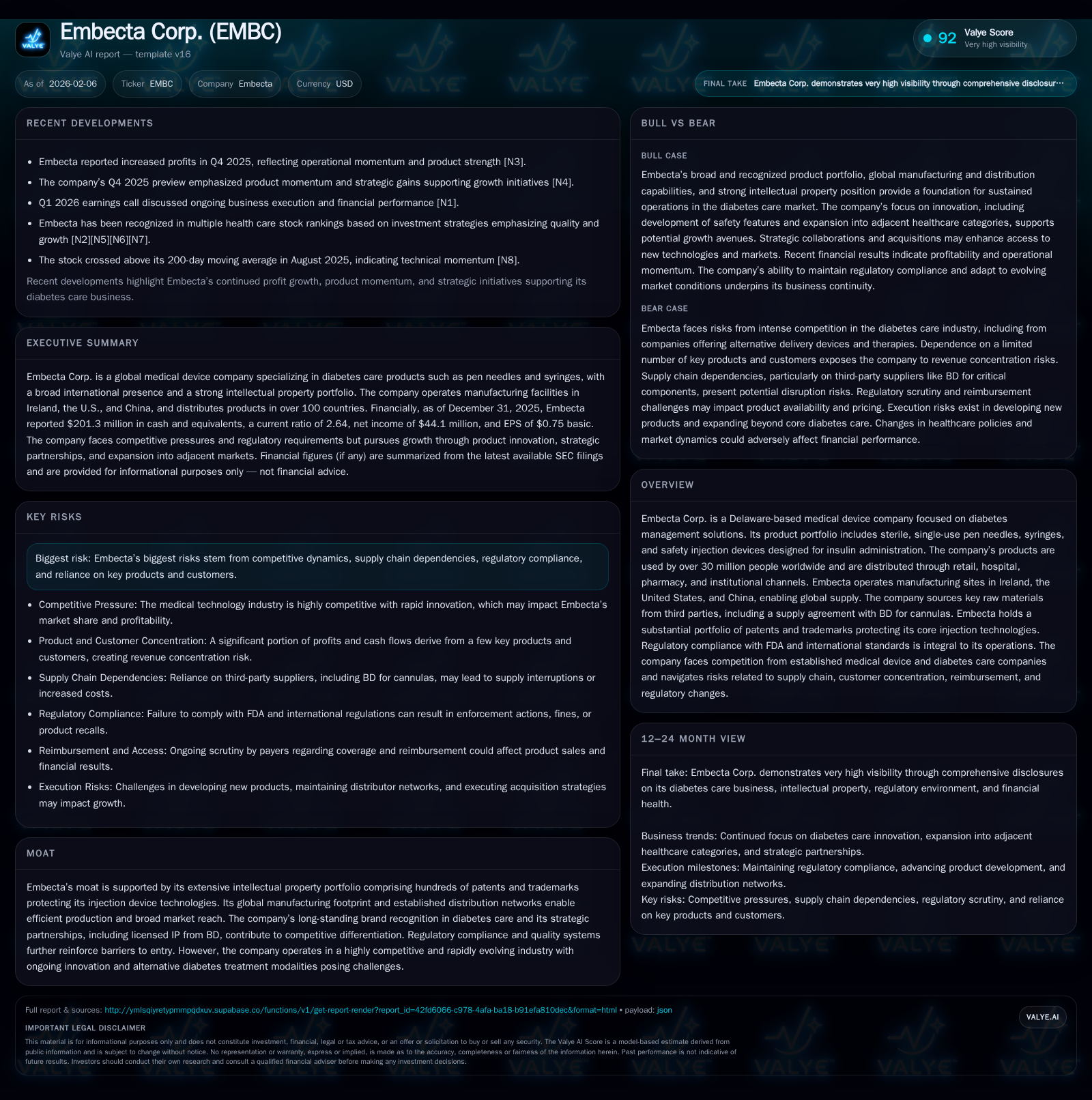
Embecta Corp. is a notable player in diabetes management devices, serving over 30 million users worldwide with a broad portfolio of pen needles, syringes, and safety injection devices. The company’s extensive patent portfolio and global manufacturing base underpin a defensible market position. However, evolving diabetes therapies, reliance on key suppliers and customers, and stringent regulatory demands present critical challenges. Embecta’s solid financial footing provides flexibility to pursue growth through innovation and partnerships as it navigates these headwinds.
Embecta’s Legacy and Global Reach: Powering Diabetes Care for Millions
Embecta Corp.’s story is deeply intertwined with the daily realities of millions managing diabetes worldwide. Over 30 million individuals rely on their sterile, single-use pen needles, syringes, and safety injection devices for insulin administration—tools that have become trusted fixtures across more than 100 countries. This scale is rooted in Embecta’s century-spanning legacy of addressing critical healthcare needs with practical innovations tailored for both patients and healthcare providers [S1].
The company’s manufacturing operations are strategically dispersed across Ireland, the United States, and China. This tri-continental footprint not only supports global supply chain agility but also facilitates compliance with diverse regional regulatory standards. Through these production sites coupled with robust distribution networks encompassing retail outlets, hospitals, pharmacies, and institutional channels, Embecta ensures its devices remain accessible across a wide-ranging geography [S1]. The combination of deep market penetration and operational breadth cements its position as a foundational player in diabetes care.
The Intellectual Fortress: How Patents and Partnerships Shape Competitive Moats
At the heart of Embecta’s competitive differentiation lies an expansive intellectual property portfolio comprising hundreds of patents and trademarks protecting its unique injection device technologies [S1]. These protections shield crucial design elements including engineering improvements that enhance safety features (e.g., dual-ended safety pen needles) and user convenience—a competitive advantage hard to replicate.
Beyond proprietary innovation, the company leverages strategic licensing agreements such as its critical supply contract with BD for cannulas embedded into its pen needles [S1]. These partnerships ensure steady access to essential components under favorable terms while reinforcing barriers for competitors attempting to duplicate this seamless integration.
Effectively combining internally developed IP with licensed components forms a layered defense against encroachment by peers—an intellectual fortress enabling sustained premium product positioning amidst commoditization pressures.
Navigating Supply Chain Complexities in a High-Stakes Medical Device Industry
While Embecta’s geographic manufacturing spread offers strategic benefits, it simultaneously introduces multifaceted supply chain risks. The company relies heavily on third-party suppliers for essential raw materials—including polymers and metal components—as well as for finished cannula supplies from BD [S1]. Interruptions stemming from supplier performance lapses or geopolitical/logistical disruptions could limit production continuity or inflate costs.
Moreover, manufacturing complexities inherent to sterile medical device production raise the stakes; any sterilization delays or quality control deficiencies could cascade into inventory shortages or regulatory scrutiny [S1][S2]. Maintaining resilient supplier relationships and contingency protocols thus remains imperative to safeguard both operational throughput and regulatory compliance.
The Evolving Diabetes Treatment Landscape: Risks of Innovation Disruption
Diabetes care stands at an inflection point characterized by rapid therapeutic innovation beyond traditional injections. Emerging modalities—such as insulin pumps with closed-loop systems, oral biologics under development, and non-invasive glucose monitoring—pose potential long-term substitution threats to conventional injection devices [S1].
Competitors including pharmaceutical giants like Novo Nordisk are advancing drug formulations integrated with novel delivery mechanisms challenging entrenched paradigms. While Embecta currently addresses a sizeable segment dependent on injection-based therapies, the company must anticipate shifts that could diminish pen needle demand or redefine safety device requirements.
This landscape demands continuous R&D investment coupled with vigilance to pivot product offerings in alignment with evolving patient preferences and clinical guidelines.
Diverse Distribution Channels and Customer Concentration: Double-Edged Swords
Embecta distributes its products through a spectrum of channels—retail pharmacies bring convenience for outpatients; hospitals source safety syringes supporting healthcare worker protection; institutional channels expand reach into clinics worldwide [S1]. This multi-channel approach diversifies revenue streams enhancing market coverage.
However, financial disclosures reveal revenue dependency concentrated among relatively few major customers [F1][S1]. A significant portion of sales funnels through large purchasing entities whose pricing power or buying volume fluctuations can materially affect Embecta’s top-line stability.
Such concentration heightens vulnerability to contract renegotiations or customer consolidation moves; hence maintaining strong commercial relationships alongside channel diversification remains a balancing act vital for revenue predictability.
Regulatory Vigilance: Compliance as Both Shield and Challenge
Operating in the medical device sphere subjects Embecta to rigorous regulatory frameworks enforced by the FDA in the United States and analogous bodies internationally [S1]. Adherence to good manufacturing practices (GMP), sterility validation protocols, post-market surveillance mandates, and periodic audits forms a continuous compliance ecosystem underpinning product approval statuses.
Furthermore, reimbursement policies implemented by public payers (e.g., Medicare) alongside scrutiny by private insurers critically influence market access conditions. Coverage determinations encompassing scope of products reimbursed or pricing caps directly impact sales performance [S1].
While such stringent oversight erects high barriers deterring newcomers thereby protecting incumbents like Embecta from facile replication, it simultaneously imposes executional risk requiring sustained investments in quality assurance infrastructure.
Financial Health Snapshot: Metrics That Matter in 2025–2026
Anchoring its operational capabilities is Embecta’s solid financial foundation as reflected in recent results. The company reported $44.1 million net income for calendar year 2025 supported by revenues reflective of substantial market demand [F1][N1]. Cash reserves stand robust at approximately $201 million providing a liquidity cushion enabling strategic maneuvering amidst uncertainty.
Current assets exceed current liabilities by nearly 2.64 times indicating sound short-term solvency that supports ongoing capital expenditures tied to plant operations or R&D initiatives [F1]. This fiscal health equips Embecta with flexibility not only for organic growth investments but also to pursue mergers or licensing deals signaling opportunistic expansion intent.
Growth Trajectories: New Products, Collaborations, and Acquisition Opportunities
Looking ahead Embecta articulates ambitions centered around expanding its product portfolio through incremental innovations alongside exploring strategic collaborations aimed at accessing cutting-edge technologies or complementary therapeutics platforms [S1]. Licensing in advanced delivery mechanisms or acquiring emerging device startups could accelerate pipeline maturation beyond core injection solutions.
Nevertheless management cautions around inherent uncertainties accompanying new product commercialization efficacy borne from competitive intensity or regulatory timelines [S1]. Hence growth trajectory projections remain contingent on successful execution across technical development stages coupled with favorable market acceptance dynamics.
Strategic Imperatives and Risk Management for Sustained Market Leadership
Synthesizing the operational landscape illustrates embedded challenges intertwined with clear opportunities. Intense competition underscores necessity for relentless innovation maintaining product relevance while protecting margins via patented technologies. Supply chain vigilance must mitigate component sourcing risks amidst global disruptions.
Rigorous adherence to evolving regulatory requirements safeguards essential market access albeit imposing cost burdens necessitating disciplined quality governance frameworks [S1][S2]. Climate change implications acknowledged within risk disclosures suggest proactive sustainability measures should be incorporated preserving operational resilience long-term. Concurrently cybersecurity defenses warrant ongoing upgrading given increased digital integration risks impacting confidential data integrity or production continuity.
Leadership certifications filed reinforce executive accountability emphasizing governance focus aligned with sustainable value creation amid uncertain environments [S2]. This holistic risk-aware posture combined with adaptive strategy execution will be pivotal as Embecta endeavors to maintain its stature as a leading diabetes device provider globally.
Disclaimer: This analysis synthesizes available information as of early 2026 without shaping investment advice or price forecasts. Forward-looking statements referenced are based solely on disclosed data subject to inherent uncertainties.
Disclaimer: This is research-only, informational analysis and not investment advice. It may include AI-generated interpretation and general industry context. Always verify important details using primary sources.

Comments