
Espey MFG & Electronics: Balancing Vertical Integration and Customer Concentration in Military Power Electronics
Espey navigates the complex interplay of stable military backlogs, tight supply chains, and concentrated customer relationships within the specialized power electronics sector.
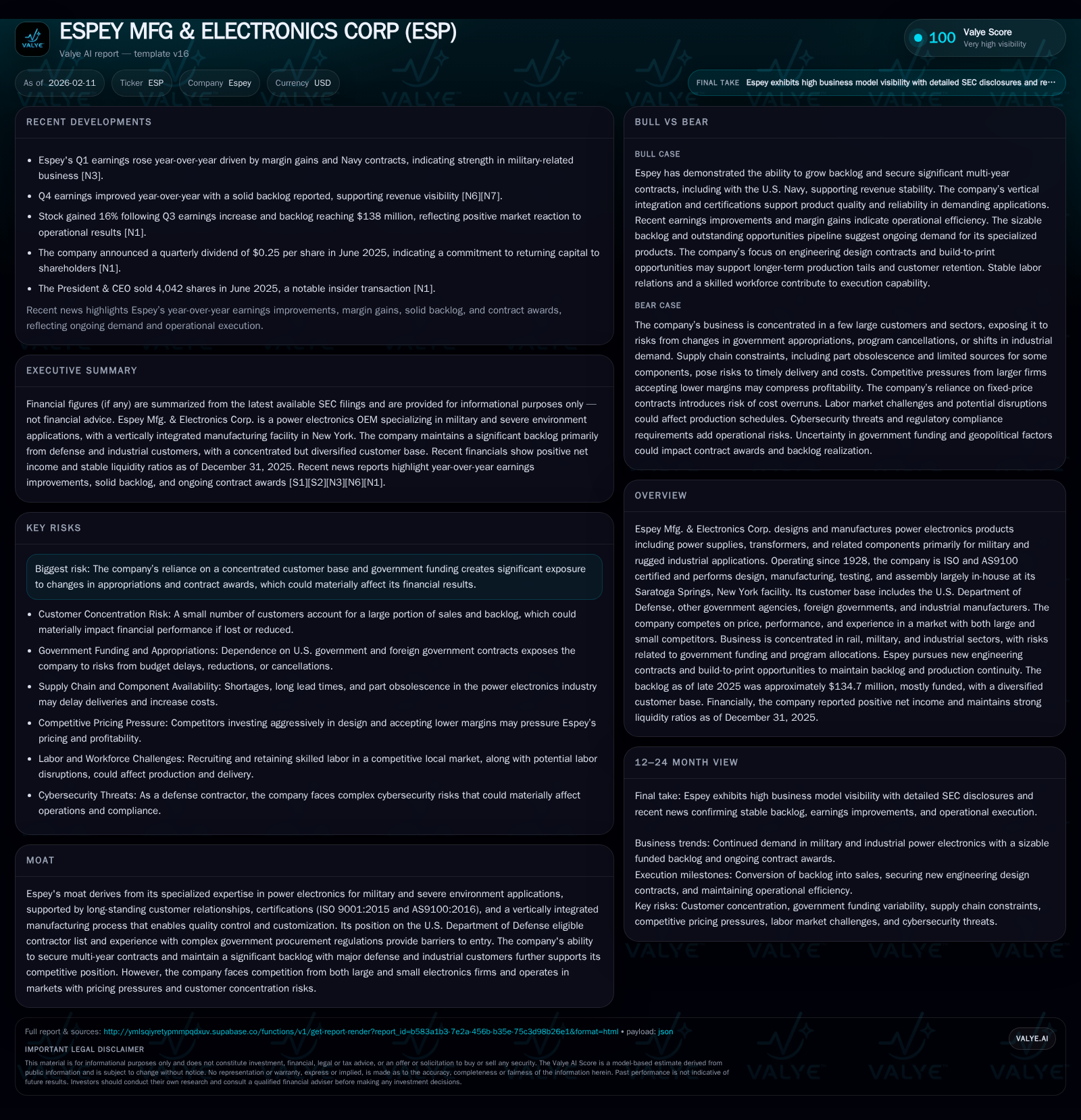
Founded in 1928, Espey MFG & Electronics Corp. operates in a niche powering rugged industrial and defense applications with highly engineered power supplies and transformers. The company's robust vertical integration and long-standing certifications support quality control and trusted relationships, especially with the U.S. Department of Defense and prime contractors. While revenue growth is expected in fiscal 2026 driven by sizable backlog orders, margin pressures loom due to rising costs, supply chain constraints, and intense competitive pricing dynamics. Espey's concentrated customer base poses notable risk but also underpins strategic stability through repeat contracts amid cautious pursuits of new engineering programs.
Legacy and Vertical Integration: Foundations of Espey’s Competitive Edge
Espey Mfg. & Electronics Corp., incorporated in New York in 1928, boasts nearly a century as a dedicated OEM in high-power energy conversion products tailored for military and severe environmental conditions [S1][S2]. Its longevity has cultivated deep-rooted expertise particularly valued by the U.S. Department of Defense (DoD), major defense primes, government agencies, foreign governments, and industrial manufacturers. Central to its competitive moat is an end-to-end vertical integration strategy — manufacturing processes including component production (such as inductors), PCB population, metal fabrication, painting, wiring, qualification, and comprehensive testing are predominantly performed in-house at its substantial Saratoga Springs facility spanning over 174,000 square feet [S1].
This integration enables rigorous control over quality standards vital to mission-critical applications where product reliability under extreme conditions is non-negotiable. The company holds ISO 9001:2015 and AS9100:2016 certifications, underscoring compliance with recognized quality management systems narrowly tailored to aerospace and defense industries [S1][S2]. Moreover, Espey offers design services ranging from initial concept engineering to build-to-print manufacturing according to customer specifications — a versatility that strengthens client trust by accommodating custom orders beyond standard product lines.
These factors collectively create significant barriers to entry for competitors lacking similar vertical breadth or regulatory certifications. Additionally, Espey’s presence on the DoD eligible contractor list positions it advantageously amid complex federal procurement ecosystems where longstanding relationships and certified status vastly influence award likelihoods.
Decoding the Backlog: The Next Chapter in Revenue Growth and Cost Challenges
Fiscal year 2026 projections signal higher revenues relative to fiscal 2025 driven primarily by backlog orders already secured [S1]. As of August 31, 2025, Espey reported an engineering program backlog worth approximately $13 million complemented by $163 million in estimated opportunities based on quotation status, historic ordering patterns, funding outlooks, and competitive positioning [S1]. These figures stem from a mix of repeat business for existing product lines as well as new programs encompassing power supplies, transformers, subassemblies and other ruggedized components.
Despite this promising top-line momentum—reflected partly by a recent quarterly revenue tally near $12.14 million [F1]—management explicitly warns of shrinking net income per share relative to prior periods due to escalated aggregate costs associated with this product mix [S1]. Inflationary pressures on raw materials combined with increased upfront investments for new program designs weigh heavily on margins. This dynamic is further complicated by prolonged supply lead times extending up to one year for certain critical parts requiring substitution or redesign due to obsolescence risks [S1].
The interplay between growing backlog fulfillment and rising input costs highlights a nuanced profitability profile; while sales volumes climb steadily thanks to contract visibility, gross profit margins experience compression reflecting competitive bid environments that demand price concessions or increased R&D expenditures.
Customer Concentration: Strategic Relationships and Associated Risks
Espey’s revenue stream exhibits pronounced reliance on a limited set of customers. The combined sales share of the top six customers approached approximately 74% during fiscal year 2025 [S1], illustrating significant concentration risk. These customers largely comprise key DoD prime contractors alongside governmental end-users—a profile emblematic of the specialized defense manufacturing sector where few large buyers dominate order flows.
This dependency amplifies operational volatility since any change in government appropriations or competitive award outcomes can materially affect revenue visibility. Moreover, shifts in individual prime contractor priorities or program cancellations carry potential downstream effects given Espey’s relatively small overall market share [S2]. While management actively pursues opportunities aimed at diversifying sales sources and reducing reliance on single major customers or programs [S1], the inherently cyclical nature of defense spending coupled with export controls impedes rapid channel expansion.
The company’s sales strategy therefore centers around nurturing enduring partnerships with these primes — leveraging proven delivery track records and system-level integration knowledge — to maximize contract renewals and secure longer-term production tails essential for stable cash flow generation [S1][S2].
Innovation Amidst Industry Pressures: Engineering Complexity and New Product Development
Amid persistent pricing pressures from large competitors who absorb upfront R&D costs at low margins [S2], Espey continues investing strategically in engineering design initiatives intended to unlock future contract awards. These efforts include undertaking funded as well as speculative design studies that may not immediately translate into orders but broaden technical capabilities within its engineering workforce [S1].
The company acknowledges inherent risks impacting backlog conversion rates such as technical challenges related to complex power electronics designs, resource availability constraints for specialized personnel, protracted customer milestone approval processes, and occasional prototype material shortages stemming from supplier delays or substitutions [S1]. These factors can produce project timeline extensions or cost overruns affecting near-term profitability.
Nevertheless, such proactive innovation remains critical for Espey’s ability to compete effectively given the evolving nature of military standards demanding higher performance metrics under harsh operational environments. The balance between absorbing short-term development expenses against positioning for multi-year production contracts underscores management’s approach toward sustained relevance in a changing industry landscape.
Supply Chain Realities: Navigating Component Scarcity and Labor Market Constraints
The current operating environment presents tangible challenges related to supplier availability alongside regional labor market dynamics. Extended lead times approaching or exceeding twelve months for certain critical components underscore the fragility of parts sourcing [S1]. Though many raw materials have multiple potential vendors mitigating some risk exposure [S1], select assemblies rely on single-source suppliers that provide superior quality yet pose bottleneck risks should disruptions occur.
Additionally, regional unemployment rates below national averages intensify competition for skilled workers essential to precision manufacturing tasks fundamental to Espey’s vertically integrated processes [S1]. Management reports stable workforce numbers but ongoing difficulties recruiting individuals possessing required expertise have prompted initiatives including targeted outside-region searches and expanded on-the-job training programs aimed at bridging skill gaps without compromising delivery schedules.
Together these supply chain headwinds constitute prominent operational constraints that must be carefully managed to avoid adverse impacts on order fulfillment timing or missed contractual commitments affecting revenue recognition and profitability forecasts.
Financial Health Snapshot: Liquidity, Margins, and Capital Deployment Plans
From a financial perspective at December 31, 2025, Espey maintains solid liquidity metrics highlighted by cash and equivalents totaling approximately $17.75 million alongside current assets near $80.9 million against current liabilities around $31.96 million — resulting in a healthy current ratio close to 2.53 indicative of comfortable short-term solvency [F1].
Capital expenditure plans remain modestly restrained relative to scale; management foresees spending capped just below $850 thousand primarily targeting machinery upgrades or facility improvements aligned with competitiveness objectives rather than expansion ambitions [S1]. This cautious capital deployment reflects an intent to optimize existing capacity while preserving working capital availability which also supports dividend payments deemed integral by governance bodies.
At the same time operating income margins face pressure owing to external cost inflation paired with internal reinvestment into design efforts required for sustaining future contract pipelines. Monitoring these dynamics will be essential given their direct influence on free cash flow generation potential amid fluctuating order intensity.
Competitive Landscape: Small Specialist vs. Large Industrial Giants
Espey occupies a unique space within a fragmented industry comprising both sprawling multinational electronics conglomerates capable of accepting lower profit margins as strategic market-share maneuvers alongside smaller highly specialized manufacturers focused on niche segments emphasizing performance differentiation.
Within this milieu, management candidly acknowledges the company “does not represent a significant share” relative to larger peers yet competes principally on pricing competitiveness supported by decades-long experience delivering complex products consistent with stringent military requirements [S2]. Such positioning entails frequent upfront design investment that depresses initial margins but cultivates durable program awards featuring extended production tails beneficial over time.
Price erosion trends fueled by aggressive competitor bidding necessitate continuous operational efficiency improvements without sacrificing quality — a perpetual balancing act fundamental to maintaining relevance against well-capitalized industrial giants wielding scale advantages often unattainable for smaller firms like Espey.
Outlook & Strategy: Balancing Stability, Risk, and Growth Opportunities
Looking ahead management projects continued revenue expansion supported primarily through backlog fulfillment albeit tempered outlooks regarding new order intake intensity forecasted below previous year levels [S1]. This cautious stance reflects expectations grounded in broader defense budget allocations influencing procurement schedules across various platforms relevant to Espey’s core markets.
Strategically the company remains committed to reaffirming longstanding customer alliances while proactively seeking new contracts accompanied by diversification efforts intended to reduce overly concentrated sales dependence [S1][S2]. Additionally oversight committees continuously evaluate acquisition possibilities focused specifically on product lines aligned synergetically with existing capabilities potentially accretive to earnings enhancing scale without diluting core competencies.
Ultimately Espey's narrative is one shaped by resilience through specialization: leveraging nearly 100 years’ worth of hard-earned domain knowledge combined with tightly controlled manufacturing prowess underpinning trusted military power electronics solutions amid an environment marked simultaneously by stable demand fundamentals yet acute margin pressures requiring vigilant execution going forward.
DISCLAIMER: This report is provided solely for informational purposes based on publicly available information including SEC filings as of early 2026. It does not constitute investment advice or recommendations concerning securities or investment strategies involving Espey MFG & Electronics Corp. Investors should perform their own due diligence before taking any action.
Disclaimer: This is research-only, informational analysis and not investment advice. It may include AI-generated interpretation and general industry context. Always verify important details using primary sources.

Comments