
Ensign Group Leverages Localized Management and Captive REIT to Navigate Post-Acute Care Challenges
Q2 2026 results spotlight Ensign’s growth via acquisitions, quality improvements, and real estate strategy amid regulatory headwinds.
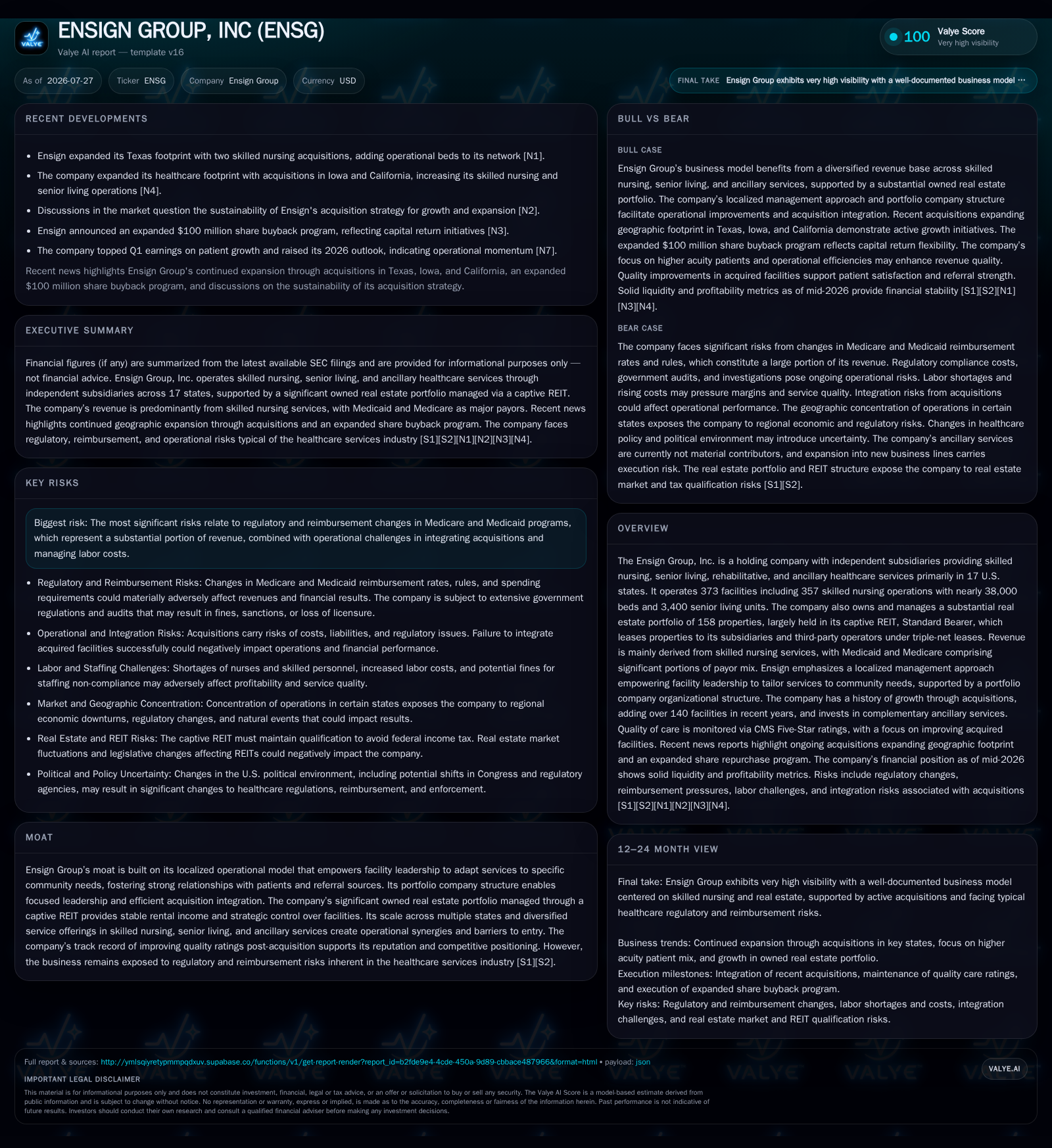
The Ensign Group reported its latest quarterly filing for Q2 2026, reaffirming its localized operational approach and demonstrating ongoing success in expanding skilled nursing facilities while managing reimbursement pressures. Its unique portfolio company structure empowers local leadership to tailor services, driving quality rating improvements that support referral relationships. Ensign’s captive REIT, Standard Bearer, provides stable rental income and strategic real estate control. The company faces typical post-acute care regulatory and labor challenges but leverages scale, geographic diversification, and ancillary services to sustain growth. Key watchpoints include reimbursement trends, quality score trajectory, acquisition integration, and labor cost management.
Recent Operating Update: Q2 2026 Filing Highlights Strategic Continuity
The Ensign Group’s Q2 2026 10-Q filing underscores continued momentum in both facility expansion and service integration across its skilled nursing footprint in 17 U.S. states [S2]. The company operates 373 facilities comprising 357 skilled nursing operations with nearly 38,000 beds alongside approximately 3,400 senior living units [S1]. Ensign reinforces its localized management philosophy by empowering facility leaders to adapt care delivery based on community-specific needs—a distinguishing element within the fragmented post-acute care industry [S1]. This approach supports high-quality clinical outcomes and fosters robust relationships with patient referral sources.
The Q2 results also mention the use of various non-GAAP measures, including adjusted EBITDA, EBITDAR (excluding rent expense), and funds from operations tied to its real estate segment [S3][S4][S5]. This reflects the dual nature of Ensign’s business as both a healthcare operator and a real estate lessor through its captive REIT, Standard Bearer.
Business Model: A Dual Approach Combining Skilled Nursing Services and Real Estate Leasing
Ensign’s revenue is dominantly driven by skilled nursing facility (SNF) operations generating 95.6% of total revenues in the year ended December 31, 2025 [S1]. These revenues are mainly reimbursed under Medicare and Medicaid programs supplemented by private payor sources. The company’s healthcare services focus on rehabilitative care and ancillary offerings such as mobile diagnostics and medical transport that support patient recovery phases and broaden service revenue diversity.
Critically, Ensign owns a substantial real estate portfolio of 158 properties encompassing about 120 of its operating facilities; additional properties are leased to third parties [S1]. This portfolio is managed largely through Standard Bearer, a captive REIT that engages in triple-net leasing arrangements with Ensign’s subsidiaries as tenants under long-term leases featuring annual CPI-based rent escalations capped at typical ranges [S1]. These leases provide the company stable rental income distinct from the more variable clinical service margins. Around two-thirds of operated facilities are leased long-term with options to purchase certain properties at predefined terms [S1].
This hybrid model—service delivery plus real estate ownership/leasing—is increasingly common among larger multi-state providers seeking to stabilize cash flow while retaining operational flexibility. The captive REIT structure aligns incentives between property ownership and facility operations while enabling external investors exposure primarily to the real estate cash flows.
Industry Structure & Competitive Positioning: Scale, Quality Leadership, and Geographic Footprint
In the post-acute healthcare sector—which includes SNFs, senior living communities, rehabilitation centers, and ancillary health services—operational scale combined with quality metrics holds significant competitive value. Ensign’s operating presence across multiple states offers geographic diversification benefiting market reach and patient referral networks.
Quality ratings measured by CMS’ Five-Star Quality Rating System materially influence patient choice and payer contracting. Despite acquiring lower-rated facilities (often with 1 or 2 stars), Ensign has grown the number of its facilities rated at 4 or 5 stars from 114 in 2021 to 153 at end of 2025, outperforming national averages by notable margins in overall star scores (+6.8%) and quality measures (+18.2%) [S1]. This track record enhances referral inflows crucial for occupancy rates—a primary driver of revenue given reimbursement models tied to patient volume.
Operational integration success remains a competitive differentiator; acquiring underperforming SNFs or senior living communities entails risks around quality maintenance but offers growth opportunities through post-acquisition improvements. Ensign’s portfolio company organizational structure supports focused leadership teams who oversee clusters of facilities yet retain local accountability for clinical excellence.
Growth Drivers: Aging Demographics, Acquisition-Fueled Expansion, Ancillary Service Growth
The aging U.S. population remains a structural tailwind bolstering demand for SNF care and senior living services. Ensign actively pursues acquisition opportunities targeting underperforming or geographically strategic facilities—recent expansions notably include adding skilled nursing assets in Texas [N3]. This acquisition pipeline not only expands bed capacity but can improve aggregate quality ratings post-integration.
Growth is also aided by diversification into ancillary healthcare services which complement core rehabilitative care offerings while enhancing patient outcomes through coordinated services.
Real estate investments via Standard Bearer create recurring rental income that supports financial resilience during periods of clinical reimbursement uncertainty or cost inflation.
Finally, legislative shifts towards value-based care incentivize providers like Ensign to improve efficiency and quality metrics further integrating care components traditionally siloed.
Risks & Watchpoints: Reimbursement Pressure, Regulatory Scrutiny, Labor Cost Inflation, Integration Challenges
Ensign faces several classic industry risks detailed in their recent risk disclosures [S16][S22]: Medicare/Medicaid reimbursement rule changes—including rate cuts or tightened spending requirements—pose material revenue risks given these payors represent major revenue portions. State-level regulatory mandates can raise operational costs or slow expansions.
Government reviews or audits may generate fines or require repayment impacting earnings visibility. Increased enforcement efforts towards SNFs heighten scrutiny risks post-acquisition when inherited compliance gaps may exist.
Labor shortages—especially among nurses and therapists—lead to rising wage pressures that compress margins unless offset by pricing or productivity gains. Staffing shortfalls also risk regulatory penalties affecting reimbursements.
Acquisition integration requires careful execution; failure could lead to quality erosion or reputational damage undermining referral volumes.
Cybersecurity remains a focus area amid increasing digital systems usage; data breaches could result in liability exposures requiring ongoing investment in defenses.
What to Watch Next: Quality Trends Post-Acquisition, Reimbursement Policy Evolution, Acquisition Pipeline Metrics
Key indicators include monitoring the sustained increase in high-star-rated facilities which validate localized management effectiveness.
Tracking occupancy rates relative to industry peers reveals referral success amid competitive pressures.
Regulatory developments around Medicare/Medicaid payment reforms will impact medium-term financial outlooks; timely adaptations signify resilience.
Integration milestones for recent acquisitions—such as the Texas skilled nursing additions—will serve as execution barometers.
Labor cost inflation trends bear watching given their direct margin impact; any wage increases above planned levels warrant attention.
Real estate lease renewals under master lease agreements with CPI escalations should be observed for potential financial effects amid inflation fluctuations.
Financial Profile Discussion
As of June 30, 2026, Ensign reported $262 million in cash and equivalents against current liabilities approximating $885 million yielding a current ratio near 1.21x—a sign of moderate short-term liquidity strength [F1]. Current assets total just over $1 billion providing comfortable coverage for upcoming obligations.
Operating leases—primarily triple-net master leases with entities like CareTrust—constitute significant obligations extending over decades but are generally supported by predictable rental receipts [S1].
Recent expansions of share repurchase authorization up to $100 million signal confidence in free cash flow generation despite capital requirements for acquisitions [S24][S26]
Ongoing capital expenditures focus on upkeep of owned properties alongside selective investments enhancing service capabilities across subsidiaries.
This analysis reflects data available as of July 27, 2026 from SEC filings. It integrates sector context without prescriptive investment conclusions. Future developments regarding reimbursement policy changes or operational execution warrant close observation given their outsized influence on financial outcomes within post-acute healthcare provision.
Disclaimer: This is research-only, informational analysis and not investment advice. It may include AI-generated interpretation and general industry context. Always verify important details using primary sources.

Comments