
Enova International’s Q1 2026 Growth Anchored by AI-Driven Credit, Diversified Fintech Offerings
Robust loan originations and machine learning-powered underwriting sustain Enova’s scalable online lending amid tightening regulations.
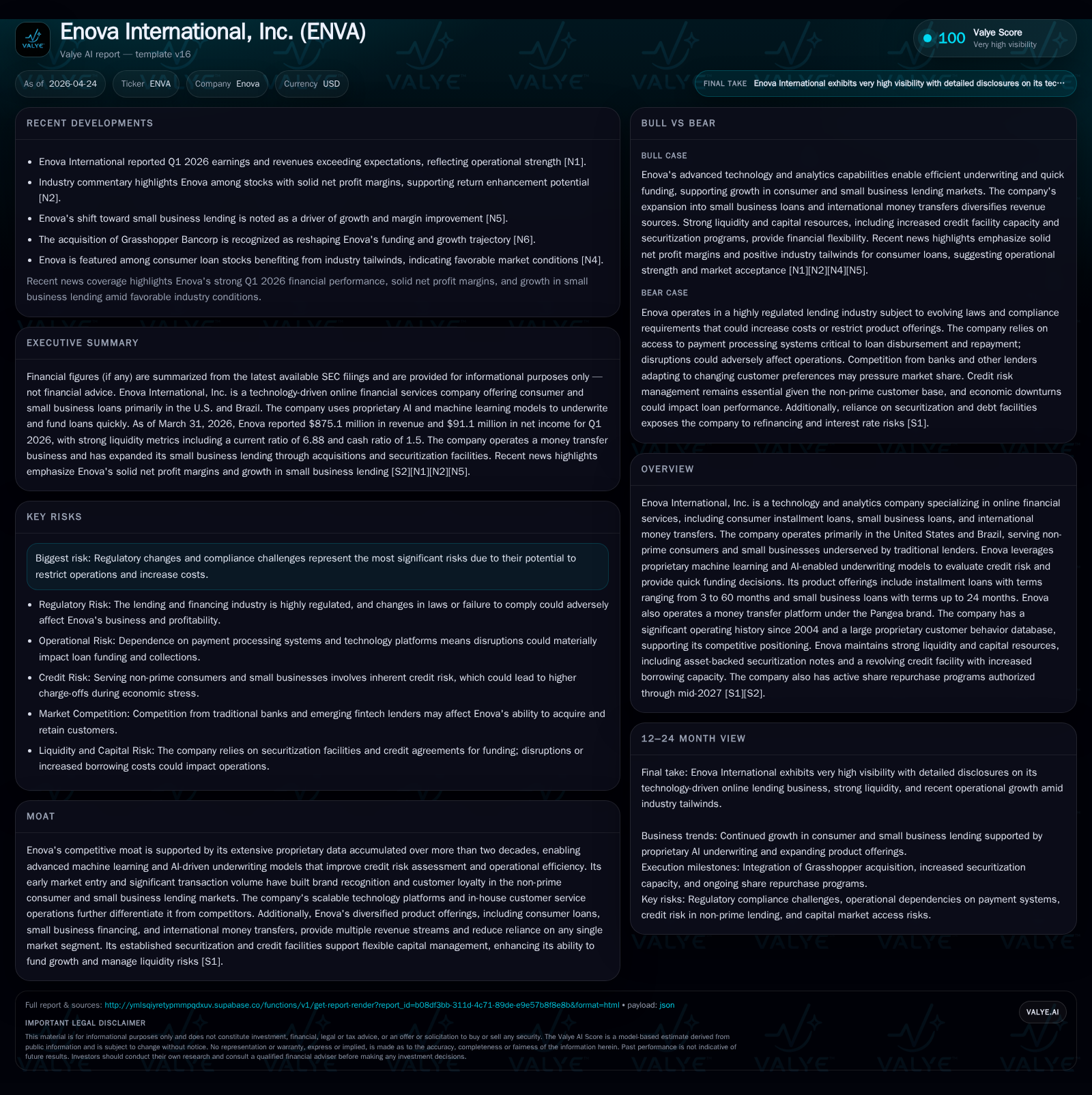
Enova International, Inc. reported continued momentum in its Q1 2026 results, leveraging proprietary AI models and advanced analytics to expand credit offerings to underbanked consumers and small businesses in the U.S. and Brazil. The company’s recent quarterly filings emphasize strong transaction volume growth and diversified revenue streams, underscoring its competitive moat built on extensive data and technology investments. Despite regulatory complexities and reliance on capital markets for funding, Enova's flexible securitization and credit facilities support sustained portfolio growth. Key near-term focus points include monitoring regulatory impacts and execution of its securitization funding strategy.
Recent Operating Update - Q1 2026
Enova International’s latest SEC filings ([S2], [S3]) covering Q1 2026 showcase strengthened operational performance with continued growth in loan originations across both consumer and small business segments. The company announced results exceeding earnings and revenue estimates ([N1]), underscoring effective underwriting powered by a mature AI and machine learning ecosystem finely tuned to its substantial proprietary database of over 69 million transactions collected since inception in 2004 ([S1]).
This quarter reflects strategic execution of Enova’s core advantage: rapidly deploying capital through digital platforms using predictive analytics enabling quick credit decisions for underserved borrower cohorts in the U.S. spanning 37 states plus Brazil, alongside small business owners nationwide in the U.S. Enova's growing installment loan portfolio with terms ranging up to five years for consumers, complemented by small business loans averaging shorter terms (up to two years), demonstrates segment diversification supporting revenue stability.
Business Model
Enova generates revenue primarily through interest and fees on online consumer installment loans, small business loans, as well as transaction fees from international money transfers under the Pangea brand ([S1]). Its loans are characterized by amortizing principal with interest recognized on an effective yield basis. The firm functions as both direct lender and arranger through bank partnerships that originate loans which it subsequently purchases or guarantees.
Central to Enova’s model is its advanced proprietary underwriting system that harnesses machine learning—accounting for approximately 90% of deployed analytical models—to assess creditworthiness dynamically, adapt pricing structures compliant with jurisdiction-specific regulations, and optimize portfolio performance ([S1]). This real-time risk assessment capability enables fast funding decisions aligned with borrower demand for convenience compared to traditional lenders.
The company emphasizes customer acquisition through targeted marketing based on behavioral insights captured in its expansive data lake exceeding 95 terabytes of transactional information.[S1] This facilitates tailored financing offers improving acceptance rates while controlling default risk.
Industry Structure and Competitive Position
Operating primarily within the alternative finance space servicing non-prime consumers and small businesses underserved or ignored by mainstream financial institutions places Enova in a niche with high barriers to entry due to the complexity of credit risk modeling at scale.
Its moat derives from early digital market entry dating back to 2004 coupled with machine learning-enhanced underwriting bolstered by a unique data repository unavailable to newer entrants (). Competitors such as OnDeck Capital (acquired) provide some overlap but lack Enova's breadth spanning both consumer and business markets internationally.
Further differentiation stems from vertical integration including in-house servicing capabilities reducing operational costs relative to peers relying heavily on third-party servicers. The Pangea money transfer platform adds a complementary income stream reducing concentration risk inherent in pure lending.
Growth Drivers & Constraints
Key drivers include:
- Structural demand from expanding populations of near-prime consumers seeking quick access to loans traditionally constrained by stringent bank criteria.
- Technology advancements improving credit decision speed and accuracy.
- Product innovation, entering new markets or geographies swiftly via scalable platform flexibility.
- Capital market access maintaining liquidity for origination scaling via securitizations and revolving lines ([S5], [S6], [S7]).
Constraints revolve mainly around:
- Regulatory scrutiny intensifying in various states complicating product design and potentially imposing stricter compliance costs ([S11], ).
- Dependence on continuous capital market funding; disruptions could impose scaling limits given sizable total debt outstanding (approx. $4.5 billion at end 2025) ([F1], [S12]-[S16]).
- Credit quality volatility necessitates vigilant portfolio monitoring amid macroeconomic shifts impacting delinquency trends ([N13]).
What to Watch Next
Milestones critical for stakeholders include:
- Execution progress on asset-backed note issuances enlarging securitization pools supporting consumer and small business portfolios beyond the $232 million noted capacity as of early 2026 ([S7]).
- Regulatory developments particularly state-level changes impacting permissible loan terms or pricing strategies.
- Credit performance indicators such as charge-off rates or >30-day delinquencies given their direct influence on portfolio valuation adjustments ([N13], [S19]).
- Technology upgrades enhancing user experience or further automating collections may bolster margins.
- Updates on share repurchase strategy reflecting management’s view on capital deployment efficacy ([F1], [S8], [S16]).
Financial Profile
Enova's fiscal year 2025 results highlight solid financial health underpinning operations:
Historical performance (annual)
| FY | Rev ($bn) | Net ($mm) | CFO ($mm) | OpInc ($mm) | Rev YoY | Net YoY |
|---|---|---|---|---|---|---|
| 2025 | 3.2 | 308 | 1819 | 739 | +18.6% | +47.2% |
| 2024 | 2.7 | 209 | 1539 | 585 | +25.5% | +19.6% |
| 2023 | 2.1 | 175 | 1167 | 422 | +22.0% | -15.6% |
| 2022 | 1.7 | 207 | 894 | 384 |
Source: SEC companyfacts cache [F1].
Capital returns and efficiency (annual)
| FY | Buybacks ($mm) | ROE% |
|---|---|---|
| 2025 | 215 | 23.1 |
| 2024 | 289 | 17.5 |
| 2023 | 153 | 14.1 |
| 2022 | 143 | 17.5 |
Source: SEC companyfacts cache [F1].
The increase in operating income (+26.5%) outpaced revenue growth reflecting improved operating efficiencies while net income surged driven also by favorable tax benefits alongside controlled expenses ([F1]). Operating cash flow growth (+18.2%) supports ongoing reinvestment into loan originations.
Liquidity remains stable with cash & equivalents at $96 million as of March 31, 2026, supplemented by committed revolving credit facility increased recently to $825 million maturity August 2029, alongside diverse asset-backed securitization facilities totaling several billion dollars in outstanding notes ([F1], ). This balance sheet flexibility is pivotal given the company’s reliance on external financing to fund growth.
Leverage metrics suggest total debt close to $4.5 billion net of cash exposure as per year-end figures; however, prudent capital allocation including active share repurchases shows management confidence in sustaining enterprise value while managing cost of capital ([F1], [S8], [S16]).
Conclusion
Enova International currently exemplifies a fintech player effectively combining deep data assets with advanced AI-driven underwriting architecture tailored toward underserved lending sectors across North America and Brazil. Its scalable technology foundation allows nimble adaptation amid evolving regulatory constraints while diversified product lines mitigate concentration risks somewhat inherent in consumer finance.
The firm’s future trajectory depends heavily on continued access to capital markets for funding origination volumes alongside tight stewardship over regulatory compliance frameworks critical for sustainable operations. Investors should closely follow management’s execution regarding new securitizations, credit portfolio health indicators, potential regulatory shifts, and ongoing technological innovation initiatives.
This analysis is based exclusively on publicly available SEC filings dated through April 23, 2026, associated news reports as cited, and company facts data snapshots ending Q1 2026 without any investment recommendation.
Disclaimer: This is research-only, informational analysis and not investment advice. It may include AI-generated interpretation and general industry context. Always verify important details using primary sources.

Comments