
Enova International Expands SMB Lending and Strengthens Liquidity in Q2 2026
Enova’s second-quarter results showcase robust revenue growth and solid liquidity amid a strategic shift towards small business lending.
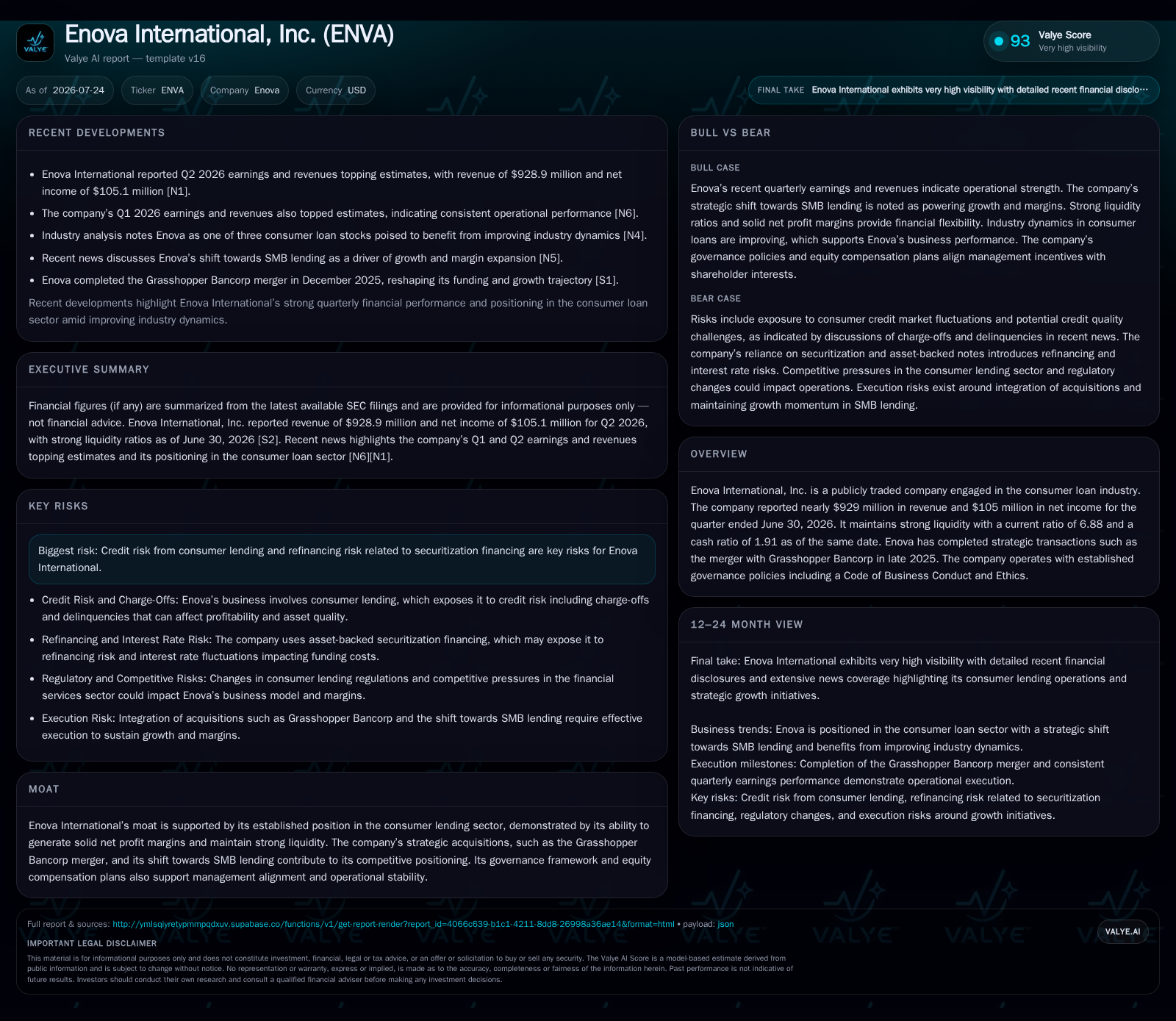
Enova International reported strong Q2 2026 financials with revenue nearing $929 million and net income of $105 million, underscoring effective scale and profitable operations. The company continues to leverage proprietary AI-driven underwriting platforms to serve underserved consumer and SMB borrowers across multiple states and Brazil. Strategic moves, including the completed Grasshopper Bancorp merger, accelerate Enova's focus on small business lending while its diversified funding structure provides balance-sheet resilience. Key risks center on credit quality dynamics and refinancing needs tied to securitization facilities.
Recent Operating Update
Enova International's latest quarterly filing on July 23, 2026, reveals a pivotal step in its growth trajectory with revenue nearing $929 million for Q2 and net income amounting to approximately $105 million [S2][N1]. This marks continued momentum from prior periods fueled by robust loan origination volumes across its consumer and small business segments. Moreover, completion of the Grasshopper Bancorp merger in late 2025 extends Enova’s platform capabilities deeper into small business (SMB) lending markets with insured bank-like functionalities now integrated [S3][S23]. These developments underscore Enova’s strategic diversification beyond its traditional core consumer installment loans toward broader financial product offerings that encompass revolving credit lines and SMB financing.
Business Model Analysis
Enova operates as a technologically sophisticated direct lender focused on alternative credit markets underserved by traditional banks. The company’s revenue stems primarily from interest income and fees generated by loans extended through online channels to consumers and SMBs. Serving clients in 37 states plus Brazil (consumer loans) and nearly all U.S. jurisdictions for small business financing highlights geographic breadth [S1]. Its proprietary underwriting technology leverages extensive historical customer behavior data—over 95 terabytes collected since inception—to power machine learning models that currently account for roughly 90% of credit decisioning processes. This enables pricing agility, rapid funding turnaround, and stringent credit risk management tailored to jurisdictional requirements.
Loan products are principally installment loans and lines of credit offered via digital platforms accessible via desktop or mobile devices. Enova’s ability to continually refine its analytical models based on portfolio performance and repayment behavior strengthens its competitive moat by improving predictive accuracy on delinquencies and charge-offs—a key driver of net interest margins. The firm also services loans internally, capturing servicing fees as part of income.
Financially, Enova carries its loans and finance receivables at fair value using discounted cash flow methodologies adjusted for estimated losses, prepayments, and servicing costs [S26]. This accounting approach emphasizes the importance of active portfolio monitoring because changes in macroeconomic conditions or borrower behavior directly impact earnings volatility through fair value adjustments.
Industry Structure and Competitive Position
Within the consumer finance and online lending sector, Enova competes alongside fintech platforms such as LendingClub (consumer-focused), OnDeck Capital (SMB lending), Avant (alternative consumer credit), and AI-centric lenders like Upstart. Unlike traditional banks constrained by legacy systems or regulatory burden, Enova’s digital-first underwriting offers speed and scale advantages but faces challenges from rapidly evolving regulatory landscapes governing multi-state operations.
The recent acquisition of Grasshopper Bancorp enhances Enova's competitive stance by embedding insured banking functions to support more stable funding sources—a crucial differentiation amid tightening debt capital markets. This move aligns Enova nearer to vertically integrated fintech lenders capable of offering both customer-facing credit products and backend deposit-taking services.
Enova's access to securitization markets is foundational to funding scale. The company maintains multiple asset-backed securitization (ABS) notes totaling approximately $3 billion as of year-end 2025, featuring staggered maturities up to the early 2030s, supplemented by corporate debt facilities including a revolving credit line increased incrementally up to $825 million most recently [F1][S4–S6]. These structures provide elasticity but introduce refinancing execution risk subject to capital market conditions.
Growth Drivers
Key growth vectors for Enova include expanding penetration into underserved SMB borrower segments leveraging Grasshopper’s charter-enhanced platform capabilities. Rising demand for non-bank alternatives among consumers wary of traditional lenders underpins continued volume growth in installment loans and revolving lines of credit products.
Technological innovation remains central: continuous enhancements to machine learning-based underwriting aims to improve loss predictions while lowering customer acquisition costs through optimized marketing algorithms. Additionally, geographic market expansions into new states or emerging economies like Brazil bolster total addressable markets.
Product diversification strategies — introducing new financing solutions responsive to regulatory shifts or customer preferences — offer incremental fee income streams while improving customer retention rates due to integrated offerings across personal and commercial lines.
Finally, partnerships with banks and other financial institutions supplement capital access while providing distribution avenues.
Risks and Growth Constraints
Despite operational strengths, Enova faces material risks that could constrain growth or depress profitability. Credit risk remains paramount; marked-to-market accounting means rising delinquencies can swiftly erode earnings visibility during economic downturns or adverse borrower behavior shifts [S26]. While proprietary analytics mitigate some uncertainty, systemic shocks remain difficult to predict.
Refinancing risk tied to securitization facilities is a critical watchpoint given that much funding expires through the late-2020s; disruptions in ABS markets or increased borrowing costs could impair growth financing options [S4][S6]. Regulatory complexity across states—and internationally—adds operational cost burdens related to licensing compliance, product modifications, and customer disclosures [S18][S19]. Continued competition from incumbent banks expanding digital channels alongside agile fintech startups exerts pressure on pricing power.
Customer acquisition cost inflation linked to intensified online marketing competition may temper returns if not offset by underwriting efficiency gains. Moreover, any technology platform failures or data breaches would damage reputation and create compliance liabilities.
What to Watch Next
Investors should monitor Q3 origination volumes by segment for evidence that SMB lending gains from the Grasshopper merger are scaling profitably without elevating loss reserves disproportionally. Management commentary on portfolio credit quality trends amid macroeconomic signals will also provide insight into underlying loan performance sustainability.
Refinancing activity related to maturing securitization notes or revolver utilization rates will reveal liquidity flexibility against operating needs. Updates on regulatory developments impacting product design or geographic reach are critical because these factors directly affect growth opportunities.
Finally, tracking share repurchase program execution will illuminate management priorities between capital return versus reinvestment in platform expansion initiatives [S14][S15].
Financial Profile Discussion
As of June 30, 2026, Enova reported cash and cash equivalents of $122 million alongside an exceptionally strong current ratio of 6.88—reflective of ample short-term liquidity relative to liabilities [F1]. This provides operational cushion for near-term working capital demands driven by loan originations.
At December 31, 2025, total debt stood near $4.5 billion predominantly composed of asset-backed securitizations carrying weighted average interest rates between approximately 5.6% - 8.3%, alongside corporate senior notes yielding around 9% -11% ranges [F1][S4–S6]. Refinancing windows spread over multiple years ease concentration risk but necessitate vigilant capital market access management.
Disclaimer: This analysis is for informational purposes only based on publicly available data as of July 24, 2026. It does not constitute investment advice or a research view regarding securities of Enova International or any other entity.
Disclaimer: This is research-only, informational analysis and not investment advice. It may include AI-generated interpretation and general industry context. Always verify important details using primary sources.

Comments