
EON Resources: Permian Basin Leverage, Liquidity Limits, and Scaling Production Prospects
The company’s ability to translate asset potential into sustainable growth will hinge on operational reliability, capital access, and the effectiveness of its risk-sharing strategies.
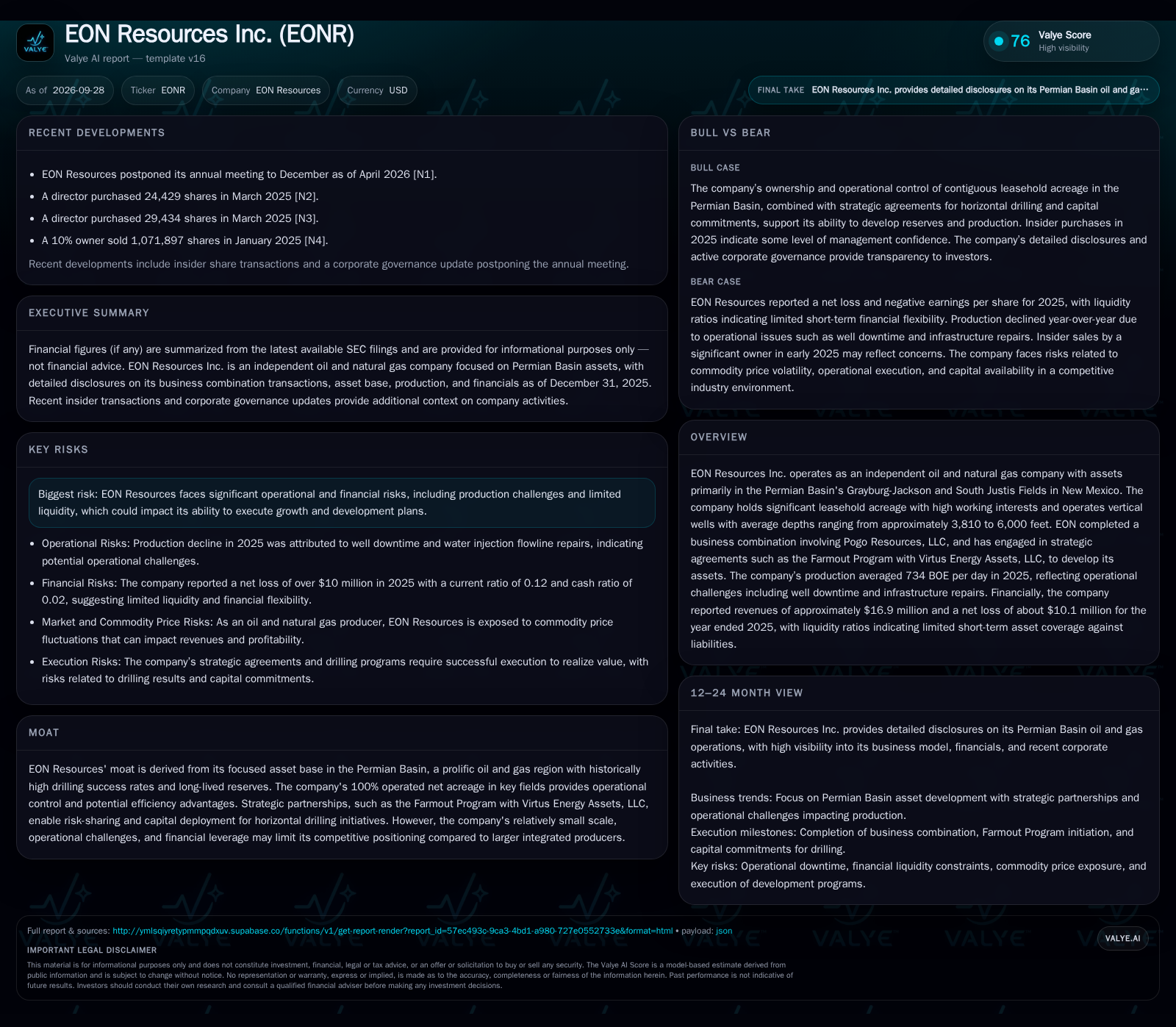
EON Resources operates 100%-controlled acreage in New Mexico’s Permian Basin with strategic partnerships for development. Despite this, production declined in 2025 due to operational setbacks, and liquidity is severely constrained with a current ratio of 0.12 and a net loss of $10.1 million. Execution of drilling programs and capital infusions are critical for value realization. Insider activity is mixed, with both purchases and significant sales in 2025, reflecting divergent views on near-term prospects. The company’s future depends on overcoming operational disruptions and securing funding for its development pipeline. [S1] [N2] [N3] [N4]
EON Resources Inc. is a Permian Basin-focused independent E&P operator with a concentrated leasehold position and full operational control over its core assets. The company’s asset base and strategic farmout partnerships should, in theory, provide a foundation for reserve growth and improved production. Recent insider activity underscores mixed sentiment about the company’s near-term prospects. The critical question is whether EON can marshal the operational execution and capital required to unlock its acreage value before liquidity pressures force strategic or financial retrenchment.
Recent Trends: Production Drops and Liquidity Pressures Shape Current Outlook
The company reported a cash ratio of 0.02 for the period. The company reported cash and liquidity metrics for the period; these figures do not by themselves establish operating runway, investment capacity, financial flexibility, or financing capacity. The company’s strategic response has included entering a Farmout Program with Virtus Energy Assets to share drilling risk and accelerate development in the Grayburg-Jackson Field. Insider activity has been mixed, with director purchases in March 2025 and a major shareholder’s large sale in January, reflecting divergent views on the company’s near-term trajectory. [S1] [N2] [N3] [N4]
Balancing Asset Control with Capital Limits in Small-Cap Permian E&P Economics
EON’s business model is built around acquiring, operating, and developing oil and gas properties in the Permian Basin, with a focus on maximizing value through high working interests and operational control. This structure theoretically enables the company to capture a larger share of incremental returns from successful drilling programs. However, the capital intensity of drilling—even shallow vertical wells—requires substantial up-front investment with a lag before production and cash flow realization. Fixed costs (lease operating expenses, infrastructure maintenance, G&A) are relatively high as a percentage of revenue for small operators, and operating leverage can be significant in either direction.
The Farmout Program with Virtus Energy Assets is a classic risk-sharing mechanism: the counterparty funds or co-funds drilling in exchange for a portion of the working interest, allowing EON to pursue development without shouldering all the capital burden. The trade-off is dilution of future upside from successful wells. Without new capital or a step-change in operating cash flow, the company risks being unable to exploit its asset base fully or may face pressure to divest properties at suboptimal terms.
How Scale, Efficiency, and Partnerships Influence Permian Basin Positioning
The Permian Basin remains the most competitive and capital-intensive oil and gas province in North America, dominated by larger independents and integrated majors with significant scale, technical resources, and access to capital. EON’s competitive advantage stems from its concentrated, 100%-operated net acreage in proven fields, allowing for operational flexibility and full capture of development upside.
Strategic partnerships, such as the Farmout Program, partially offset these disadvantages by sharing risk and accelerating development. Still, the lack of vertical integration, limited bargaining power with service providers, and lower economies of scale constrain EON’s ability to compete on cost and technology. Substitute assets—especially from larger, better-capitalized peers—can outcompete smaller operators for both investor attention and drilling economics. The company’s ability to carve out a durable niche depends on consistently reliable operations, successful execution of drilling programs, and the ability to secure growth capital without excessive dilution.
Operational Recovery and Farmout Wins as Drivers of Asset Value Expansion
A favorable outcome for EON Resources would involve a restoration of operational reliability—reducing well downtime and infrastructure failures—combined with successful execution of the Farmout Program. If Virtus Energy Assets and other partners can deliver on drilling commitments, with new wells coming online at or above type-curve expectations, production could recover and potentially exceed prior peaks. This would translate to higher cash flow, improved coverage of fixed costs, and a reduced need for dilutive external capital.
Confirmation of this scenario would include sequential quarterly increases in BOE production, visible reductions in lease operating costs per barrel, new farmout or JV agreements with credible partners, and evidence of positive well results (IP rates, EURs) from recent drilling. Additional insider purchases, third-party capital infusions, or asset sales at attractive multiples would further validate the thesis. Falsification would occur if production continues to stagnate, if farmout partners withdraw or underperform, or if the company is forced into distressed asset sales or recapitalizations.
Organic Growth Potential Under Capital Constraints Defines Base Case
The most plausible path for EON Resources is a slow operational recovery, with production stabilizing near current levels as infrastructure repairs are completed and existing wells are optimized. The Farmout Program may yield incremental new wells, but capital limitations and risk-sharing dilution mean that growth is modest and lumpy. Cash flow may improve but is unlikely to fully offset current liabilities or fund a significant ramp in development without external financing.
Under this scenario, EON remains a marginal player: able to maintain its asset base and participate in incremental drilling, but persistently constrained by liquidity and at risk from commodity price volatility. Evidence supporting this view would include flat or slightly rising production, continued negative net income, and periodic small-scale farmout or asset monetization transactions. The thesis would be challenged if the company materially grows production without significant dilution or distress, or if operational setbacks drive further declines.
Value Risks from Liquidity Tightening and Potential Asset Sales
If operational disruptions persist or worsen—through continued well downtime, failed repairs, or unsuccessful new drilling—EON’s already thin liquidity could be exhausted. In this scenario, the company faces a cash crunch that forces asset sales under distressed conditions, potentially at steep discounts to intrinsic value. Alternatively, EON could be compelled to accept highly dilutive financings or cede control of core assets to partners or creditors.
Signs confirming this path would include further declines in production, a widening net loss, breaches of lease or debt covenants (if disclosed), and announcements of asset sales or recapitalizations at punitive terms. A sharp drop in insider or institutional ownership could also signal eroding confidence. The scenario would be less likely if the company secures bridge financing, executes a turnaround in field operations, or finds a strategic acquirer for its acreage at a premium.
Factors Influencing EON Resources’ Ability to Monetize Its Acreage
Quarterly production volumes (BOE/day) and sequential changes, as these will show whether operational recovery and new drilling are offsetting declines.
Lease operating expense per BOE, which, if disclosed, would clarify whether cost control is improving with scale or further deteriorating.
Updates on the Farmout Program with Virtus Energy Assets, including the number of wells drilled, capital commitments, and well performance metrics.
Cash and equivalents at each quarter-end, particularly relative to current liabilities, to gauge solvency risk.
Announcements of new joint ventures, farmouts, or asset sales that materially change the company’s risk profile or liquidity.
Insider buying or selling, especially by senior management or large shareholders, as a sentiment gauge for near-term prospects.
Any changes in reserve estimates or independent reserve reports, if disclosed, to test whether drilling activity is translating into sustainable reserve growth.
Disclosure of debt maturities, covenant requirements, or new financing arrangements, which would highlight potential financial flexibility or distress.
Disclaimer: This is research-only, informational analysis and not investment advice. It may include AI-generated interpretation and general industry context. Always verify important details using primary sources.

Comments