
Franklin Wireless: Strategic Pivot, Product Transition Risks, and the Economics of Next-Gen Connectivity
Franklin Wireless is navigating a sharp revenue decline and shifting market dynamics as it transitions away from legacy mobile hotspots toward fixed wireless routers and telecom modules. Execution on new product lines and resilience to supply and regulatory shocks will determine whether the company can stabilize and scale its business in evolving wireless markets.
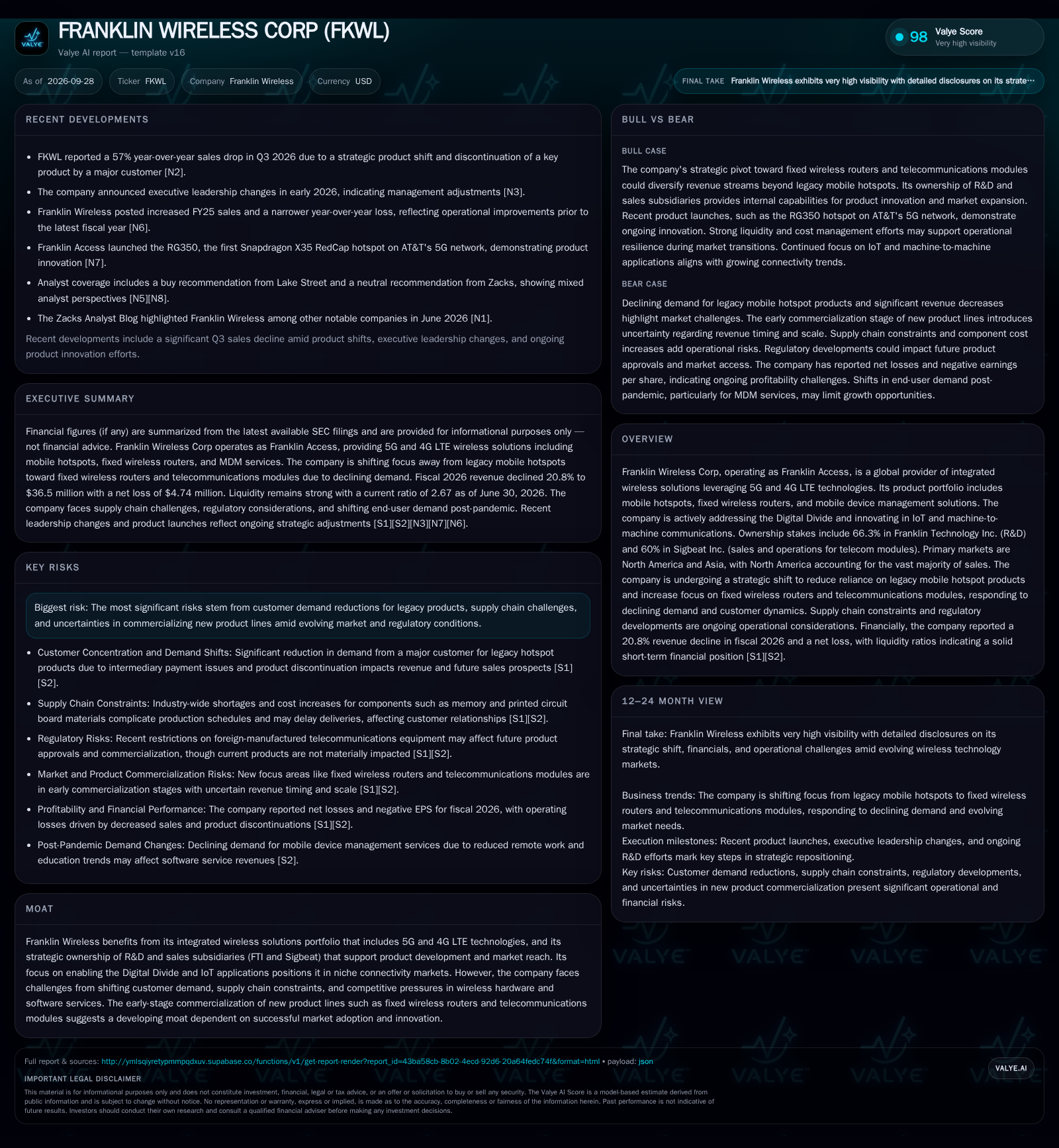
Franklin Wireless is experiencing a major business transition, marked by a 20.8% revenue drop for fiscal 2026 and a widened net loss. The company is reducing reliance on legacy mobile hotspots after a major customer discontinued a key product, instead focusing on fixed wireless routers and telecommunications modules.Early-stage commercialization and supply chain volatility create uncertainty, even as the company maintains a reported current ratio and stable gross margins. The success of this pivot will depend on the pace of adoption for new products and the company's ability to manage operational risks and shifting demand in core markets. [S1] [S2]
Franklin Wireless finds itself at a crossroads after a steep drop in revenue and profitability following the discontinuation of a major mobile hotspot product by a key carrier customer. The company is betting on a strategic pivot to fixed wireless routers and telecommunications modules to replace lost revenue streams, but these products are still in the early stages of adoption. The coming quarters will test the company’s ability to innovate and adapt in a rapidly changing wireless landscape.
Revenue Decline, Product Discontinuation, and Strategic Refocus
Franklin Wireless reported a 20.8% revenue decline for fiscal 2026, with net sales falling to $36.5 million, primarily due to the discontinuation of a key mobile hotspot product by a major carrier customer. This event highlights the company's vulnerability to customer concentration and product lifecycle risk. The net loss for the year reached $4.74 million, with gross margins holding at 17.1% despite the sharp sales drop. In response, Franklin Wireless has accelerated its shift toward fixed wireless routers and telecommunications modules, both of which are still in the early stages of commercialization. The company’s reported liquidity position, with cash and equivalents of $14.6 million and a current ratio of 2.67 as of June 30, 2026. Recent executive leadership changes and cost-cutting in operating expenses signal ongoing efforts to adapt to the new market reality. [S1] [S2] [N3]
How Product Transition Shapes Revenue Streams and Cost Structure
Franklin Wireless’s legacy business relied heavily on selling mobile hotspots in bulk to major carriers, a model characterized by large order volumes but high customer concentration and exposure to rapid product obsolescence. Gross margins in this segment have historically been modest, reflecting intense price competition and the commoditization of hardware. The company’s shift to fixed wireless routers and telecommunications modules could change the revenue mix, as these products potentially serve a broader array of commercial and industrial use cases—ranging from small business backup connectivity to IoT and machine-to-machine integrations.
The economics of routers and modules may offer opportunities for higher average selling prices, longer product lifecycles, and value-added software or support services, but only if Franklin Wireless can establish meaningful differentiation and secure commercial adoption. Early-stage commercialization means limited current volume, so fixed costs (R&D, SG&A) are still spread over a shrinking revenue base, pressuring profitability. If the company can scale new product sales and leverage its R&D and sales subsidiaries (FTI and Sigbeat), operating leverage could begin to work in its favor. However, persistent supply chain constraints and component cost inflation—especially for memory and PCB materials—could continue to squeeze margins and complicate cost planning. [S1] [S2]
Contested Markets: Wireless Hardware, IoT, and the Fight for Differentiation
Franklin Wireless operates in highly competitive wireless hardware and connectivity markets, facing pressure from global OEMs, white-label manufacturers, and established telecom equipment providers. In mobile hotspots, the company has already suffered from commoditization and the strategic whims of large carrier partners. The move into fixed wireless routers and telecom modules pits Franklin Wireless against both entrenched incumbents and nimble IoT-focused startups.
Potential advantages include the company’s integrated R&D and sales subsidiaries, which could enable faster innovation cycles and customization for niche commercial or industrial applications. Its experience servicing the Digital Divide initiative and focus on IoT and machine-to-machine applications may help carve out differentiated use cases. However, switching costs for enterprise customers in hardware remain low unless paired with robust software, device management, or network integration offerings. The company’s ability to build recurring or service-based revenue streams alongside hardware sales will likely determine the strength of its competitive moat over time.
Successful Commercialization of Next-Gen Routers and Modules Drives Recovery
If Franklin Wireless can rapidly ramp commercial adoption of its fixed wireless routers and telecommunications modules, the company could replace lost legacy volume with higher-margin, longer-lifecycle products. Success would likely require establishing partnerships with multiple carriers, winning contracts for enterprise or industrial deployments, and layering in value-added software services (such as advanced device management or IoT connectivity platforms).
Evidence supporting this upside would include sequential growth in router/module sales, publicized multi-year carrier or enterprise wins, expansion of device management offerings with recurring revenue, and improvement in gross margin as new products scale. Faster-than-expected recovery in overall revenue and a return to profitability would further confirm the thesis. Conversely, if adoption is slow or fails to materialize at scale, or if new product margins disappoint, the upside scenario would be falsified.
Gradual Stabilization with Ongoing Losses as Product Mix Shifts
The most plausible near-term outcome is a period of stabilization marked by continued modest revenue declines, ongoing losses, and a slow ramp in new product sales. Fixed wireless routers and modules may see incremental adoption, but are unlikely to fully offset the decline in legacy hotspots within the next few quarters. Cost-cutting and liquidity management keep the company afloat, but operating leverage remains negative until new product lines achieve scale.
Signs of this scenario include continued but narrowing losses, stable or slightly improving gross margins, and slow sequential growth in new segment revenues. If the company can maintain its liquidity cushion and avoid further major customer losses, it may buy time to prove out its new strategy. However, persistent supply chain shocks or regulatory hurdles could disrupt even this modest stabilization.
Prolonged Demand Weakness and Commercialization Delays Strain Liquidity
The company could face a worsening financial picture if demand for new routers and modules fails to materialize, or if supply chain disruptions and regulatory headwinds persist. Continued reliance on a shrinking legacy product base would accelerate cash burn and erode liquidity, potentially forcing the company to seek external financing or further cut R&D and SG&A, which could undermine future competitiveness.
Confirmation of this downside would include further steep declines in total revenue, continued or widening operating losses, depletion of cash and short-term investments, and no material traction in new product commercialization. Regulatory changes affecting product approvals or the loss of additional carrier partners would compound the risk. Conversely, stabilization or growth in new product sales would help falsify the worst-case scenario.
Milestones That Will Define Franklin Wireless’s Wireless Pivot
Quarterly revenue breakdown by product line (legacy mobile hotspots vs. fixed wireless routers and telecommunications modules) would help gauge the pace of the transition—if disclosed.
New customer wins or carrier contracts for fixed wireless routers and telecom modules, especially those with multi-year or recurring revenue terms, would signal commercial traction.
Gross margin trends as new products scale; sustained or improving margins would suggest successful transition and improved pricing power.
Operating expense management and R&D allocation to ensure that cost cuts do not undermine future product development or market expansion.
Cash and liquidity trends, particularly the rate of cash burn relative to revenue stabilization or recovery.
Updates on supply chain conditions, such as component price inflation, lead times, or material shortages, and the company’s ability to mitigate these risks.
Regulatory developments or changes in carrier approval processes that could affect the commercialization timeline for new products.
Adoption rates or revenue contribution from enhanced software/device management offerings, which could provide higher-margin recurring revenue.
Disclaimer: This is research-only, informational analysis and not investment advice. It may include AI-generated interpretation and general industry context. Always verify important details using primary sources.

Comments