
Inflection Point Acquisition Corp. VIII: SPAC Formation, Capital Structure, and Value Creation Dynamics
Inflection Point Acquisition Corp.
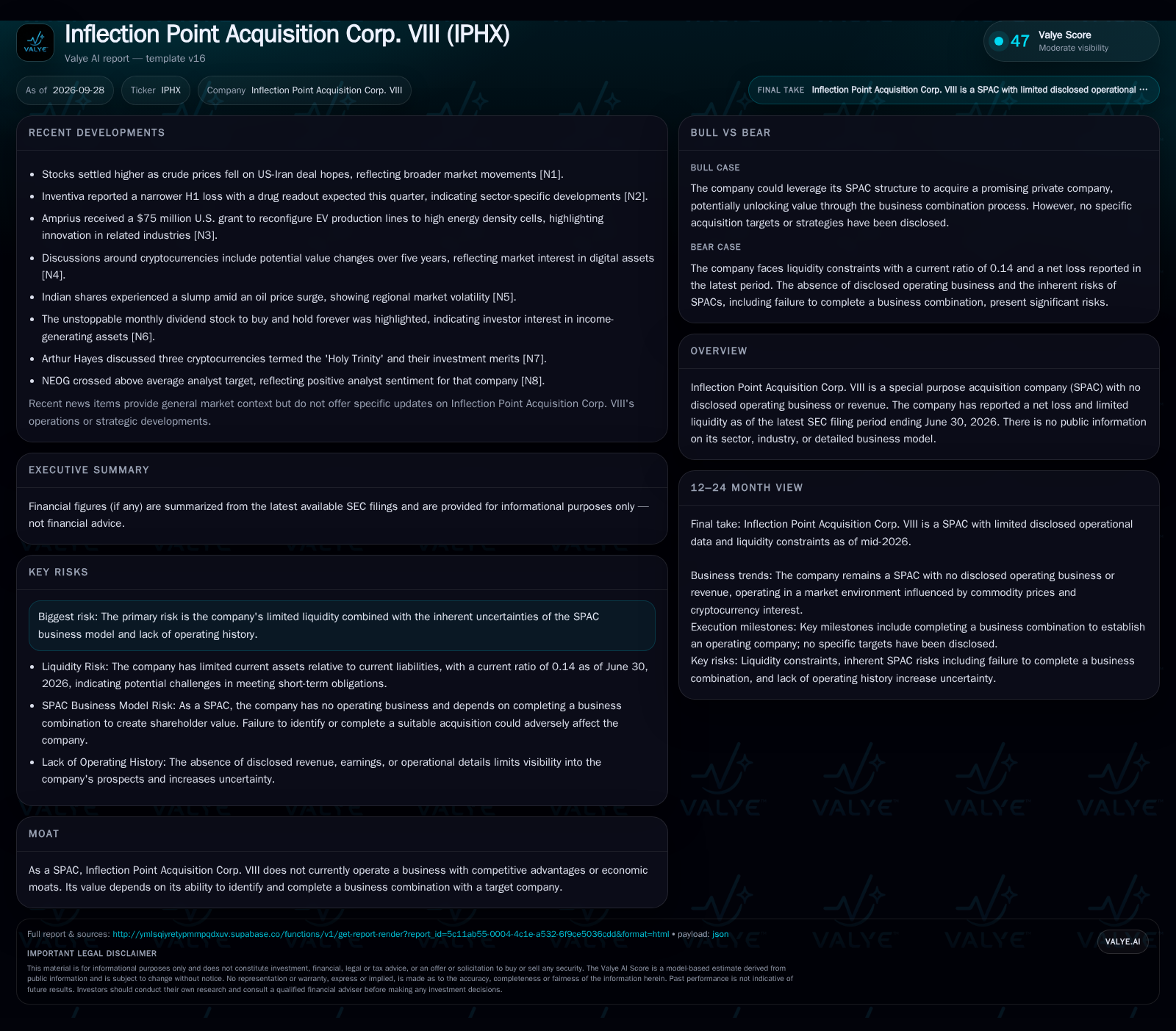
Inflection Point Acquisition Corp. VIII is a newly public SPAC that has raised $287.5 million and is now searching for an acquisition target. The trust proceeds are reserved for a future business combination, while the operating company itself shows minimal liquidity and a net loss. The company's future value hinges on its ability to identify and execute a successful deal before the SPAC’s maturity window closes. [S1]
Inflection Point Acquisition Corp. VIII is a newly listed special purpose acquisition company (SPAC) that has just completed its IPO, raising $287.5 million in a trust account to fund a yet-to-be-identified business combination. The capital structure and incentive alignment now set the stage for a high-stakes search for value.
IPO Proceeds Held in Trust with Limited Operating Cash and No Target Announced
Inflection Point Acquisition Corp. VIII completed its IPO on August 31, 2026, raising $287.5 million by selling 28.75 million units at $10 each, including the full over-allotment. All proceeds are held in a trust account, dedicated exclusively to funding a future business combination. Simultaneously, the company issued 8 million private placement warrants at $1 each, generating an additional $8 million for sponsor-related purposes. The company reported cash and liquidity metrics for the period; these figures do not by themselves establish operating runway, investment capacity, financial flexibility, or financing capacity. No operating business, revenue, or acquisition target has been disclosed, and the company reported a net loss of $97,897 for the period. [S1]
Examining SPAC Fee Structures, Trust Safeguards, and Dilution Effects
The economics of a SPAC like Inflection Point Acquisition Corp. VIII are fundamentally different from traditional operating companies. The bulk of the capital raised ($287.5 million) is locked in a trust account, invested in short-term instruments until a qualifying acquisition is identified. The operating entity itself is intentionally thinly capitalized, with working capital provided by the sponsor until a deal is completed. SPAC sponsors typically receive founder shares (often ~20% of post-IPO equity) and warrants, aligning their incentives with deal completion—but also introducing dilution for public shareholders post-merger.
Cash outflows at this phase are mostly legal, regulatory, and diligence costs, as evidenced by the $19.5 million in IPO transaction expenses. Sponsors may provide bridge capital or working capital loans to cover ongoing costs, but these are usually minor relative to the trust. The trust is generally protected from operating losses, but the clock is ticking: if no business combination is completed within the SPAC’s designated window (often 18-24 months), the trust is returned to shareholders minus certain expenses. The real economic value for public shareholders is only realized if the SPAC identifies and merges with a high-quality target at a favorable valuation. Otherwise, the structure can lead to significant dilution and misaligned incentives, particularly if a deal is rushed to avoid liquidation.
Navigating Deal Competition Within the Crowded SPAC Landscape
Inflection Point Acquisition Corp. VIII enters a highly competitive SPAC environment, where hundreds of blank-check companies vie for a limited pool of attractive private targets. The company has not disclosed any sector focus, which theoretically broadens its search field but also means it lacks a built-in edge in sourcing or evaluating deals. Competitors include other SPACs with more experienced sponsors, sector specialization, or pre-identified targets, as well as private equity buyers and direct listings, all offering alternative routes for companies seeking public capital.
SPACs face distinct counterforces: private targets are increasingly sophisticated in negotiating terms, and the dilution from warrants and sponsor shares can make SPAC mergers less attractive compared to other exit options. Additionally, the post-2021 SPAC market has seen increased regulatory scrutiny and greater investor skepticism, raising the bar for successful deal completion and aftermarket performance. Without a unique sourcing network, operational expertise, or sector focus, Inflection Point’s ability to differentiate itself in this crowded landscape is unproven.
Potential for Shareholder Gains via a Leading Sector Business Combination
The primary upside scenario for Inflection Point Acquisition Corp. VIII is the successful identification and completion of a business combination with a high-growth, high-quality private company. If the SPAC can leverage its capital and public platform to attract a target in a dynamic sector—such as technology, healthcare, or clean energy—at a reasonable valuation, the merger could create substantial value for shareholders. This outcome would be signaled by early rumors or announcements of a letter of intent (LOI) with a reputable target, followed by strong market reception and low redemption rates at the merger vote.
Confirmation of this scenario would include: disclosure of a compelling target with differentiated technology or market position, favorable deal terms with manageable dilution, and evidence that the target’s management and existing investors are rolling significant equity into the combined company. Conversely, failure to secure a target, repeated deal terminations, or high shareholder redemptions would falsify the upside case.
Managing Due Diligence, Negotiations, and Redemption Timing Under SPAC Deadlines
The most plausible middle path is that Inflection Point Acquisition Corp. VIII spends the coming quarters searching for a suitable target, incurring ongoing legal and advisory costs, and ultimately announces a business combination in line with the typical SPAC lifecycle. The process may involve protracted negotiations, due diligence, and iterative deal structures to accommodate both the target’s valuation expectations and public shareholder concerns about dilution.
In this scenario, the deal may proceed but face high redemption rates, with a significant portion of the trust withdrawn by shareholders at the merger vote. This would reduce the cash delivered to the target and could necessitate additional PIPE (private investment in public equity) financing or renegotiated terms. Confirmation would come from a deal announcement, proxy filings, and market reaction, while warning signs would include delays, repeated extensions of the SPAC deadline, or an inability to secure a PIPE.
Risks of Deal Collapse, Liquidation, and Sponsor Capital Exposure
The adverse scenario is that Inflection Point Acquisition Corp. VIII fails to identify or close a business combination within the required timeframe, forcing the SPAC to liquidate and return trust proceeds to public shareholders. In this case, shareholders would receive their pro rata share of the trust (minus certain expenses), but warrants and sponsor capital would be rendered worthless or deeply impaired.
Downside confirmation would include repeated unsuccessful deal attempts, lack of LOIs or merger announcements, and formal communications about liquidation or deadline extensions. Persistent market skepticism, regulatory complications, or deteriorating economic conditions could further hinder deal prospects and increase the likelihood of trust liquidation rather than value creation.
Key Milestones Influencing Inflection Point Acquisition Corp. VIII’s Trajectory
Announcement of a letter of intent (LOI) or definitive agreement with a potential business combination target.
Disclosure of the target company's sector, financials, and growth profile—if and when a deal is announced.
Shareholder redemption rates at the time of the merger vote, which will determine the cash available to the combined entity.
PIPE financing commitments or alternative capital raises to supplement the trust account if redemptions are high.
Revisions to the SPAC’s deadline for completing a business combination (extensions or amendments).
Sponsor loans, working capital infusions, or bridge financings—if disclosed—to fund ongoing expenses at the SPAC level.
Management’s communication regarding deal pipeline, sector focus, or sourcing strategy—if provided in filings or investor communications.
Any regulatory or legal developments, such as SEC comment letters or changes in SPAC market rules, that may affect deal timing or structure.
Disclaimer: This is research-only, informational analysis and not investment advice. It may include AI-generated interpretation and general industry context. Always verify important details using primary sources.

Comments