
Integrated BioPharma: Customer Concentration, Margin Pressures, and the Strategic Challenge of Contract Manufacturing
Integrated BioPharma's contract manufacturing business delivers high revenue visibility but exposes the company to substantial customer concentration risk and persistent margin pressures from supply chain, inflation, and regulatory costs. The company's ability to diversify its customer base and manage cost headwinds will determine whether it can transition from operational stability to sustainable profitability in a competitive and regulated nutraceutical landscape.
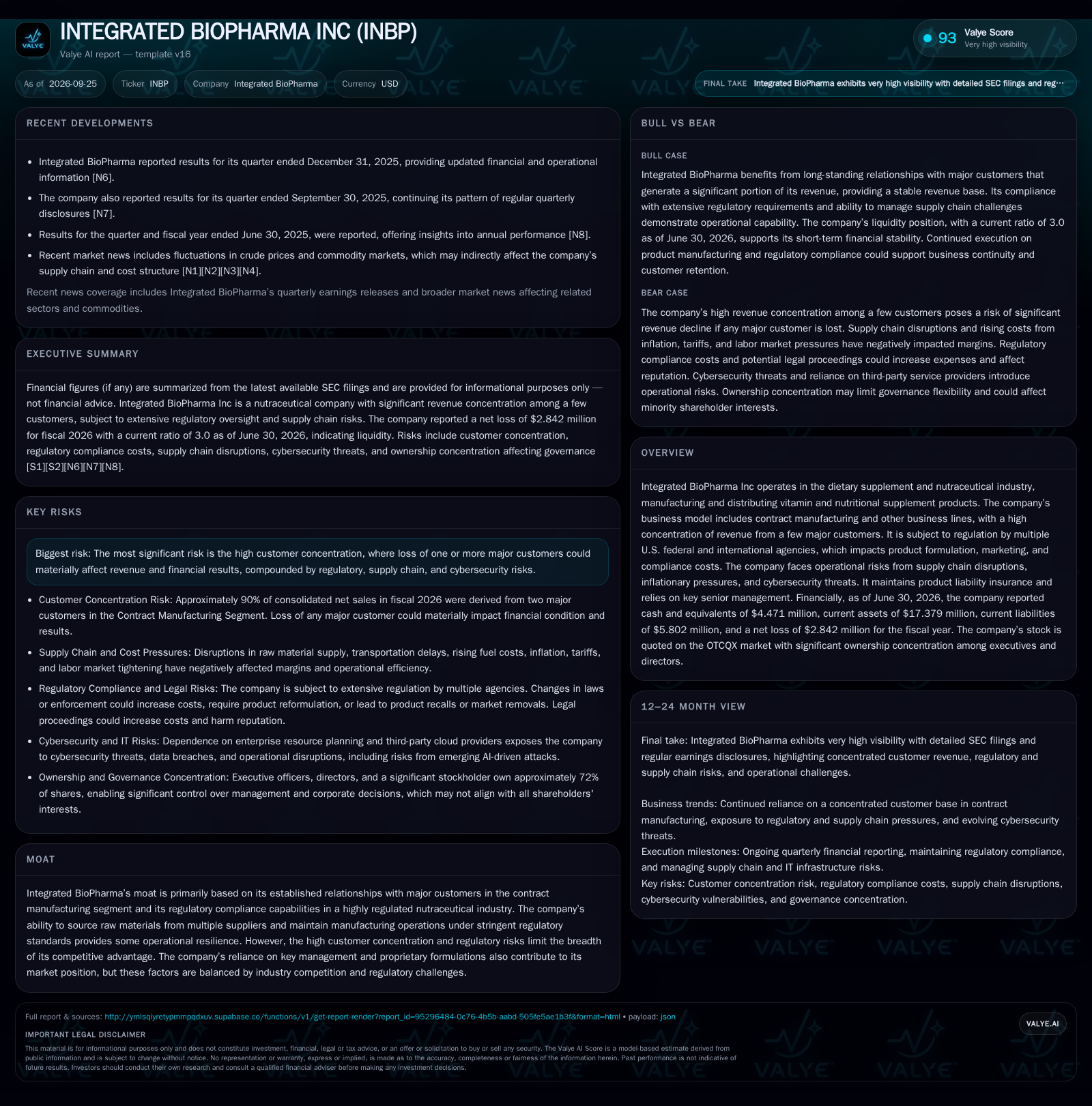
Integrated BioPharma Inc relies on two major customers for about 90% of its contract manufacturing sales, leaving it exposed to abrupt revenue shifts if relationships falter.Despite a reported current ratio of 3.0 and $4.471 million in cash as of June 2026, the company reported a net loss of $2.842 million. Supply chain disruptions, inflationary cost increases, and regulatory expenses continue to erode margins. The company’s future hinges on its ability to reduce customer concentration, control costs, and adapt to ongoing competitive and regulatory challenges. [S1] [S2] [N6] [N7] [N8]
Integrated BioPharma operates in the nutraceutical and dietary supplement industry, where it manufactures and distributes vitamin and nutritional supplement products. The company’s contract manufacturing business model has delivered revenue stability through long-standing relationships with a few major customers, but this same concentration now represents a critical vulnerability. As inflation, supply chain disruptions, and regulatory costs pressure margins, Integrated BioPharma’s future will depend on its ability to diversify its customer base and improve operational efficiency in a sector where regulatory oversight and competition remain intense. [S1] [S2]
Recent Results Expose Customer Concentration and Margin Pressure
Integrated BioPharma reported that roughly 90% of its consolidated net sales in fiscal 2026 originated from just two major customers in its Contract Manufacturing Segment, underscoring a significant vulnerability to customer loss or renegotiation. For the fiscal year ended June 30, 2026, the company posted a net loss of $2.842 million, highlighting ongoing profitability challenges despite its established market presence. The company reported a current ratio of 3.0 for the period. [S1]
The company’s exposure to supply chain disruption, inflation, tariffs, and labor costs has continued to erode margins, and regulatory compliance remains a meaningful drag on operating efficiency. Ownership is tightly held, with insiders and a significant shareholder controlling about 72% of outstanding shares, which consolidates governance but may limit strategic flexibility. [S1] [S2]
How Revenue Concentration and Cost Pressures Shape the Underlying Economics
Integrated BioPharma’s core business is contract manufacturing for nutraceutical brands, with a small number of customers accounting for the vast majority of sales. This model provides predictable order flow and operating scale when relationships are stable, but it introduces high revenue volatility if even one major customer reduces volume or exits. Such concentration also limits pricing power in customer negotiations, potentially leading to margin compression if costs rise faster than contract pricing can be adjusted.
The company’s cost structure is heavily influenced by raw material prices, transportation, and labor costs—factors that have all faced upward pressure due to inflation and supply chain disruptions in recent years. Because contract manufacturing is typically a high-volume, low-margin business, even modest increases in input costs can quickly erode profitability unless offset by price increases or operational efficiencies. Fixed costs related to regulatory compliance, quality assurance, and IT systems add to the overhead burden, while variable costs scale with production volume.
Operating leverage may be limited unless the company can achieve greater customer or product diversification. The need to comply with evolving regulatory regimes (FDA, FTC, state-level rules) also requires ongoing investment, which could further constrain margins if not supported by top-line growth or improved product mix.
Customer Relationships, Compliance, and the Limits of Differentiation
Integrated BioPharma’s longstanding relationships with major customers and its ability to manufacture under strict regulatory standards are its primary sources of competitive advantage. In the contract manufacturing segment, these factors support customer retention and may create moderate switching frictions due to validation, quality, and supply chain integration requirements.
However, the industry is fragmented, with many contract manufacturers capable of meeting regulatory and quality standards. Larger competitors may have greater scale, more diversified customer bases, and broader product offerings, making it difficult for Integrated BioPharma to differentiate solely on compliance or reliability. Price competition is intense, and customers may leverage the threat of switching to negotiate more favorable terms.
Substitution risk arises from customers bringing manufacturing in-house or shifting to lower-cost providers domestically or abroad. The company’s ability to source raw materials from multiple suppliers does provide some operational resilience, but this is a common industry practice rather than a unique moat.
What It Would Take for Margin Recovery and Revenue Diversification
The most favorable scenario is one in which Integrated BioPharma successfully broadens its customer base—reducing reliance on its top two clients—and passes through price increases to offset rising input costs. This could occur if the company leverages its regulatory compliance track record to attract emerging brands, private labels, or international customers seeking a U.S.-based, FDA-compliant manufacturing partner.
Margin recovery would also require improved supply chain management, potentially through long-term contracts with suppliers, greater use of automation, or selective product mix shifts toward higher-value or custom formulations. Evidence for this scenario would include a declining share of revenue from the top two customers, improved gross margins, and new customer wins announced in earnings releases.
Falsification would occur if customer concentration remains unchanged and margins continue to deteriorate despite cost-control efforts, or if new business is not sufficient to offset potential volume losses from major clients.
Continued Dependence and Incremental Cost Management
The most plausible trajectory is a continuation of Integrated BioPharma’s current pattern: stable but highly concentrated revenue, modest attempts to pass along cost increases, and ongoing margin pressure from industry-wide input cost inflation and compliance overhead. The company may maintain operational stability and meet its near-term obligations given its liquidity, but is unlikely to achieve sustained profitability unless one or more levers—diversification, pricing power, or cost reduction—materially improve.
Evidence supporting this scenario would be persistently high customer concentration, continued net losses or breakeven results, and incremental rather than transformative changes in gross margin. Falsification would require either a major customer loss triggering a sharp revenue decline, or a meaningful expansion in the customer base and margin profile.
The Risk of Customer Loss and Escalating Cost Headwinds
A negative scenario would be triggered by the loss of one or both major customers, which could immediately eliminate a substantial portion of revenue and push the company into a liquidity crisis. In such a scenario, fixed costs would quickly become unsupportable, leading to deeper operating losses, potential restructuring, or the need for external capital at unfavorable terms.
Alternatively, further supply chain shocks, inflation, or regulatory changes could increase costs without the ability to pass them through to customers, further compressing margins. Evidence for this scenario would include a sudden drop in reported revenue, disclosure of major customer contract non-renewals, deteriorating cash balances, or urgent cost-cutting measures. Falsification would require clear evidence of revenue stability and cost containment even in the face of external shocks.
Milestones That Will Define Integrated BioPharma’s Next Phase
Quarterly disclosure of revenue concentration: A declining percentage of sales from the top two customers would indicate progress toward diversification.
Gross margin trends: Improvement or stabilization in gross margin would signal successful cost control or pricing power.
New customer announcements: Winning additional manufacturing contracts, especially with branded or international clients, would suggest reduced dependence on legacy relationships.
Supply chain cost disclosures: Evidence of successful raw material hedging, logistics optimization, or direct sourcing relationships would help test the company’s ability to manage input cost volatility.
Regulatory compliance costs: If disclosed, tracking the proportion of revenue consumed by compliance and quality assurance would clarify the fixed-cost burden.
Operating cash flow: Sustained positive operating cash flow would demonstrate that the business is not reliant on balance sheet liquidity to fund operations.
Management or insider share sales: Any significant insider selling, given the current ownership structure, could signal shifting confidence or strategic direction.
Cybersecurity incident disclosures: Given reliance on cloud providers and ERP systems, any reported disruptions or breaches would test operational resilience.
Disclaimer: This is research-only, informational analysis and not investment advice. It may include AI-generated interpretation and general industry context. Always verify important details using primary sources.

Comments