
NioCorp’s Elk Creek Project: Liquidity Strength, Pre-Revenue Risks, and the Challenge of Critical Mineral Project Economics
With reported liquidity position and major development milestones reached at its Elk Creek critical minerals project, NioCorp stands at a pivotal pre-production juncture. The company’s ability to convert its cash position and project advancement into a viable mining operation will be tested by capital intensity, commodity market volatility, and the competitive landscape for strategic minerals.
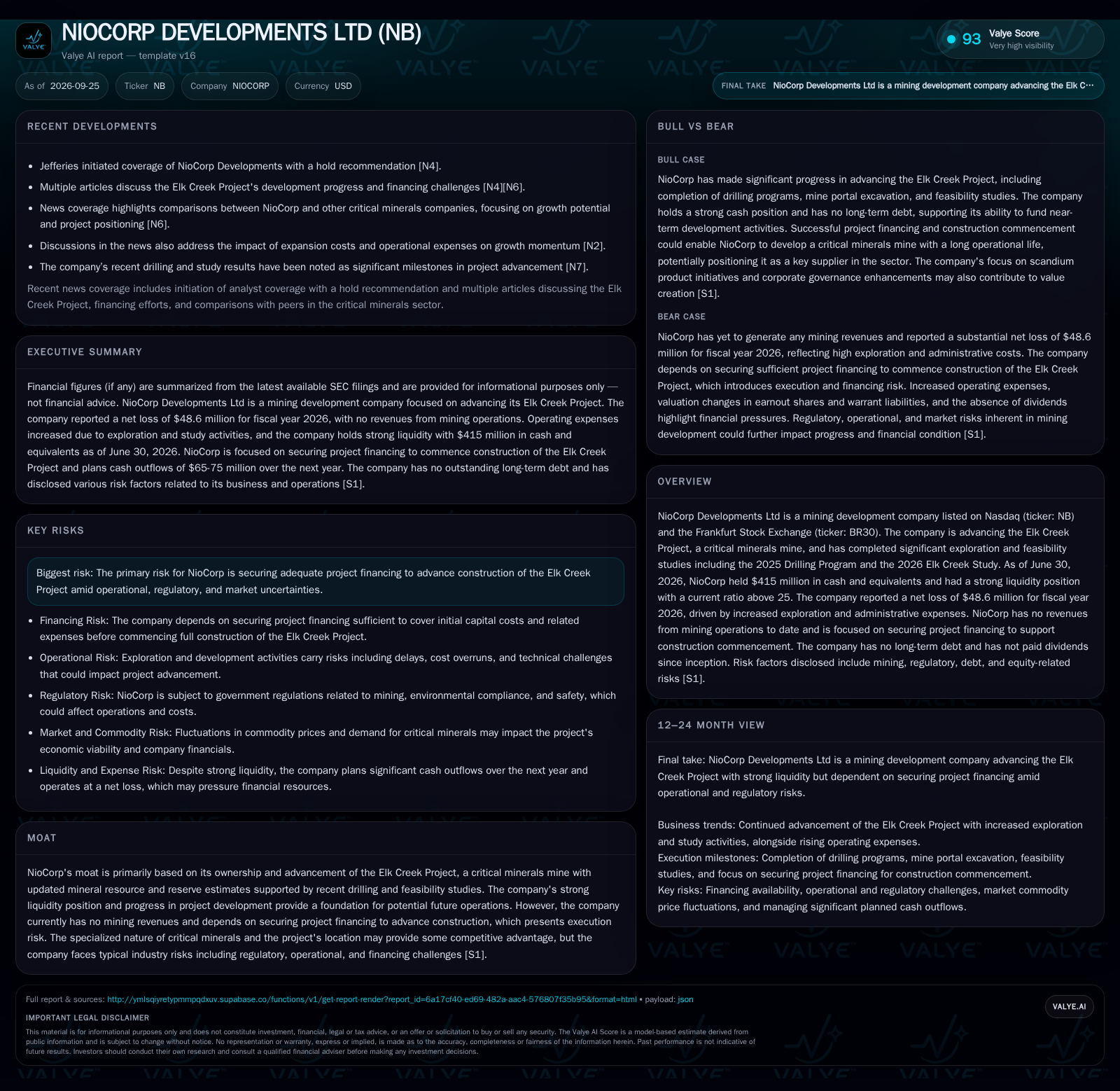
NioCorp Developments holds $415 million in cash and no long-term debt, having advanced its Elk Creek Project through resource drilling and feasibility studies. Despite a net loss of $48.6 million in fiscal 2026 and no mining revenues to date, it has completed key project milestones and begun mine portal excavation. [S1]
NioCorp Developments Ltd, advancing the Elk Creek critical minerals project, enters late 2026 with unusually reported liquidity position for a pre-revenue mining developer—holding $415 million in cash, a current ratio over 25, and no long-term debt. The company has achieved major technical milestones, including updated drilling and feasibility studies and beginning excavation of its mine portal. Yet, with a $48.6 million net loss for fiscal 2026 and no operating revenues, NioCorp’s path to commercial production still depends on successfully bridging the gap between project development and future mining operations. The company’s next phase will test not only its financial resources but also its ability to navigate capital-intensive construction, commodity price volatility, and the competitive realities of the global critical minerals market. [S1]
NioCorp’s Financial Position and Project Milestones in 2026
The company reported a net loss of $48.6 million for fiscal 2026, primarily due to increased exploration and administrative expenses tied to its Elk Creek Project. Key operational milestones include completion of the 2025 Drilling Program, updated resource and reserve estimates, and the initiation of mine portal excavation in February 2026. Despite these advances, NioCorp has yet to generate any revenue from mining operations, and all spending continues to be allocated toward project development, feasibility, and corporate overhead. [S1]
Critical Mineral Project Economics: Funding, Cash Burn, and the Path to Revenue
NioCorp’s business model is, at present, entirely pre-revenue and capital-consuming. Cash outflows for the next twelve months are projected at $65–$75 million, primarily for continued advancement of the Elk Creek Project and corporate costs. The economics of critical minerals mining are defined by high fixed costs in exploration, permitting, and construction, with variable costs tied to labor, energy, reagents, and logistics once production commences. Until commercial mining begins, all expenditures are investments with uncertain future payoff, and the company’s ability to generate operating leverage is deferred until it achieves production scale.
The absence of long-term debt provides flexibility but also signals that NioCorp is relying on equity capital or potential future project financing for construction and ramp-up. The company’s current cash position is large relative to its near-term burn, but the capital required for full mine construction and commissioning could be several times higher, depending on the scope of the project and prevailing cost inflation. Should NioCorp move into production, its revenue mix would likely depend on market prices and offtake agreements for niobium, scandium, and other critical minerals—a dynamic that introduces commodity price risk and potential pricing power if supply constraints persist.
Project Uniqueness, Market Positioning, and Sector Headwinds
NioCorp’s competitive positioning is anchored in its control and advancement of the Elk Creek Project, which aims to supply critical minerals such as niobium and scandium—inputs vital to high-performance alloys and clean energy applications. The company benefits from first-mover status in advancing a U.S.-based project at a time when supply chain security for critical minerals is a strategic concern for governments and manufacturers. However, the moat is not absolute: project economics remain unproven, and execution risk is high given the capital intensity and long timelines typical of greenfield mining.
Competition includes both domestic and international mining companies developing similar mineral resources, as well as potential substitutes in material science and recycling. The company’s ability to secure offtake agreements, favorable regulatory treatment, or government support could provide a temporary competitive edge, but these advantages can be eroded by commodity price cycles, permitting delays, or technological shifts that reduce demand for specific minerals. Peer comparisons in news coverage reflect investor uncertainty about NioCorp’s relative value and risk profile in a crowded development-stage sector. [N4] [N6]
What Could Unlock NioCorp’s Value: From Project Milestones to Production Commitments
The most favorable scenario for NioCorp involves successfully leveraging its reported liquidity position to complete mine construction, secure offtake agreements with strategic buyers, and transition into commercial production. This would require the company to maintain cost discipline during project advancement, obtain necessary permits and regulatory approvals, and potentially attract project financing or joint venture partners to fund the capital-intensive construction phase.
Confirmation of this scenario would include announcements of binding offtake contracts for Elk Creek’s output, the securing of full construction financing without excessive dilution, and visible progress toward first production—such as completion of mine infrastructure, processing plant construction, and initial commissioning. Evidence that would falsify this scenario includes prolonged delays, cost overruns consuming liquidity, or inability to secure the further funding required for full project build-out.
Plausible Next Steps: Managing Cash Burn While Advancing Elk Creek
The most likely trajectory for NioCorp is a continuation of non-revenue operations over the next 12–24 months, with ongoing cash outflows for exploration, permitting, and feasibility work at Elk Creek. The company’s liquidity allows it to fund these activities without immediate recourse to debt or dilutive equity offerings. However, as the project moves closer to construction decision points, NioCorp will need to secure additional capital—either through strategic partnerships, offtake-linked project finance, or equity.
Base case confirmation would come from steady progress on permitting, completion of engineering and construction planning, and prudent management of the existing cash position. Falsification would involve unexpected regulatory setbacks, significant cost inflation, or failure to secure the next round of required funding as cash reserves are drawn down.
Where Things Could Go Wrong: Burn Rate, Funding Risks, and Project Delays
NioCorp’s principal risks stem from the capital-intensive, pre-revenue nature of its business. In an adverse scenario, the company could face cost overruns or delays in advancing the Elk Creek Project that outpace its liquidity buffer, forcing it to seek additional funding under unfavorable terms. Regulatory or permitting obstacles could further slow progress, while adverse movements in commodity prices could undermine the project’s long-term economics and investor appetite for mining development exposure.
Confirmation of downside dynamics would include announcements of increased budget requirements, unsuccessful financing rounds, or regulatory actions halting or slowing project advancement. Evidence that would falsify the worst-case scenario would be the demonstration of cost control and timely achievement of project milestones with cash reserves still intact.
Milestones and Metrics That Will Define NioCorp’s Transition to Producer Status
Progress updates on mine construction (portal advancement, processing plant buildout, infrastructure) and whether these remain on schedule and budget.
Disclosure of any binding offtake agreements or strategic partnerships with downstream buyers or government entities.
Permitting and regulatory milestones for the Elk Creek Project—any delays or successful approvals announced.
Quarterly and annual cash burn rates versus projected outflows, and whether actual expenses track or exceed guidance.
Announcements regarding project financing, debt facilities, or equity raises—terms, timing, and potential dilution.
Commodity price trends for niobium, scandium, and any other minerals in the Elk Creek resource mix, as these will impact project economics.
If disclosed, updates to mineral resource and reserve estimates, especially if new drilling or studies materially change the project’s scale or grade.
Any changes in sector policy, domestic critical mineral incentives, or international trade restrictions that could alter the competitive landscape or project economics.
Disclaimer: This is research-only, informational analysis and not investment advice. It may include AI-generated interpretation and general industry context. Always verify important details using primary sources.

Comments