
Scholastic’s Multi-Segment Model Under Strain: Cost Pressures, Diversification, and the Search for Renewed Leverage
Scholastic’s latest quarter highlights the tension between its diversified publishing, education, and entertainment assets and rising structural costs. With a net loss and persistent operating expense drag, the company’s ability to translate brand strength and IP into sustainable margins is increasingly tested by digital disruption and evolving school market dynamics.
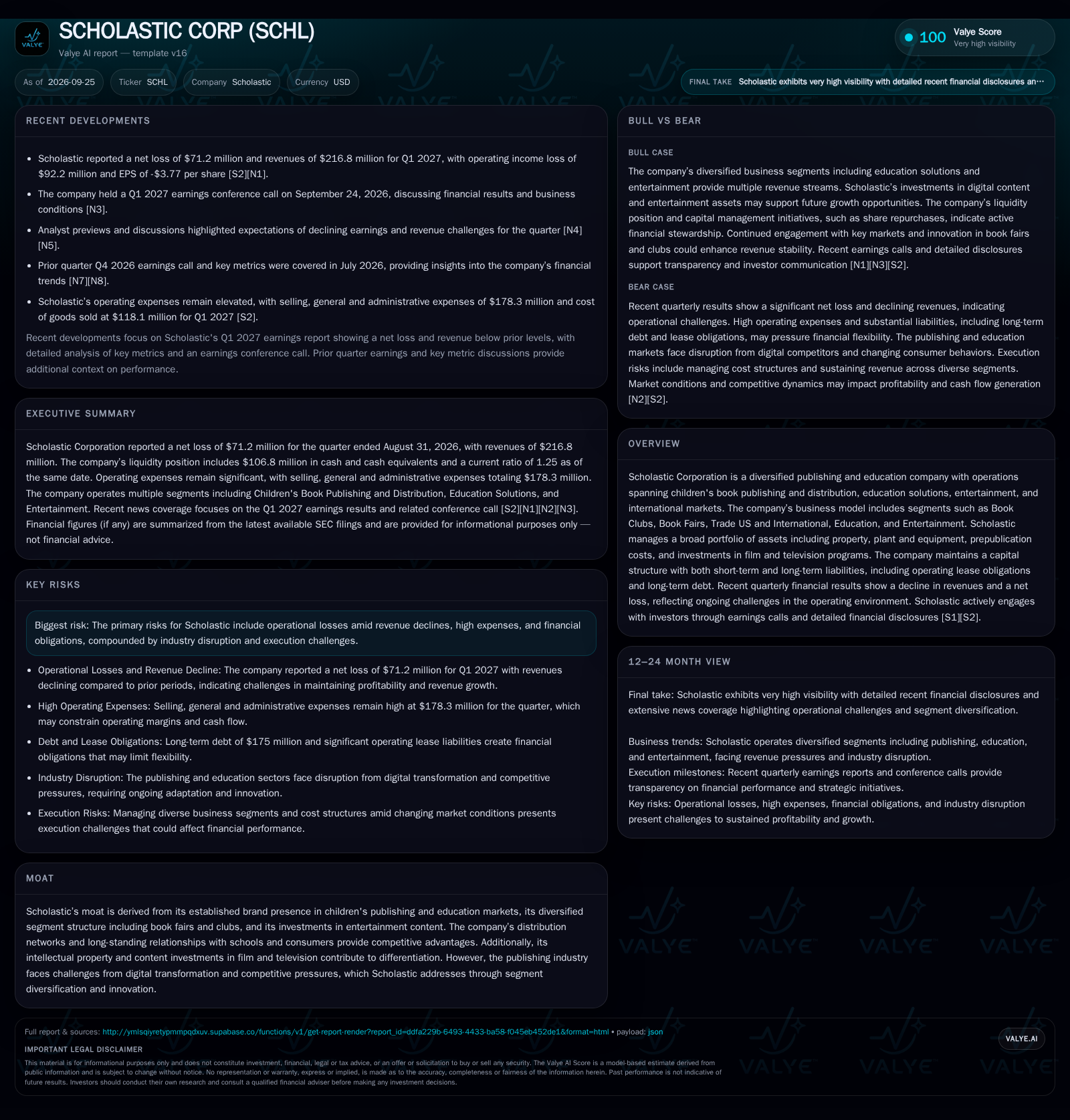
Scholastic posted a net loss of $71.2 million on revenues of $216.8 million for Q1 2027, with high operating costs and a current ratio of 1.25. The company’s diversified segments—spanning book clubs, education, and entertainment—face mounting margin pressure amid industry disruption and substantial fixed obligations. The path forward hinges on cost control, digital adaptation, and the ability to monetize intellectual property across channels. [S2]
Scholastic Corporation’s latest financials reveal a company at a crossroads: while its legacy as a dominant player in children’s publishing, education, and entertainment remains intact, the Q1 2027 net loss and ongoing cost pressures underscore the challenges of adapting a multi-segment model to new digital realities. With significant fixed obligations and intensifying competition from digital-native content providers, Scholastic’s ability to harness its brand, distribution reach, and intellectual property will determine whether recent setbacks mark a cyclical dip or a more structural margin reset.
Recent Financial Performance and Balance Sheet Pressures
For the quarter ended August 31, 2026, Scholastic reported revenues of $216.8 million and a net loss of $71.2 million, translating to a basic and diluted loss per share of $3.77. Operating costs remain elevated, with cost of goods sold at $118.1 million and selling, general and administrative expenses totaling $178.3 million. The company reported cash and liquidity metrics for the period; these figures do not by themselves establish operating runway, investment capacity, financial flexibility, or financing capacity. Notably, Scholastic carries $175 million in long-term debt and over $300 million in operating lease liabilities, highlighting a significant fixed-cost base. These facts frame the company’s immediate challenge: balancing near-term liquidity with the need for sustainable operating leverage in the face of industry headwinds. [S2]
Multiple Revenue Streams, Margin Drag, and the Fixed Cost Conundrum
Scholastic’s business model spans several segments: traditional Book Clubs and Book Fairs, Trade publishing (U.S. and international), Education Solutions, and Entertainment. Each segment carries distinct economics and risk profiles. Historically, Book Fairs and Clubs have relied on volume-driven, school-based distribution, with relatively high fixed costs for logistics, warehousing, and sales infrastructure. Education and Entertainment segments offer potential for higher-margin, IP-driven revenue—especially if digital content and licensing can scale—but require substantial up-front investment in content development and marketing.
Persistent high SG&A and depreciation/amortization—$178.3 million and $12.6 million, respectively, for the quarter—suggest that Scholastic’s cost base is not fully variable and is only partially offset by top-line performance. This limits operating leverage, especially when revenue growth stalls or contracts. The company’s large asset base (including prepublication costs, film/TV investments, and physical infrastructure) creates both optionality and capital intensity, making cost control and asset productivity central to future margin recovery. If Scholastic can shift a greater share of sales to digital and IP-licensing channels, gross margins could improve. However, this transition typically requires upfront investment and may not immediately offset declines in traditional print or event-based revenue streams.
An additional layer of complexity arises from the interplay between fixed and variable costs across Scholastic’s segments, which complicates margin management. For instance, the Book Clubs and Fairs segments, while volume-driven, have a high proportion of fixed logistics and sales expenses that do not scale down easily during revenue contractions. This creates a structural margin floor that can be difficult to breach without significant operational restructuring. Conversely, the Education and Entertainment segments, although potentially more scalable via digital platforms, face upfront content development costs and marketing investments that may delay profitability. This cost structure dynamic means that Scholastic’s margin recovery is conditional on not only revenue growth but also the pace and scale of fixed cost rationalization and the ability to flex cost bases in response to market shifts.
Brand Strength vs. Digital Disruption: Where Scholastic Stands
Scholastic’s enduring brand, deep relationships with schools, and broad catalog of children’s content constitute significant competitive advantages. The company’s distribution networks and long-standing institutional ties create switching frictions for school districts and educators, supporting recurring engagement in Book Fairs and Clubs. Its investments in entertainment and intellectual property further differentiate it from smaller publishers and pure-play educational content providers.
However, the competitive landscape is shifting. Digital-native content platforms, direct-to-consumer education technology companies, and large media conglomerates are increasingly targeting Scholastic’s core audiences with interactive, personalized, and often lower-cost offerings. Schools and families have more alternatives for both curricular and recreational reading, and digital procurement channels can bypass traditional book fairs and clubs. The question is whether Scholastic’s legacy advantages—brand trust, physical presence, IP portfolio—can be effectively translated into digital channels and new commercial models before cost pressures erode its margin cushion.
The challenge of translating brand strength into digital competitiveness also hinges on Scholastic’s ability to innovate in content delivery and customer engagement. Digital disruption is not solely about cost reduction but also about creating differentiated user experiences that can justify premium pricing or subscription models. Scholastic’s legacy relationships with schools provide a distribution advantage, but digital-native competitors often excel at data-driven personalization and agile content updates, which are increasingly valued in education technology. Therefore, Scholastic’s success depends on its capacity to integrate digital analytics, user feedback loops, and adaptive learning technologies into its offerings. Failure to do so could result in commoditization of its content and erosion of pricing power, further pressuring margins.
Unlocking Value Through Digital Transformation and IP Monetization
A favorable scenario for Scholastic would see the company leveraging its content library and brand equity to accelerate digital revenue growth, expand licensing deals, and deepen engagement with both schools and families through multi-channel distribution. Successful execution could include the rollout of new digital education products, adaptive learning platforms, or streaming content tied to popular book franchises.
Margin uplift would likely depend on reducing reliance on low-margin print distribution and event-based sales, while capturing higher-value recurring revenues from subscription, licensing, or digital curriculum contracts. Evidence supporting this scenario would include: a shift in revenue mix toward digital/IP-driven segments; declining SG&A as a percentage of sales; new high-profile licensing or streaming deals; and stabilization or growth in net income despite continued industry disruption. Conversely, if digital initiatives fail to scale or IP monetization remains limited, the upside scenario would be undermined.
Segment Diversification Buys Time, But Margin Recovery Remains Elusive
The most plausible near-term trajectory is one of modest revenue stabilization as Scholastic leans on its diversified segment portfolio to offset declines in any single channel. Incremental improvements in cost discipline—such as targeted SG&A reductions or more efficient event logistics—could narrow losses, but structural margin expansion may remain out of reach absent a step-change in digital or IP-driven income.
Confirmation of this scenario would come from steady, if unspectacular, revenue across Book Clubs, Education, and Entertainment, with gradually improving operating margins but continued sensitivity to fixed costs and school market dynamics. Falsification would require either a major digital breakout or, conversely, a pronounced acceleration in losses due to further print declines or execution missteps.
Fixed Obligations Amplify the Impact of Revenue Shortfalls
A negative outcome would see Scholastic’s traditional revenue streams—especially print and school-based channels—declining faster than digital or licensing can compensate, with high fixed costs and lease/debt obligations magnifying the impact on cash flow and solvency.
Signs confirming this scenario would include further net losses, shrinking cash balances, rising leverage ratios, and possible asset sales or restructuring measures. Inability to pivot meaningfully to digital or to rationalize the cost base would heighten the risk of covenant breaches, liquidity stress, or the need for external capital at unfavorable terms.
Milestones That Will Clarify Scholastic’s Margin Trajectory and Strategic Flexibility
Quarterly shifts in revenue mix between print, digital, and licensing/IP segments—if disclosed—would help test the pace and scale of the company’s digital transition.
Trends in SG&A and cost of goods sold as a percentage of sales will indicate whether operating leverage is improving or deteriorating.
Updates on major licensing, streaming, or educational technology partnerships would signal traction in IP monetization and digital platform expansion.
Cash flow from operations and changes in net working capital: persistent negative trends would raise solvency concerns.
Net debt and lease liability trajectory: growing obligations without margin improvement would amplify downside risk.
Evidence of school district renewal rates or retention in Book Fairs and Clubs—if disclosed—would clarify customer stickiness amid digital competition.
Announcements of asset sales, restructuring, or cost-reduction initiatives would suggest management’s response to fixed-cost pressure.
Any new guidance on capital allocation, including share repurchases, dividends, or investment in digital/entertainment content, would help clarify management’s strategic priorities.
Disclaimer: This is research-only, informational analysis and not investment advice. It may include AI-generated interpretation and general industry context. Always verify important details using primary sources.

Comments