
Cracker Barrel: Liquidity Pressures, Margin Squeeze, and the Test of the Restaurant-Retail Model
The company’s unique restaurant-retail model and seasoned leadership underpin its resilience, yet margin pressures and industry headwinds test its ability to sustain growth and adapt to changing consumer preferences.
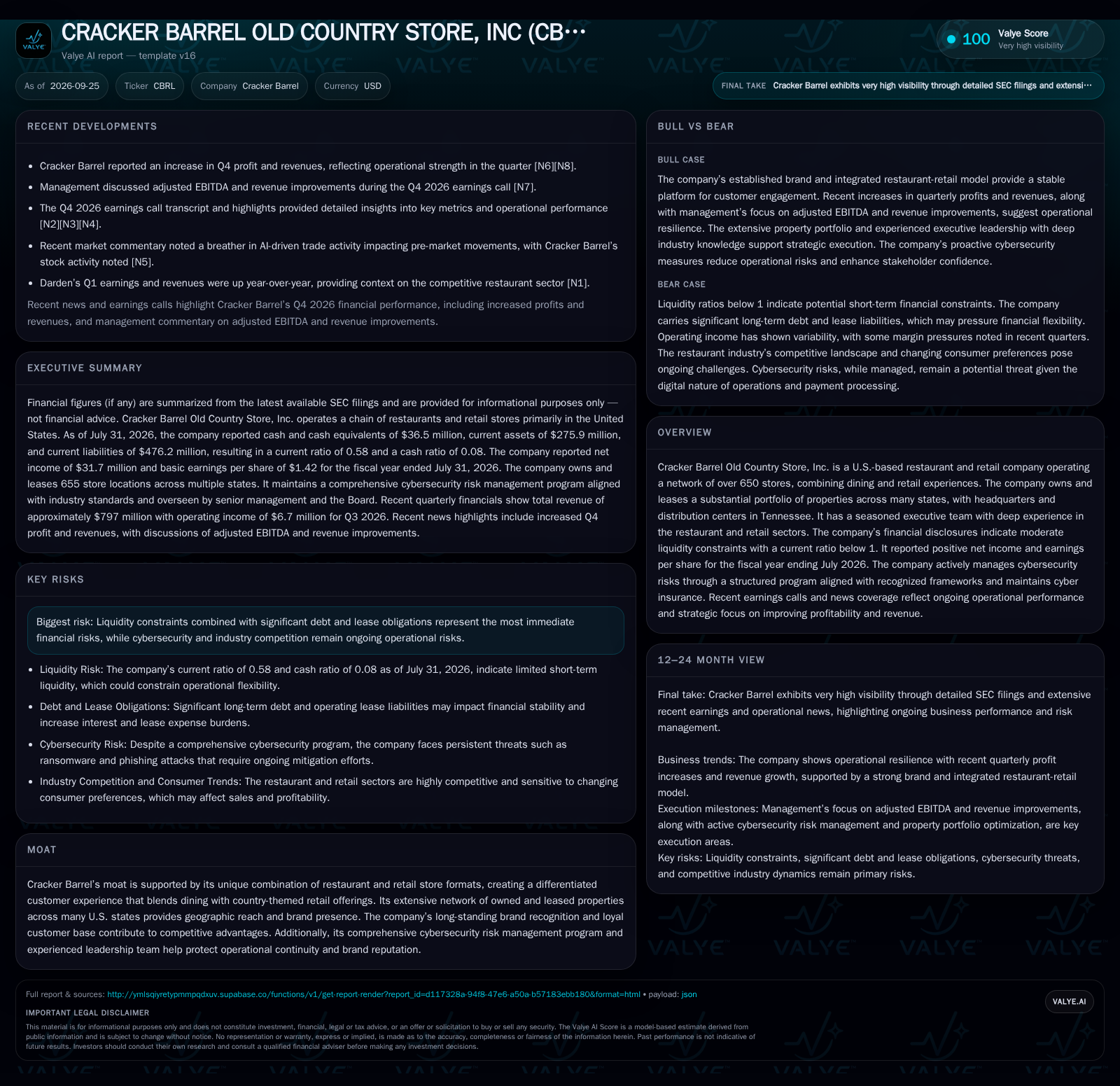
The company’s unique restaurant-retail model and seasoned leadership underpin its resilience, yet margin pressures and industry headwinds test its ability to sustain growth and adapt to changing consumer preferences. Management expects further EBITDA and revenue improvements, but execution will depend on balancing cost control, guest traffic, and capital needs. [S1] [N6] [N7] [N8]
Cracker Barrel Old Country Store has recently delivered improved profits and revenue, leveraging its distinctive combination of hospitality and retail across a broad U.S. footprint. This dynamic sets up a challenging landscape: Cracker Barrel’s ability to extract operating leverage from its model and adapt to competitive and consumer pressures will be critical in determining whether recent momentum can be sustained or whether financial constraints will force a strategic rethink.
Profitability Gains Meet Persistent Liquidity Constraints
Cracker Barrel reported a notable increase in profit and revenue for Q4 2026, with management emphasizing adjusted EBITDA and revenue improvements during recent earnings calls. Net income for the fiscal year ended July 31, 2026, was $31.7 million, and Q3 2026 operating income stood at $6.7 million on $797 million in revenue. Despite these gains, the company’s liquidity metrics remain challenged: as of July 31, 2026, Cracker Barrel held $36.5 million in cash and cash equivalents, with current assets of $275.9 million against current liabilities of $476.2 million, resulting in a current ratio of just 0.58 and a cash ratio of 0.08. The company also carries significant long-term debt and lease obligations, underscoring ongoing balance sheet pressures even as operational performance shows signs of resilience. [S1] [N6] [N7] [N8]
Decoding the Economics of the Restaurant-Retail Hybrid
Cracker Barrel’s business model fuses full-service dining with an on-site country-themed retail experience, aiming to could support larger baskets and cross-sell between segments. The company’s 655 locations—split nearly evenly between owned and leased properties—provide broad geographic reach and potential for operational leverage, as fixed costs can be spread across both restaurant and retail revenue streams. However, the model is capital intensive: property ownership/leases, inventory, labor, and supply chain management drive substantial fixed and variable costs. Margin pressure is evident in recent results, with Q3 2026 operating income of $6.7 million on $797 million in revenue. This suggests incremental revenue gains are not fully translating into profit, likely due to rising input costs, wage inflation, and competitive discounting. The company’s liquidity constraints may limit its ability to fund store refreshes, technology upgrades, or new unit growth without external financing or improved cash flow generation.
Retail sales can help offset restaurant cyclicality, but inventory risk and the need for constant merchandise refreshes introduce volatility. While the hybrid format offers some insulation from pure-play restaurant pressures, it also exposes Cracker Barrel to broader retail sector headwinds, including changing consumer spending patterns and inventory markdown risk.
Brand Strength vs. Competitive Intensity and Substitution Threats
Cracker Barrel’s moat rests on its differentiated blend of nostalgia-driven dining and curated retail, supported by decades of brand equity and a loyal customer base. The company’s scale—over 650 locations—provides negotiating leverage with suppliers and some national advertising efficiencies. However, the broader restaurant sector remains highly competitive, with regional chains, quick-service restaurants, and emerging fast-casual concepts all vying for consumer attention and wallet share. Substitution risk is elevated as consumers seek value, convenience, and new experiences, particularly amid inflationary pressures.
The retail segment faces its own competitive set, ranging from specialty gift shops to digital-first retailers, diluting the uniqueness of the in-store shopping experience. Cracker Barrel’s ability to defend traffic and ticket growth will depend on menu innovation, guest experience, and the ongoing relevance of its retail assortment. Switching costs are relatively low in both restaurant and retail, making customer retention an ongoing challenge. While the company’s cybersecurity program mitigates operational risk, it does not directly strengthen its competitive position unless tied to enhanced guest experience or digital engagement.
When Brand and Execution Unlock Operating Leverage
If Cracker Barrel successfully leverages its brand to drive consistent traffic growth, optimize menu pricing/mix, and refresh its retail offering, incremental revenue could yield improved operating leverage. A favorable scenario would see labor and input cost inflation moderating, allowing gross margins to expand as fixed costs are absorbed by higher sales. Management’s focus on adjusted EBITDA and revenue improvements, as referenced in the Q4 2026 outlook, could translate into stronger cash flow if overhead is contained and retail inventory is managed tightly.
Confirmation for this scenario would include sustained same-store sales growth, margin expansion in quarterly results, and evidence of positive guest traffic trends. Disclosures of successful cost control initiatives, improved inventory turnover, and new format/store refreshes driving higher average unit volumes would further support this narrative. Conversely, if rising costs or weak demand offset revenue gains, or if liquidity pressures force asset sales or underinvestment in the store base, this upside would be difficult to realize.
Stability Amid Margin Pressure and Financial Constraints
The most plausible near-term outcome is that Cracker Barrel maintains modest profitability and revenue growth, but does not achieve significant margin expansion. Ongoing competitive pressures and cost inflation may limit the company’s ability to fully capitalize on its scale and brand, while liquidity constraints restrict optionality for aggressive reinvestment or expansion. Management may prioritize cost containment, selective menu/retail innovation, and operational efficiency to protect margins, but the balance sheet is likely to remain stretched as debt and lease obligations persist.
Confirmation of this scenario would be continued positive but low-single-digit same-store sales growth, flat-to-moderately-improving margins, and stable or slowly improving liquidity ratios. Falsification would require a meaningful deterioration in guest traffic, a spike in cost pressures, or evidence of covenant breaches or distressed asset sales.
Liquidity Crunch and Margin Squeeze Threaten Strategic Flexibility
If cost pressures intensify or if consumer demand weakens—due to recession, competition, or shifts in spending—Cracker Barrel could face an acute cash flow shortfall. Failure to generate sufficient operating cash flow may force Cracker Barrel to cut capital spending, delay store refreshes, or even consider asset sales or debt restructuring, especially if debt service and lease payments escalate. Margin compression from discounting or inflation could further erode profitability, increasing the risk of covenant breaches or distressed financing.
Evidence of downside unfolding would include negative comparable-store sales, declining operating margins, further deterioration in liquidity ratios, or announcements of asset sales, dividend suspension, or new debt issuance under stressed terms. Significant management turnover or adverse regulatory/legal developments could accelerate downside risks.
Milestones That Will Determine Cracker Barrel’s Next Chapter
Quarterly and annual same-store sales growth rates for both restaurant and retail segments, if disclosed, will be critical for assessing demand resilience and pricing power.
Operating margin and adjusted EBITDA trends should be monitored for signs of either positive leverage or incremental cost pressure.
Guest traffic and average check size, if disclosed, would clarify whether revenue gains are driven by volume, pricing, or mix shifts.
Details on new store openings, closures, or remodels, as well as capital expenditure levels, will signal management’s confidence and strategic priorities.
Inventory turnover and retail gross margin metrics (if disclosed) will illuminate the health of the retail segment and risk of markdowns.
Any major changes in executive leadership, particularly in finance or operations, could foreshadow shifting risk appetites or strategic pivots.
Disclaimer: This is research-only, informational analysis and not investment advice. It may include AI-generated interpretation and general industry context. Always verify important details using primary sources.

Comments