
Manchester United plc: Brand Power Meets Liquidity Strain as Profitability Volatility Intensifies
The coming quarters will test whether operational improvements can offset structural risks tied to sports performance, debt, and a volatile revenue mix.
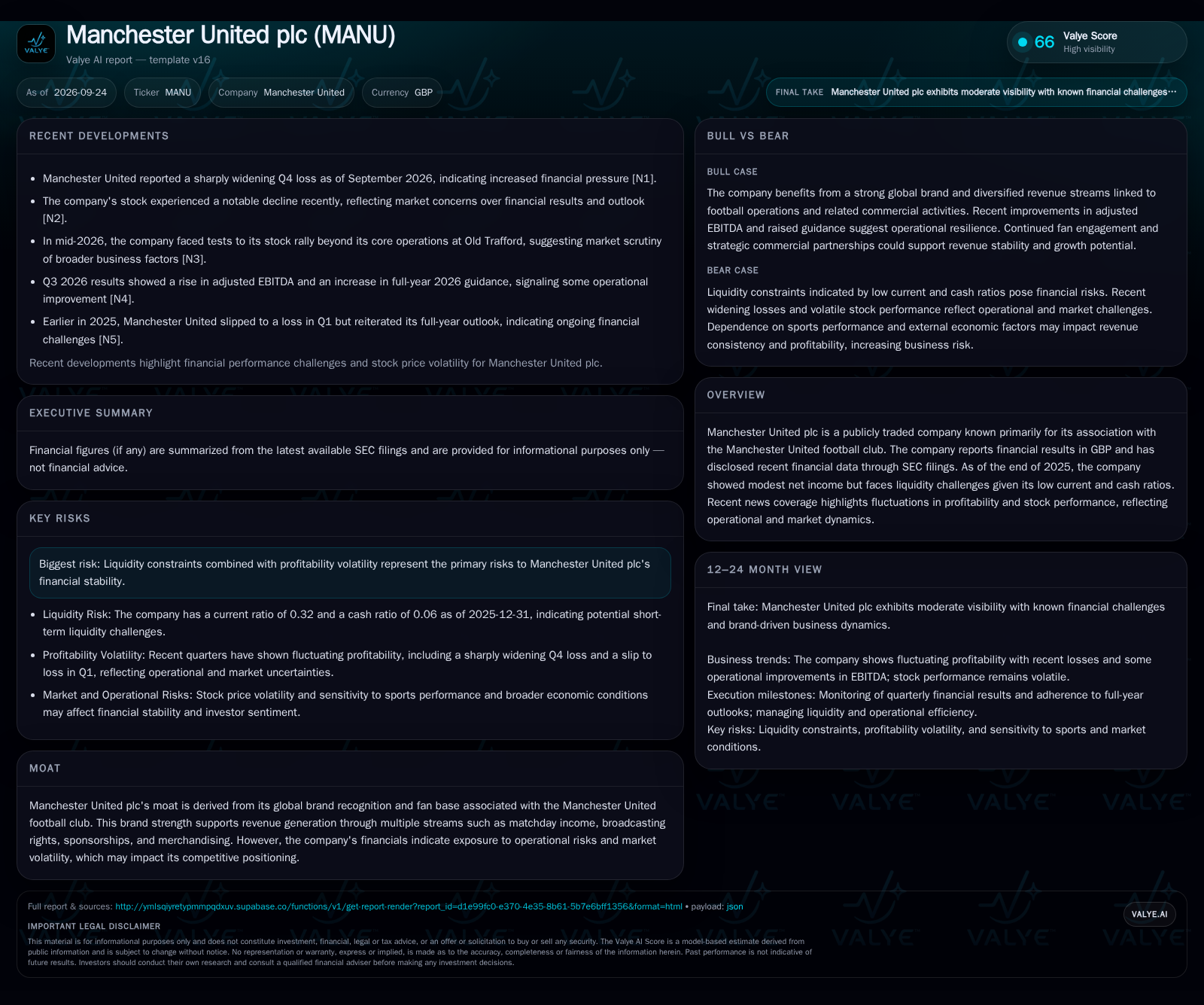
The company's financial stability hinges on its ability to convert operational momentum into sustained profitability amid significant short-term obligations and volatile revenue streams. Investors should closely monitor cash generation, commercial deal flow, and the impact of on-field performance on core revenues. [S1] [N1] [N4]
While operational improvements—such as increased adjusted EBITDA and raised guidance in Q3 2026—suggest the potential for turnaround, the company’s ability to navigate mounting short-term obligations and volatile profit trends remains in question. The next year will be pivotal in determining whether Manchester United can leverage its commercial strengths to restore financial stability, or whether structural challenges will continue to erode shareholder value.
Sharply Widening Losses and Liquidity Pressure Define the Current State
As of September 2026, Manchester United plc reported a sharply widening Q4 loss, intensifying concerns about the company’s ability to withstand operational and market shocks [N1]. [S1] While Q3 2026 brought a rise in adjusted EBITDA and an increase in full-year guidance, these improvements have yet to translate into a reversal of the broader trend toward profitability volatility [N4]. Stock performance has mirrored this uncertainty, with sharp rallies and subsequent fumbles throughout 2026, reflecting the market’s skepticism regarding the durability of any operational recovery [N2] [N3].
How Manchester United Generates—and Risks—Cash Flow
Manchester United’s business model is predicated on monetizing the power of its global brand through three primary revenue streams: matchday (ticketing and stadium-related), broadcasting (domestic and international media rights), and commercial (sponsorships, licensing, and merchandising). Each stream is highly sensitive to on-field performance, brand perception, and macroeconomic trends. Broadcasting and sponsorship contracts can provide a degree of forward revenue visibility, but the magnitude and timing of cash flows are variable—especially as performance impacts qualification for high-profile tournaments and related payouts.
Operating leverage is structurally high: fixed costs are significant, encompassing player wages, stadium operations, and administrative overheads. When revenues rise (for example, through qualification for lucrative tournaments or new sponsorship deals), incremental margins can be substantial. However, the flip side is acute vulnerability to downturns: if performance falters or global macro shocks hit, high fixed costs mean losses can widen rapidly, as seen in recent quarters [N1] [S1]. Capital needs are recurrent, as competitive pressures often require ongoing investment in player acquisitions, stadium infrastructure, and digital engagement platforms.
The timing and structure of revenue recognition also play a critical role in cash flow dynamics. For example, broadcasting revenues are often received in lump sums or installments tied to contractual milestones, which can create periods of cash inflow concentration followed by leaner intervals. Similarly, commercial contracts may include performance-based incentives or renewal clauses contingent on sporting success, adding complexity to revenue predictability.
Moreover, the club’s investment decisions must balance short-term financial pressures against long-term brand and competitive positioning. Player acquisitions, while costly, can enhance team performance and thus unlock higher revenue tiers through tournament qualification and broader commercial appeal. However, overextension in transfer spending without commensurate revenue growth risks exacerbating liquidity strain. Similarly, investments in stadium modernization or digital platforms may not yield immediate returns but are essential for sustaining fan engagement and commercial relevance amid evolving consumption habits. The interplay between these capital allocation choices and operational cash flow underscores the complexity of managing financial health in a high fixed-cost environment.
Brand Strength Versus Competitive and Structural Headwinds
Manchester United’s principal competitive advantage lies in its globally recognized brand and an enormous, multi-generational fan base. This supports premium sponsorship deals, global merchandising sales, and outsized media coverage. However, in the modern football landscape, these advantages are increasingly contested. Peer clubs—particularly in the English Premier League and top European leagues—have rapidly internationalized their brands and invested heavily in commercial operations, narrowing the gap in global reach and sponsorship appeal.
The Premier League’s collective bargaining for media rights ensures a baseline of broadcast revenue, but competition for top-four league positions (and thus Champions League qualification) is fierce. Clubs with sovereign wealth backing or more flexible capital structures pose ongoing threats, both on the pitch and in commercial negotiations. Alternative forms of entertainment, changing consumption patterns, and the rise of digital-first fan engagement platforms offer substitution risks. Manchester United’s ability to retain pricing power in ticketing, merchandising, and sponsorships will depend on both sporting success and the club’s agility in evolving its commercial offerings.
In addition to direct competitive pressures, Manchester United faces structural shifts in fan engagement and content consumption that could alter revenue composition over time. The rise of streaming services and social media platforms has fragmented audiences, challenging traditional broadcast models and necessitating innovative content delivery strategies. This evolution may open new monetization avenues, such as subscription-based digital experiences or personalized fan interactions, but also introduces uncertainty regarding revenue scale and timing. The club’s ability to integrate these digital initiatives effectively will influence its capacity to maintain or grow commercial revenues in an increasingly crowded entertainment landscape.
Furthermore, regulatory and governance factors inherent in football’s ecosystem impose additional constraints on financial and competitive strategy. Salary caps, financial fair play rules, and transfer regulations can limit operational flexibility and necessitate prudent financial planning. These constraints may protect against reckless spending but also restrict rapid scaling or recovery efforts following performance downturns. Understanding how these frameworks interact with the club’s capital structure and revenue volatility is crucial for assessing the sustainability of its competitive positioning and financial resilience.
Operational Turnaround and Commercial Expansion Drive Financial Recovery
A favorable trajectory would see Manchester United successfully converting recent operational improvements—like the Q3 2026 rise in adjusted EBITDA and increased guidance—into consistent, positive net income and stronger cash generation [N4]. This would likely require a combination of improved on-field performance (securing higher broadcast and prize revenues), high-profile commercial deals, and effective cost discipline. If the club can leverage its brand to secure new or expanded global sponsorships, tap digital monetization channels, and maintain top-tier competitive status, operating leverage could allow for outsized margin improvement.
Evidence for this scenario would include consecutive quarters of positive net income, rising cash balances, improved current and cash ratios, and announcements of major commercial partnerships or licensing expansions. Sustained growth in global fan engagement metrics, if disclosed, would further substantiate the durability of the brand’s commercial appeal.
Profitability Volatility Persists as Brand Strength Buoys but Does Not Transform Fundamentals
The most plausible outcome is continued volatility in profitability, with Manchester United’s brand enabling some resilience in commercial revenue, but without a decisive return to sustained earnings growth. Operational improvements may be uneven, as gains in EBITDA or guidance are offset by periods of poor sporting performance, macroeconomic headwinds, or cost escalations. Liquidity constraints are likely to remain a persistent challenge absent external financing or asset sales.
Confirmation of this scenario would be ongoing fluctuations in net income (including intermittent losses), little sustained improvement in cash or current ratios, and periodic news of both commercial wins and setbacks. If the company continues to reiterate full-year outlooks despite quarterly losses, this would further indicate management’s attempt to manage expectations amid structural instability.
Liquidity Crunch and Competitive Slippage Threaten Franchise Value
A more adverse scenario would see liquidity constraints intensify, forcing Manchester United to seek external financing on unattractive terms, sell assets, or curtail investment in the squad and infrastructure. Poor on-field performance could lead to missing out on Champions League revenues and weakening the club’s negotiating position in sponsorship renewals. In this environment, fixed costs would remain high while revenues stagnate or decline, exacerbating net losses and eroding shareholder value.
Signs supporting this downside include further declines in cash and current ratios, announcements of emergency credit arrangements or asset disposals, and a deterioration in commercial partnership terms. A drop in disclosed fan engagement metrics or a failure to renew major sponsorships would further signal brand erosion and diminishing competitive relevance.
What Will Determine Whether Manchester United Restores Financial Stability?
Quarterly trends in net income and adjusted EBITDA: sustained improvement would support a turnaround thesis; recurring losses would heighten downside risk.
Announcements of new or renewed major sponsorships and commercial partnerships: these would indicate the brand’s continued ability to command premium terms.
Evidence of successful digital monetization strategies or global fan engagement growth, if disclosed, would confirm the club’s adaptation to changing consumption patterns.
Player wage-to-revenue ratio, if disclosed, as a measure of cost discipline and operating leverage management.
On-field performance indicators—especially league and European competition qualification—as these directly impact core revenue streams.
Disclosure of new financing arrangements, credit facility drawdowns, or asset sales: these would reveal stress or proactive steps to shore up liquidity.
Trends in merchandise and ticketing sales, especially in international markets, would test the thesis that brand power can offset local market or performance headwinds.
Disclaimer: This is research-only, informational analysis and not investment advice. It may include AI-generated interpretation and general industry context. Always verify important details using primary sources.

Comments