
Paychex’s AI-Driven Expansion: Platform Leverage, Retention Economics, and the Roadmap After Paycor
Paychex’s recent integration of AI capabilities and the Paycor acquisition are reshaping its growth profile, but execution around upmarket expansion, client retention, and margin dynamics will determine whether the company can extend its leadership in a highly competitive HCM landscape.
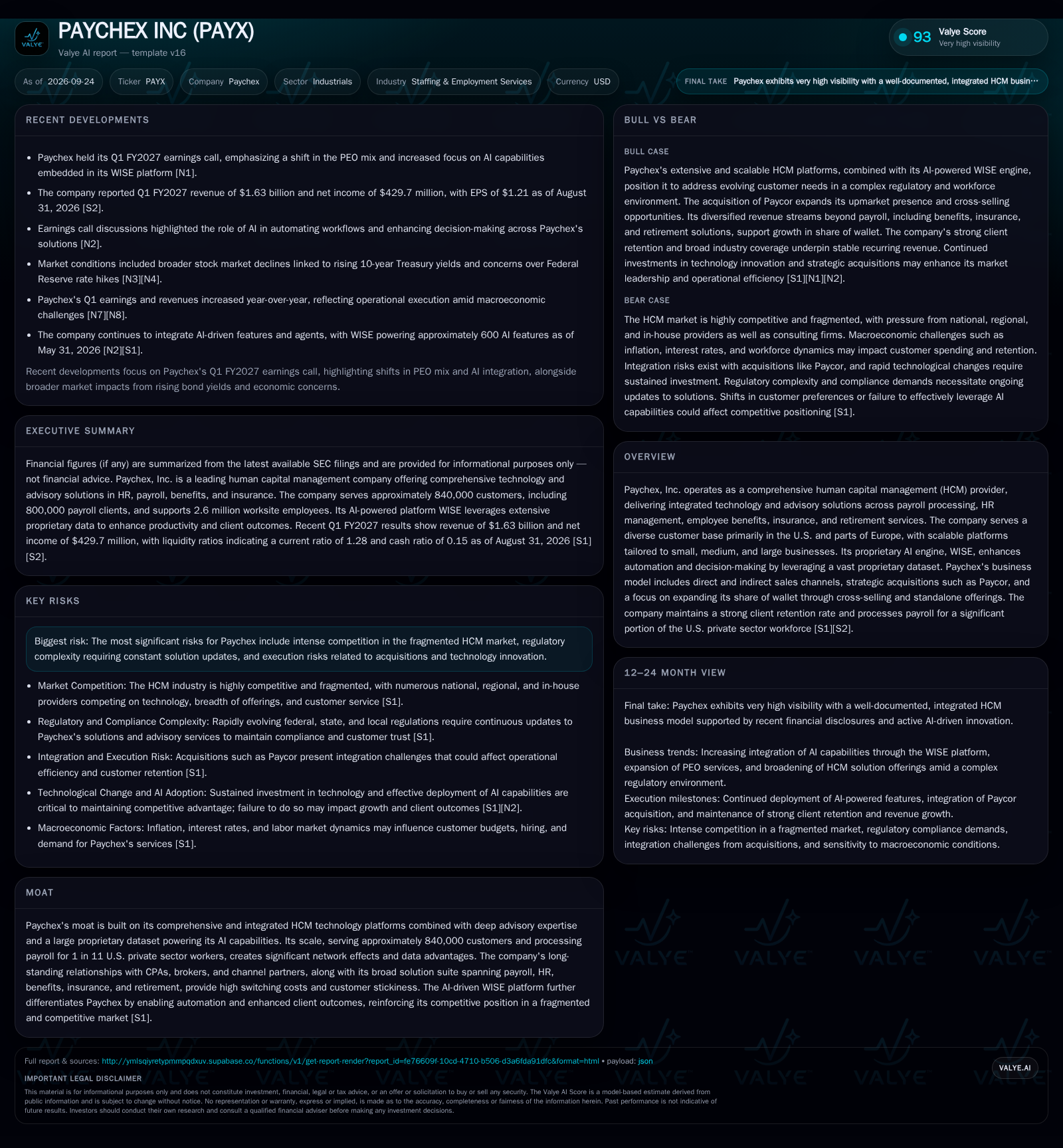
Paychex reported Q1 FY2027 revenue of $1.63 billion and net income of $429.7 million, underscoring both scale and profitability as it integrates Paycor and deepens AI automation through its WISE platform. The company’s retention rate remains around 82-83%, but ongoing shifts in PEO mix and the challenge of cross-selling into a fragmented market put the spotlight on whether Paychex can translate platform breadth and data advantages into sustainable margin expansion and upmarket share gains. Watch for evidence on Paycor integration, AI-driven upsell, and retention trends as the next 12-24 months unfold [S1] [S2] [N1] [N2].
Paychex stands at a critical juncture as it leverages its vast customer base, proprietary data, and AI-driven automation to deepen its presence in the human capital management (HCM) market. The recent acquisition of Paycor and the expansion of its WISE AI platform are designed to move Paychex further upmarket and to increase cross-sell into adjacent HR, benefits, and insurance services. However, the company’s ability to maintain high client retention, manage mix shifts in its PEO business, and extract margin from new AI capabilities will be tested by fierce competition and evolving customer needs. How Paychex executes on these fronts will shape its growth and profitability trajectory over the next several years.
How Paychex’s Scale and AI Initiatives Are Shaping Its Present
As of May 31, 2026, Paychex serves approximately 840,000 customers, including about 800,000 payroll clients, and supports 2.6 million worksite employees through its HR outsourcing solutions [S1]. This scale allows Paychex to process payroll for roughly 1 in 11 U.S. private sector workers, highlighting its entrenched industry position. The Q1 FY2027 results—$1.63 billion in revenue and $429.7 million in net income—demonstrate strong ongoing profitability despite macroeconomic headwinds [S2] [N7] [N8]. A key recent development is the integration of Paycor, completed in April 2025, which is intended to expand Paychex’s reach into larger, more complex HCM clients and to complement its existing platforms [S1].
Paychex’s technology strategy is anchored by WISE, its AI-powered platform, which now powers approximately 600 features and leverages a proprietary dataset of over 26 trillion data points to automate workflows and enhance decision-making [S1] [N2]. The company’s payroll client retention rate remains robust at 82-83% as of fiscal 2026, but the market’s fragmentation and competitive intensity continue to create pressure points [S1]. These facts set the stage for evaluating whether Paychex’s recent moves can drive durable competitive advantage and margin expansion.
Revenue Mix, Platform Economics, and the Leverage of Data
Paychex’s revenue model is anchored in recurring fees for payroll processing, HR administration, benefits, insurance, and retirement solutions. Historically, payroll—often a sticky, compliance-driven service—has provided a resilient base, with cross-sell into higher-margin adjacent services (insurance, retirement, HR outsourcing) offering incremental growth and margin uplift. The company’s multi-platform strategy (SurePayroll for small businesses, Paychex Flex for SMBs, and Paycor for larger enterprises) allows for segmentation and tailored pricing, with the potential for higher average revenue per client as complexity and service penetration increase [S1].
The addition of Paycor gives Paychex greater access to upmarket clients, whose needs around compliance, analytics, and integration command higher price points but also require more sophisticated solutions and support. AI-driven automation and workflow enhancements (via WISE) could compress manual labor costs and improve operating leverage, particularly if adoption drives increased client self-service and reduces support intensity. However, the economics of PEO (Professional Employer Organization) and ASO (Administrative Services Organization) arrangements are sensitive to scale, risk pooling, and service mix, with changes in PEO mix potentially impacting both gross margin and revenue visibility. The company reported a current ratio of 1.28 for the period. [S2]
Defending Share in a Fragmented, Technology-Intensive Arena
The HCM sector is marked by a mix of national and regional providers, as well as competition from in-house solutions and consulting firms [S1]. Direct competitors include both specialized payroll processors and broad HCM platforms, with differentiation often coming from ease of integration, breadth of service, compliance expertise, and pricing. Paychex’s scale, deep CPA/broker relationships, and large proprietary dataset provide switching frictions and some network effects, particularly for smaller and mid-sized clients that value bundled solutions.
AI and automation are rapidly becoming table stakes, with Paychex’s WISE platform aiming to keep pace with or outstrip rivals on workflow automation and decision support. The risk is that larger enterprise HCM players, or nimble SaaS entrants, could out-innovate or undercut on price, especially for digital-first clients. The Paycor acquisition is intended to shore up Paychex’s upmarket ambitions, but integration effectiveness and cultural fit will be critical. The breadth of Paychex’s service offering (payroll, benefits, insurance, retirement, HR outsourcing) increases switching costs, but also exposes the company to potential dilution if competitors pick off high-value modules or if cross-sell rates stall.
If AI Integration and Upmarket Cross-Sell Deliver, Margin Expansion Follows
The most favorable scenario for Paychex is that the integration of Paycor and the scaling of WISE-driven AI features lead to both upmarket client wins and deeper cross-sell into the existing base. If adoption of new AI-powered workflows reduces support costs and increases client stickiness, operating leverage could improve meaningfully. Success would be visible in sustained or rising client retention above 83%, higher average revenue per client (especially in the mid and large segments), and incremental margin expansion despite competitive pricing pressure.
Evidence to confirm this scenario would include: accelerating contribution from non-payroll services in reported revenue mix, positive commentary on Paycor integration progress, and external validation of WISE’s effectiveness (e.g., client testimonials, case studies, or analyst recognition of platform leadership). Falsification would come from stagnant or declining cross-sell, margin compression, or client churn in upmarket segments.
Execution Delivers Incremental Gains, but Competitive and Macro Headwinds Persist
The most plausible path is that Paychex maintains its high retention and steady revenue growth, with incremental improvements from AI-driven automation and Paycor integration, but faces ongoing headwinds from competition and macroeconomic volatility. In this scenario, the company’s scale and breadth offset much of the competitive pressure, but rapid share gains or margin leaps are elusive. Retention hovers in the low-80s, revenue per client rises modestly through cross-sell, and the company continues to invest heavily in technology and compliance to keep pace.
Evidence supporting this scenario would be stable or slightly improving retention and margin metrics, continued feature rollouts from WISE, and moderate growth in upmarket or non-payroll revenues. Falsification would be a sharp decline in retention, persistent integration issues with Paycor, or external signs that competitors are outpacing Paychex in innovation or client acquisition.
Competitive Disruption or Integration Missteps Erode Retention and Margins
A more adverse outcome would see Paychex struggle to integrate Paycor, leading to operational disruption, client confusion, or attrition in the upmarket segment. If competitors accelerate innovation or cut prices aggressively, Paychex could see declining retention, especially among larger clients with more choices. The risk is amplified if macroeconomic pressure leads SMB clients to in-source payroll or switch to lower-cost providers, compressing both revenue and margin.
This scenario would be confirmed by declining client retention rates (especially in high-value segments), negative earnings surprises, or disclosures of integration delays and cost overruns. Signs of price compression, rising customer acquisition costs, or net churn in core payroll would further validate downside risk.
Tracking the Levers That Will Shape Paychex’s Next Chapter
Sustained or rising client retention rates, especially in the payroll and upmarket HCM segments, will be essential for validating durable competitive advantage.
Reported revenue mix shifts—specifically, the contribution of non-payroll services (benefits, insurance, HR outsourcing)—would indicate success in cross-selling and wallet share expansion.
Quantitative and qualitative updates on Paycor integration progress, including revenue synergy realization and customer churn rates post-acquisition, would help test the upmarket thesis.
Adoption rates and client engagement metrics for AI-powered WISE features, if disclosed, would serve as leading indicators for margin and retention improvement.
Gross margin trends, particularly in PEO and ASO offerings, will reveal the impact of mix shifts and operational leverage from automation.
Technology investment levels and the speed of new feature rollouts—especially those tied to regulatory compliance or customer-requested enhancements—will signal ongoing innovation capacity.
Any disclosures on net new client acquisition costs or competitive win/loss rates would provide insight into market share dynamics.
Disclaimer: This is research-only, informational analysis and not investment advice. It may include AI-generated interpretation and general industry context. Always verify important details using primary sources.

Comments