
Rezolute, Inc.: Navigating Regulatory Uncertainty to Unlock Rare Disease Market Potential
Rezolute’s lead asset, ersodetug, faces a pivotal moment: clinical progress and promising biomarker evidence contrast with missed trial endpoints and an uncertain FDA pathway.
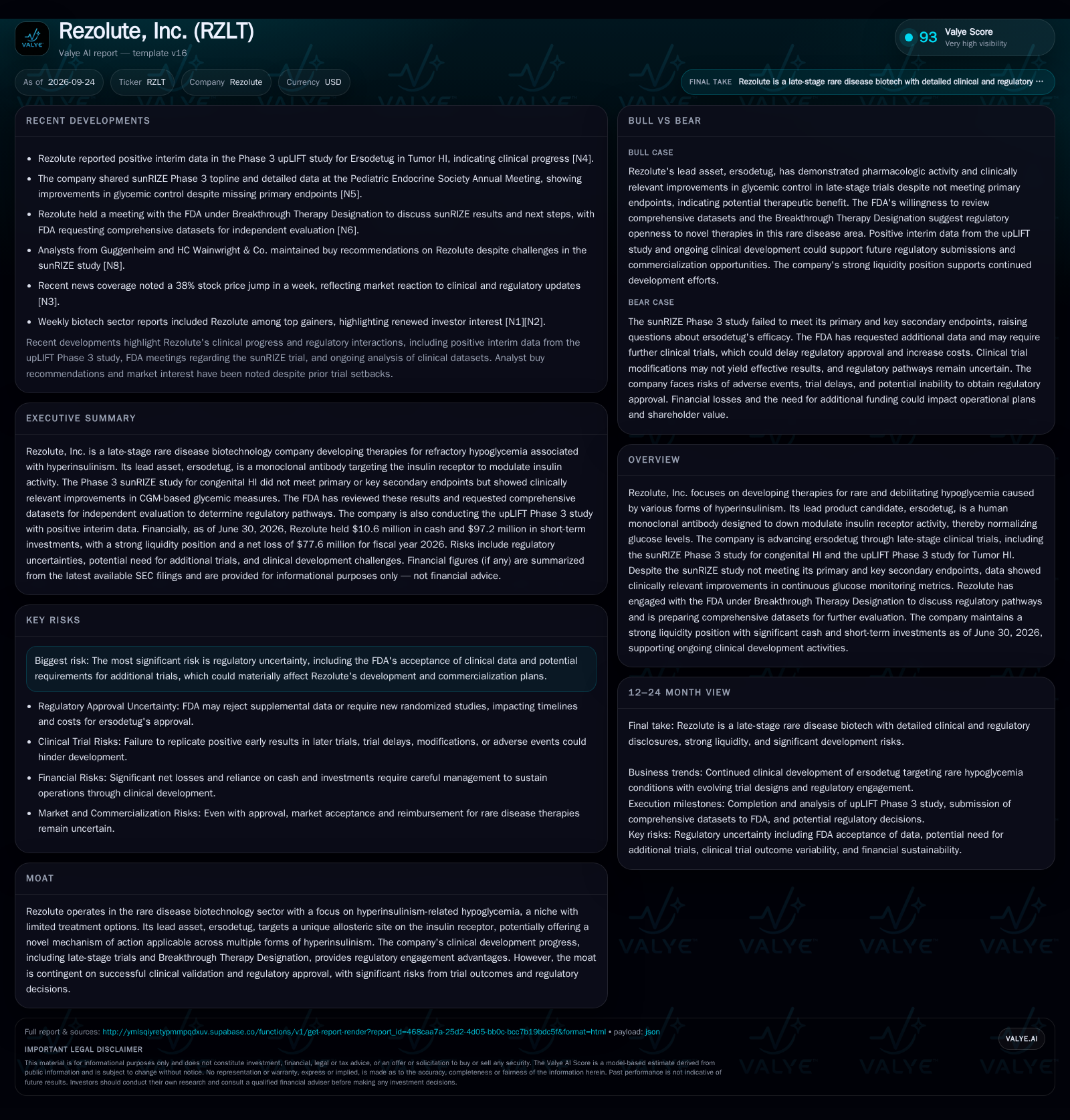
Rezolute’s late-stage program for rare hypoglycemia, centered on ersodetug, is at an inflection point. The lead asset showed clinical and biomarker improvements despite missing primary endpoints in the key sunRIZE Phase 3 trial. The FDA has acknowledged measurement challenges but requires more data before considering approval. Financially, Rezolute holds over $100 million in cash and short-term investments, supporting ongoing trials and regulatory engagement. The company’s fate now hinges on whether clinical benefits can be robustly demonstrated and accepted by regulators, with additional trials a real possibility if current data prove insufficient. [S1] [N4] [N6]
Rezolute, Inc. is at a critical juncture in its quest to commercialize ersodetug, a first-in-class therapy for rare hypoglycemia due to hyperinsulinism. While late-stage trials have delivered encouraging signals—like improved glycemic control and pharmacologic activity—the failure to meet primary efficacy endpoints in the sunRIZE study clouds the regulatory outlook. However, the company’s long-term trajectory now depends on whether upcoming regulatory reviews and further trial results can transform clinical promise into an approvable product.
Latest Developments: Clinical Setbacks Tempered by Regulatory Engagement
Rezolute’s most material recent development is the outcome of the sunRIZE Phase 3 trial for congenital hyperinsulinism, in which its lead asset, ersodetug, failed to meet both its primary endpoint (reduction in hypoglycemia events by SMBG) and key secondary endpoint (time in hypoglycemia by CGM) at 24 weeks. Despite these headline misses, the trial did show clinically relevant and nominally statistically significant improvements in continuous glucose monitoring (CGM) measures and glycemic control in treatment arms, as well as clear pharmacologic activity by biomarker response. [N5] [S1]
The FDA, after a March 2026 meeting under Breakthrough Therapy Designation, acknowledged the difficulty of measuring hypoglycemia in congenital HI and the confounding impact of behavioral factors but reiterated the need for robust, well-controlled data. The agency encouraged Rezolute to submit comprehensive datasets for independent evaluation, leaving open the possibility of a regulatory path forward if additional analyses are persuasive. [N6] [S1]
Financially, Rezolute reported $10.6 million in cash and $97.2 million in short-term investments as of June 30, 2026, with current assets of $110.5 million versus current liabilities of $11.4 million, yielding a current ratio of 9.68. Net loss for the year was $77.6 million. [S1]
Meanwhile, the upLIFT Phase 3 trial in Tumor HI has reported positive interim data, suggesting potential expansion opportunities beyond congenital HI. [N4]
Therapeutic Economics: High-Value Niche, High-Risk Development
Rezolute’s business model reflects the classic late-stage rare disease biotech profile: high upfront R&D investment, binary clinical risk, and the potential for outsized returns if regulatory approval is achieved. Ersodetug’s target indications—congenital and Tumor HI—represent rare, debilitating conditions with limited treatment options, which often translate to premium pricing and concentrated, specialist-driven commercialization if a therapy is approved.
Should ersodetug achieve approval, its economics would likely hinge on orphan-drug pricing power, with annual treatment costs potentially reaching six figures per patient, in line with other rare-disease biologics. The addressable market is inherently limited by patient prevalence, but payor access may be supported by the severity and unmet need of HI.
The cost base is currently dominated by R&D and clinical trial expenses, with net losses of $77.6 million in FY2026 and a cash/investment position designed to fund near-term clinical and regulatory work. Fixed costs could decrease post-approval, but manufacturing, commercialization, and pharmacovigilance would add new expense layers.
Operating leverage could be substantial if approval unlocks rapid adoption in the target patient pool. Conversely, if further trials are required or approval is denied, sunk costs and future funding needs could rise sharply.
Positioning in the Rare Disease Arena: Novel Mechanism, but Barriers Remain
Rezolute’s competitive position is defined by two factors: the novelty of ersodetug’s mechanism—targeting an allosteric site on the insulin receptor—and the lack of effective, disease-modifying therapies for HI. This provides a potential first-mover advantage and, if efficacy is proven, a pathway to orphan exclusivity and limited direct competition in the near term.
However, the rare disease therapeutic landscape is increasingly crowded with both established pharmas and specialized biotechs pursuing genetic, small-molecule, and antibody-based approaches. Any approval delays or equivocal efficacy results could invite competition, including gene therapies, next-generation antibodies, or repurposed metabolic modulators.
Switching costs may be high for patients stabilized on an effective therapy, but initial adoption depends on robust, regulator-accepted clinical evidence. Payer scrutiny is also intense in rare disease, and without clear superiority over existing management (including off-label and surgical options), pricing power could be constrained.
Platform expansion into related forms of HI or other insulin-related disorders is plausible if the core mechanism is validated, but each indication would require additional investment and regulatory navigation.
If FDA Accepts Clinical Benefit: From Data Challenges to Commercial Launch
The favorable scenario for Rezolute hinges on the FDA accepting the totality of evidence from the sunRIZE trial—including CGM-based improvements, biomarker data, and pharmacologic activity—as sufficient for approval, perhaps with post-marketing requirements. This could be catalyzed by the agency’s recognition of the challenges in measuring hypoglycemia events and the unmet need in congenital HI.
If the upLIFT trial in Tumor HI also continues to deliver positive results, Rezolute could rapidly expand its label and target population, accelerating revenue ramp and de-risking the pipeline.
Evidence supporting this scenario would include FDA communications indicating that the submitted datasets are adequate for review, a formal acceptance of a marketing application, or even accelerated approval based on secondary endpoint and biomarker data. Additional positive clinical data from upLIFT or real-world evidence showing meaningful patient benefit would further confirm the upside.
Commercially, early adoption by centers of excellence and inclusion in treatment guidelines would signal strong market traction.
Most Likely Outcome: Prolonged Regulatory Review and a Need for Further Data
The most plausible path forward is a drawn-out regulatory process in which the FDA, after independent review of comprehensive datasets, requests additional analyses or a new, well-controlled clinical trial to address data gaps from sunRIZE. This would delay commercial timelines, increase costs, and require Rezolute to manage cash prudently or seek additional funding.
In this scenario, the upLIFT program in Tumor HI becomes more important as a potential near-term value driver, but its success alone may not offset the setback in congenital HI unless regulatory requirements are harmonized.
Confirmation would come from FDA feedback requesting further studies, a Complete Response Letter, or public disclosures of new trial protocols. Conversely, a surprise acceptance of the current data package would falsify this scenario and move Rezolute rapidly toward market entry.
Operationally, the company would likely need to adjust spending, potentially seek partnerships, or consider strategic alternatives if timelines extend materially.
Adverse Pathway: Regulatory Rejection and Funding Pressure
The adverse scenario materializes if the FDA deems the sunRIZE data insufficient for approval and mandates a new, large-scale, randomized controlled trial—potentially with more stringent endpoints. This would significantly delay any commercial launch, increase R&D burn, and force Rezolute to raise substantial new capital or downsize operations.
If upLIFT also encounters efficacy or safety setbacks, the pipeline’s value could erode quickly, leaving the company vulnerable to strategic setbacks or forced asset sales.
Evidence confirming this scenario would include explicit FDA rejection of the current dataset, public disclosure of failed secondary programs, or a sharp reduction in cash and equivalents without offsetting financing.
A further risk is that competitors advance alternative therapies during Rezolute’s delay, eroding first-mover potential and negotiating leverage with partners or acquirers.
Milestones That Will Determine Rezolute’s Trajectory in Rare Disease Therapeutics
FDA feedback on the adequacy of the comprehensive datasets submitted for sunRIZE—formal acceptance or requests for new trials would be decisive.
Interim and final efficacy/safety results from the upLIFT Phase 3 trial in Tumor HI, including whether positive interim data translate into statistically significant and clinically meaningful outcomes.
Cash burn rate and updates on financial runway, especially if additional trials are mandated or timelines slip—disclosed quarterly if available.
Any indication of partnership, licensing, or strategic collaboration that could provide non-dilutive funding or commercial support.
Regulatory developments in Europe or other ex-US markets, where regulatory standards and unmet need may differ.
Emergence of new competitor data or approvals in HI or overlapping rare metabolic disorders, which could shift the competitive landscape.
If disclosed, real-world evidence or expanded-access program outcomes that demonstrate patient benefit or safety outside trial settings.
Management guidance on expected regulatory timelines and development milestones—delays or acceleration would materially impact sentiment.
Disclaimer: This is research-only, informational analysis and not investment advice. It may include AI-generated interpretation and general industry context. Always verify important details using primary sources.

Comments