
AtlasClear Holdings: Integrating Fintech Across Clearing, Custody, and Banking for Underserved Financial Firms
AtlasClear Holdings pursues a modern, API-driven platform strategy to streamline clearing, custody, and banking for smaller financial institutions, but faces execution risks in acquisition integration and the challenge of scaling against entrenched legacy providers.
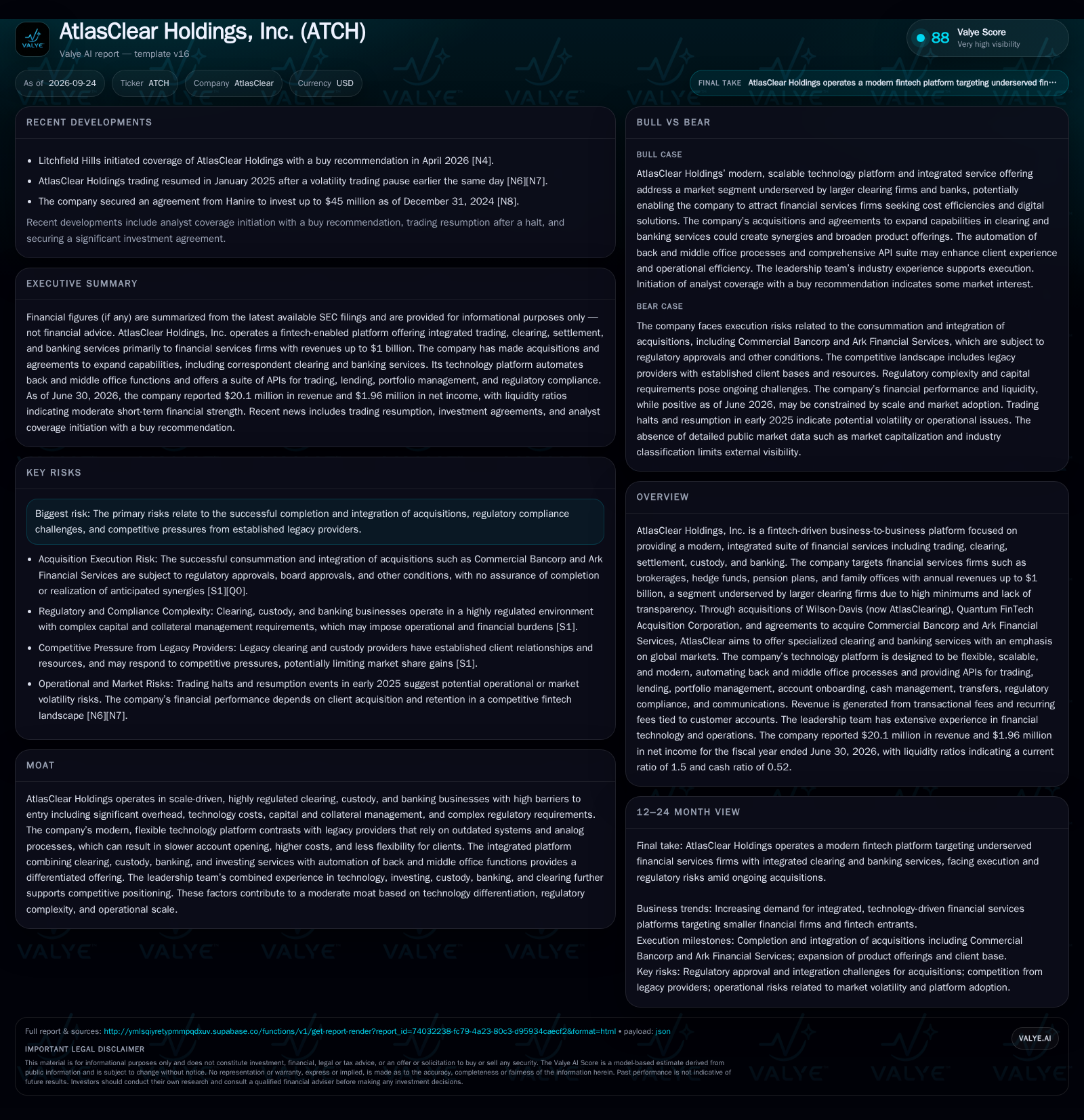
AtlasClear Holdings targets financial services firms underserved by large clearing houses, offering integrated fintech solutions with a focus on automation and flexibility. Ongoing acquisitions aim to expand its capabilities in clearing and banking, but the company’s ability to scale, integrate acquisitions, and navigate regulatory complexity will determine its success. Revenue as of June 2026 was $20.1 million with net income of $1.96 million, and an analyst buy initiation highlights some market optimism [S1] [N4].
AtlasClear Holdings, Inc. is positioning itself at the convergence of fintech and traditional financial infrastructure, aiming to deliver a fully integrated suite of clearing, custody, and banking services to mid-sized financial services firms often overlooked by larger providers. With its API-first technology platform, recent acquisitions, and a management team with deep industry experience, AtlasClear aspires to streamline complex, regulated processes for clients seeking cost efficiency and digital agility. Yet, with pending acquisitions, regulatory complexity, and legacy competition, the company’s path to sustainable scale and differentiation remains fraught with both opportunity and execution risk.
Recent Financial Results and Strategic Moves Set the Stage
AtlasClear Holdings reported $20.1 million in revenue and $1.96 million in net income for the fiscal year ended June 30, 2026, signaling positive operating momentum as it scales its fintech-driven B2B platform [S1]. The company reported cash and liquidity metrics for the period; these figures do not by themselves establish operating runway, investment capacity, financial flexibility, or financing capacity. [S1] Execution of a share purchase agreement to acquire Commercial Bancorp (a federal reserve member bank) and Ark Financial Services, alongside the earlier acquisition of Wilson-Davis (now AtlasClearing), reflects an aggressive build-out of banking and clearing capabilities, all subject to regulatory approvals [S1]. Litchfield Hills’ initiation of coverage with a buy recommendation in April 2026 signals some market optimism around the company’s strategy [N4].
Fee-Driven Model Anchored in Technology and Recurring Revenue Potential
AtlasClear’s business model is built on a mix of transactional fees—such as for clearing, execution, and banking—and recurring revenue streams including platform minimums, asset-based fees, account maintenance, and spreads on credit/debit balances [S1]. This blend offers the potential for a relatively stable and scalable revenue base, especially as client accounts grow and assets under custody increase. The company’s platform automates back and middle office workflows, likely reducing marginal operating costs for each new client and driving operating leverage over time if scale is achieved. However, large upfront investments in technology, regulatory compliance, and capital reserves are inherent to the clearing and banking verticals, meaning that fixed costs are significant and breakeven thresholds can be high. The ability to cross-sell multiple services to each client could boost average revenue per account and increase retention, but success depends on the company’s ability to deliver a seamless, integrated experience and to keep pace with evolving regulatory and security requirements.
The interplay between fixed and variable costs in AtlasClear’s model underscores the importance of achieving scale to unlock profitability. Given the capital-intensive nature of banking and clearing operations, the company must reach a critical mass of client accounts and transaction volume to dilute fixed overheads such as compliance infrastructure, technology maintenance, and capital reserves. Additionally, the recurring revenue streams tied to assets under custody or account minimums provide a stabilizing effect, but their growth is contingent on both client retention and asset inflows. If the company can enhance client stickiness through integrated service offerings and superior user experience, it may reduce churn and increase lifetime value, further supporting margin expansion. Conversely, failure to scale could leave the company burdened by high fixed costs and volatile transactional income.
Challenging Legacy Providers with Modern Tech—But Facing High Barriers
AtlasClear seeks to differentiate itself from entrenched legacy clearing and custody providers by offering a modern, API-driven platform that emphasizes automation, transparency, and flexibility. In theory, this could attract smaller financial firms frustrated by high minimums, slow onboarding, and inflexible systems at larger providers. However, the competitive moat in clearing and custody is built on regulatory compliance, capital adequacy, operational track record, and deep integrations with financial infrastructure—areas where incumbents have entrenched advantages and client trust. While automation and technology can lower client onboarding friction and potentially reduce costs, customer switching is typically slow due to operational risk aversion and regulatory hurdles. Competitor categories include established clearing houses, custody banks, and new fintech entrants offering modular or embedded financial services. AtlasClear’s success may hinge on its ability to demonstrate reliability, security, and regulatory compliance at scale, while continuously innovating to stay ahead of both legacy and digital-native competitors.
AtlasClear’s competitive positioning also depends on its ability to navigate regulatory complexity more nimbly than legacy incumbents. While established players benefit from entrenched relationships and regulatory licenses, their legacy systems often impede rapid innovation and responsiveness to client needs. AtlasClear’s API-first approach could enable faster adaptation to regulatory changes, customized client workflows, and integration with third-party fintech services. However, this advantage is conditional on the company’s capacity to maintain robust compliance controls and cybersecurity safeguards within a modular technology stack. Moreover, the company must manage the risk that fintech entrants focusing on niche services or embedded finance solutions may erode the addressable market by offering highly specialized or lower-cost alternatives, thereby fragmenting client demand.
If Integration Succeeds, AtlasClear Could Redefine Service for Underserved Firms
The most favorable scenario for AtlasClear is that it successfully completes and integrates its acquisitions, securing regulatory approvals and unlocking the full suite of banking, clearing, and custody services under a unified, technology-driven platform. If the company can prove operational reliability, regulatory compliance, and a superior client experience, it may rapidly attract mid-sized financial institutions seeking alternatives to legacy providers. Evidence confirming this scenario would include accelerating growth in customer accounts, rising recurring fee revenue, successful cross-selling (e.g., clients adopting both banking and clearing services), and consistently positive net income. Strategic partnerships or further analyst upgrades would also support the narrative of successful execution and growing market share.
Gradual Expansion with Execution and Regulatory Headwinds
The most plausible near-term trajectory is that AtlasClear grows at a measured pace, with client wins and revenue growth offset by the challenges of acquisition integration, regulatory scrutiny, and the need to build trust in a risk-averse client base. In this scenario, the company’s revenue base expands gradually as new services come online and existing relationships deepen, but operating margins remain under pressure from ongoing investment in technology, compliance, and integration costs. Evidence of this path would be steady (but not exponential) growth in revenue and client accounts, periodic regulatory or operational hiccups, and moderate profitability. Delays in acquisition closings, slower-than-expected cross-selling, or higher-than-anticipated regulatory costs would confirm the base case.
Integration Stalls or Regulatory Barriers Limit Scale
In a negative scenario, AtlasClear struggles to close or integrate its acquisitions—perhaps due to regulatory pushback, cultural clashes, or operational missteps—resulting in elevated costs, management distraction, and lost client confidence. The company may also face difficulty scaling its platform if legacy competitors respond aggressively with pricing or technology upgrades, or if clients are slow to switch due to perceived risk. Signs confirming this scenario would include persistent delays or failures in closing acquisitions, stagnation or decline in customer accounts and revenue, deteriorating profitability, and negative analyst or client commentary. Regulatory actions or compliance failures could further erode trust and limit the company’s ability to compete in core markets.
Benchmarks for Testing AtlasClear’s Integration and Growth Ambitions
Progress and timing of regulatory approvals and closings for the Commercial Bancorp and Ark Financial Services acquisitions.
Growth rate in customer accounts and assets under custody or administration (if disclosed), which would evidence market traction.
Breakdown of recurring versus transactional revenue as a percentage of total revenue—would help assess business model stability.
Updates on technology platform enhancements, API uptake, and client onboarding speed—indicators of product differentiation.
Operating margin trends and cost-to-income ratio, signaling whether automation and scale are improving profitability.
Evidence of successful cross-selling (e.g., clients adopting multiple services, such as both clearing and banking).
Disclosure around regulatory inquiries, compliance costs, or capital requirements, which could impact scalability.
Retention rates and client churn, if disclosed, as a measure of customer satisfaction and switching friction.
Disclaimer: This is research-only, informational analysis and not investment advice. It may include AI-generated interpretation and general industry context. Always verify important details using primary sources.

Comments