
Hall Chadwick Acquisition Corp: SPAC Deal Clock Ticks as REEcycle Target Emerges
With its $207 million IPO proceeds held in trust and a business combination agreement in place with rare earth recycler REEcycle, Hall Chadwick Acquisition Corp is now racing against the SPAC deadline. The outcome will hinge on deal execution, sector tailwinds in critical minerals, and the ability to convert trust capital into a value-creating operating company.
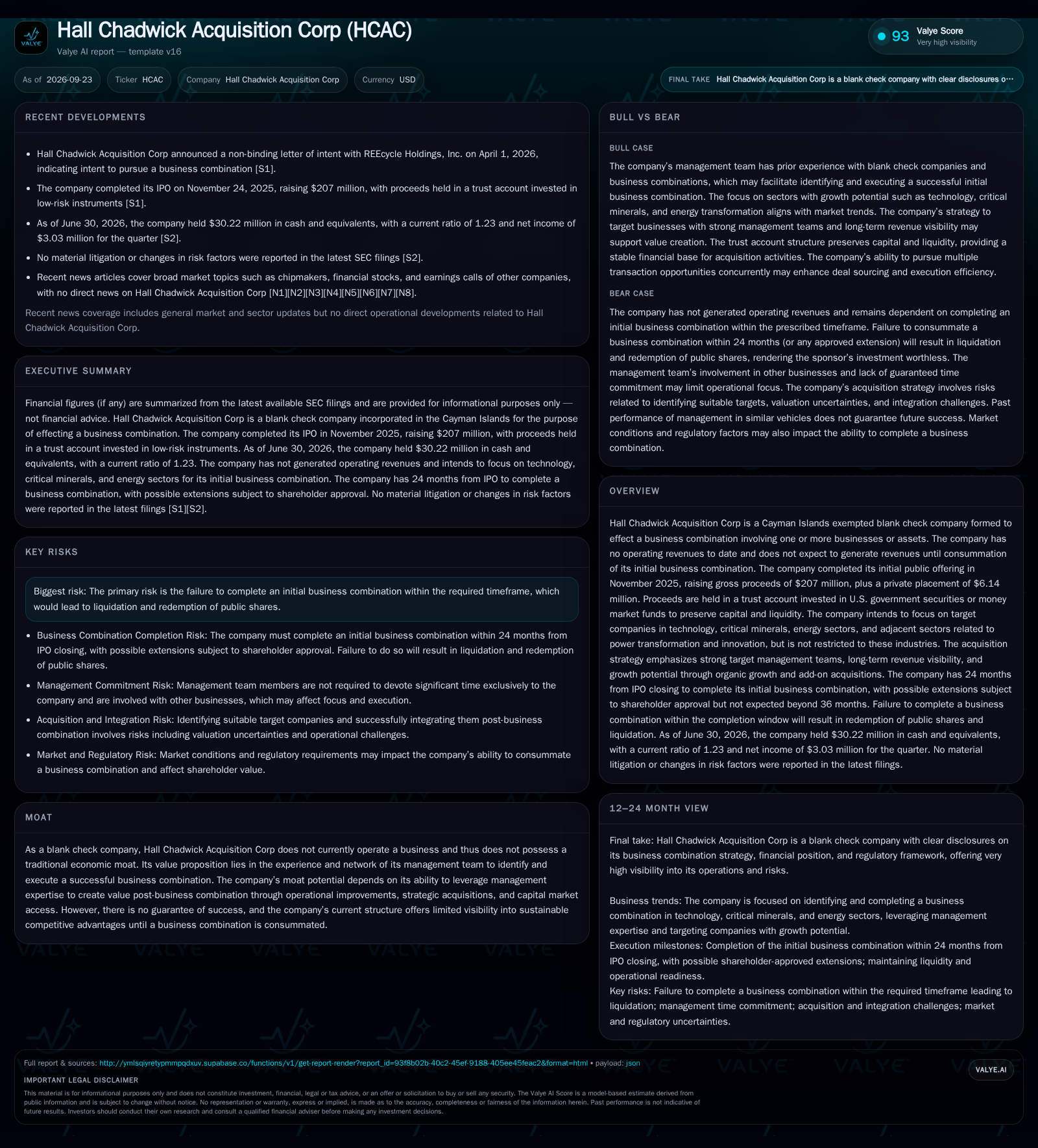
Hall Chadwick Acquisition Corp (HCAC) is a blank check company with $207 million in trust post-IPO, a pending business combination agreement with REEcycle Holdings, and a 24-month window to complete the merger or return funds to shareholders. The thesis now pivots on due diligence, regulatory approval, and REEcycle’s potential to scale in the rare earth recycling sector—a market shaped by supply chain geopolitics and technology adoption. Execution risk is acute, but the capital base and sector focus could enable a high-impact transaction if diligence confirms the target’s commercial viability. [S1] [S2]
Hall Chadwick Acquisition Corp (HCAC) stands at a pivotal moment typical of late-stage special purpose acquisition companies (SPACs): its $207 million IPO proceeds are secure in trust, a business combination agreement is now in place with REEcycle Holdings, and the clock is running on the 24-month deadline to turn capital into an operating business or return it to shareholders. The thesis for HCAC now pivots from trust preservation to deal execution and the commercial prospects of REEcycle—a rare earth recycling company positioned at the intersection of energy transition and critical minerals supply chains. The next year will test whether HCAC’s management can convert sector tailwinds and capital into durable value creation, or whether execution and market risks will force a return of funds.
SPAC Proceeds, REEcycle Agreement, and the Countdown to Business Combination
Hall Chadwick Acquisition Corp completed its IPO in November 2025, raising $207 million, with all proceeds placed in a trust account invested in U.S. government securities or money market funds to preserve capital. In May 2026, HCAC signed a business combination agreement with REEcycle Holdings, a rare earth element recycling company, marking a transition from the target search phase to transaction execution. As of June 30, 2026, HCAC reported $30.22 million in cash and equivalents, a current ratio of 1.23, and net income of $3.03 million for the quarter, driven by interest income from trust assets rather than operating activities. The company faces a 24-month deadline from IPO closing—November 2027—to complete the merger or liquidate and return funds to public shareholders. [S1] [S2]
How the SPAC Structure Shapes Economics and the Path to Value Creation
HCAC, like most SPACs, is a capital pool with minimal fixed overhead, generating only nominal interest income from trust assets prior to a business combination. The core economic inflection occurs only upon successful merger, at which point the combined entity—presumably REEcycle—would inherit the SPAC’s cash, public listing, and shareholder base. From that moment, economics depend entirely on REEcycle’s revenue model, margin profile, and capital intensity.
Rare earth recycling is typically capital intensive, requiring upfront investment in processing facilities and technology. Margins can be attractive if a proprietary process enables high recovery rates and low costs, but commercial viability hinges on securing feedstock, offtake agreements, and regulatory compliance. If REEcycle’s process can consistently produce market-grade rare earth oxides at a cost competitive with traditional mining, and if end markets (e.g., magnet manufacturers, EV supply chains) are accessible, operating leverage could be significant as volumes scale. However, the initial phase post-merger may require further capital for scaling and customer acquisition. The SPAC’s trust proceeds provide a strong starting balance sheet, but future funding needs will depend on REEcycle’s growth trajectory and capital discipline.
Strategic Landscape for Rare Earth Recycling: Barriers, Substitutes, and SPAC Dynamics
The rare earth recycling sector is characterized by high technical barriers, regulatory scrutiny, and a limited set of credible competitors, including established recyclers, integrated mining firms, and technology startups. The key sources of potential advantage for REEcycle, and thus for HCAC post-combination, would be proprietary hydrometallurgical techniques, access to end-of-life magnet feedstock, and the ability to secure long-term offtake agreements with downstream buyers.
However, counterforces are substantial: traditional mining remains the dominant supply source, and new entrants must compete not only on cost but also on purity, reliability, and ESG credentials. Technology substitution risk exists if direct alternatives (such as new battery chemistries or magnet designs) reduce end-market demand for specific rare earths. Within the SPAC context, competition also extends to capital markets—investors may reallocate if the proposed business combination does not offer clear differentiation or credible growth prospects.
If REEcycle’s Technology Proves Scalable, the SPAC Could Unlock High-Multiple Growth
The most favorable outcome for HCAC shareholders would be the successful completion of the REEcycle merger, followed by validation of REEcycle’s technology at commercial scale. If REEcycle can demonstrate high-yield, low-cost recovery of rare earths from end-of-life magnets, secure supply contracts with OEMs or magnet manufacturers, and lock in offtake agreements, the company could benefit from structural demand for critical minerals driven by the energy transition (e.g., EVs, wind turbines).
Confirmation would come from public disclosures of successful pilot or commercial-scale operations, customer commitments, and rapid revenue ramp post-merger. Evidence that offtake partners are willing to pay a premium for recycled rare earths, especially given geopolitical pressures to localize supply chains, would further validate the thesis. A post-merger capital raise at favorable terms could also signal market confidence in the growth trajectory.
Most Likely Path: Deal Closes but Execution and Ramp Remain Unproven for Several Quarters
The most plausible trajectory is that HCAC completes the merger with REEcycle within the required window, transitioning from a SPAC to a publicly listed rare earth recycling company. In this scenario, initial market enthusiasm may be tempered by the need for REEcycle to prove commercial scale, secure consistent feedstock, and demonstrate product acceptance in the market. Early quarters post-merger are likely to be characterized by modest revenue, ongoing capital expenditures, and a focus on operational milestones rather than immediate profitability.
Investors would seek evidence of ramping production, customer pipeline development, and progress toward positive operating cash flow. Delays in scaling operations, longer sales cycles, or challenges in qualifying product with end users would be the main risks to near-term performance. Confirmation of this scenario would come from quarterly updates on plant utilization, customer trials, and backlog development.
Deal Failure or Post-Merger Underperformance Could Trigger Share Redemptions or Value Erosion
The primary adverse scenario is failure to consummate the REEcycle merger within the 24-month deadline, forcing HCAC to liquidate and return funds to public shareholders. Alternatively, if the deal closes but due diligence reveals technical, regulatory, or commercial weaknesses in REEcycle’s business model, initial post-merger trading could be volatile, with substantial shareholder redemptions.
If REEcycle fails to secure feedstock or cannot achieve target recovery rates at scale, or if customer adoption is slower than expected, the business could burn through trust proceeds without achieving sustainable economics. Regulatory setbacks, cost overruns, or market shifts away from rare earth-dependent technologies would further exacerbate downside risk. Confirmation would come from missed transaction deadlines, lack of customer traction, or negative disclosures regarding plant operations or regulatory compliance.
Milestones and Metrics That Will Determine HCAC’s Post-SPAC Value Creation
Progress toward definitive closing of the REEcycle merger, including regulatory and shareholder approvals.
Public disclosure of REEcycle’s pilot or commercial-scale facility performance, including recovery rates and cost per kilogram (if disclosed).
Evidence of signed supply or offtake agreements with OEMs, magnet manufacturers, or other strategic partners.
Updates on HCAC’s trust account balance and any redemptions prior to or at the time of merger closing.
REEcycle’s customer pipeline development and any public commitments from anchor customers (if disclosed).
Quarterly updates on plant ramp, capacity utilization, and production volumes post-merger (if disclosed).
Any additional capital raises, PIPE investments, or funding commitments to support REEcycle’s growth plan.
Regulatory or permitting updates that could impact REEcycle’s ability to operate at scale.
Disclaimer: This is research-only, informational analysis and not investment advice. It may include AI-generated interpretation and general industry context. Always verify important details using primary sources.

Comments