
Aura Systems: Proprietary Axial Flux Induction Motors Confront Financial Strain and Adoption Barriers
Aura Systems’ rare-earth-free axial flux induction motor technology positions it as a potential disruptor in the industrial and military electrification markets.
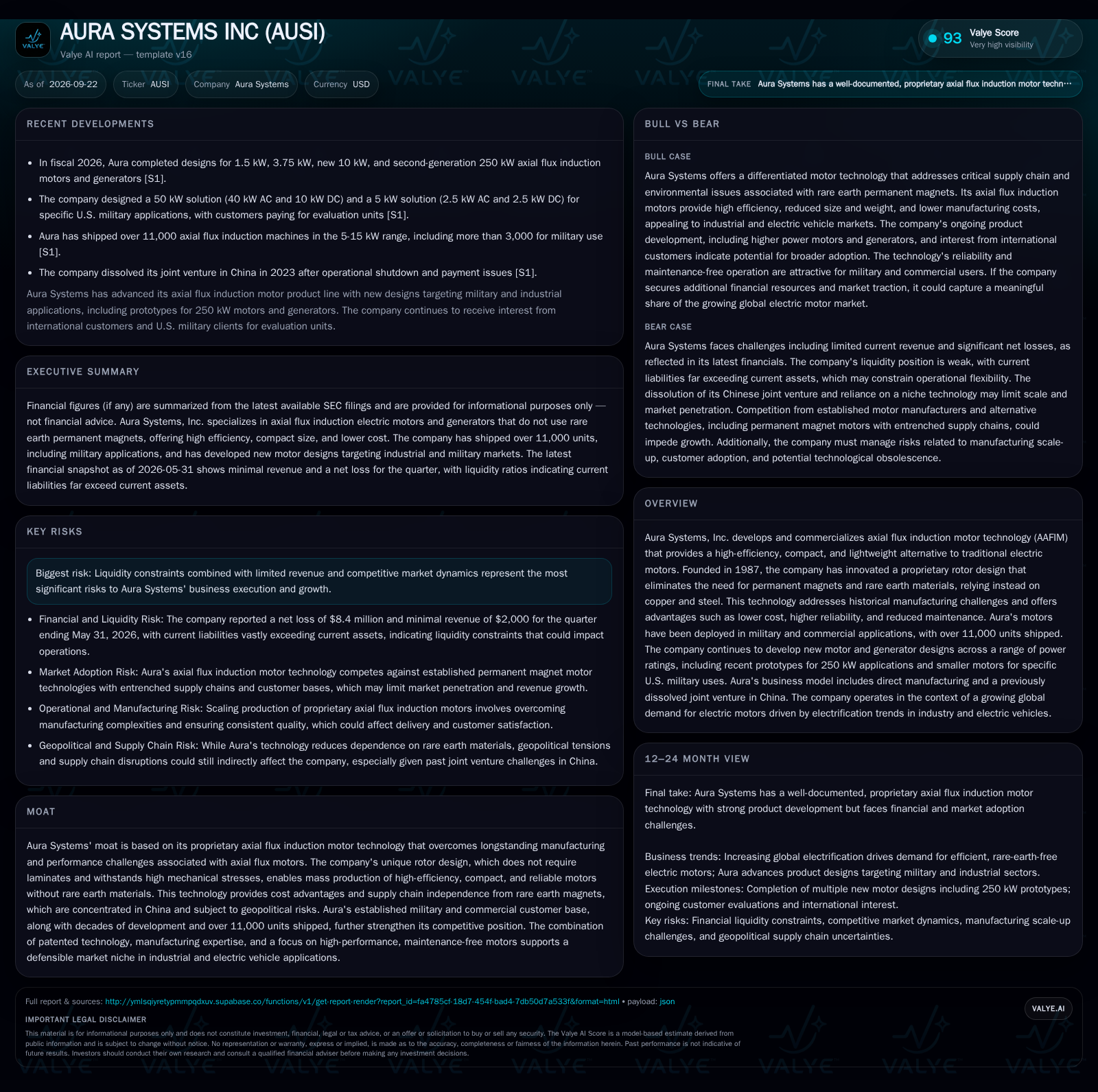
Aura Systems has shipped over 11,000 axial flux induction motors and generators, touting high efficiency and rare-earth-free design as differentiators. Recent product development includes new high-power prototypes and evaluation units for military customers. The challenge ahead is converting technical achievement and industry interest into sustainable revenue and operational stability. [S1] [S2]
Aura Systems has spent decades refining its axial flux induction motor technology, culminating in a rare-earth-free, high-efficiency design that directly addresses both performance and supply chain vulnerabilities in electrification. While over 11,000 units shipped and recent traction with military customers indicate technical credibility, the company’s financial position is precarious—marked by minimal revenue, ongoing losses, and a current liabilities burden that dwarfs available assets. The critical question is whether Aura can marshal the resources and market momentum needed to convert its engineering edge into lasting commercial and financial viability.
Recent Engineering Milestones and Acute Financial Constraints Define Aura’s Present
Aura Systems recently completed designs for next-generation axial flux induction motors across a broad power spectrum, from 1.5 kW to 250 kW, including evaluation units tailored for U.S. military applications. These milestones reinforce the company’s technical progress and ongoing engagement with demanding customers. However, the company reported only $2,000 in revenue and a net loss of $8.4 million for the quarter ending May 31, 2026. The company reported cash and liquidity metrics for the period; these figures do not by themselves establish operating runway, investment capacity, financial flexibility, or financing capacity. The 2023 dissolution of its Chinese joint venture after operational and payment difficulties further illustrates Aura’s execution and scaling challenges. [S1] [S2]
How Aura’s Motor Technology Could Reshape Cost Structures—If Commercialization Scales
Aura’s axial flux induction motors are engineered to deliver high efficiency, compactness, and weight reduction by using only copper and steel—eschewing costly and geopolitically sensitive rare earth permanent magnets. This design theoretically enables a lower bill of materials and supply chain resilience, especially as electrification accelerates across industrial and vehicle applications. The company’s motors are reportedly about one-third the size and weight of equivalent radial flux motors and use 60% less copper, potentially reducing both direct material costs and downstream integration expenses.
Despite these advantages, Aura’s business model faces classic commercialization hurdles. Revenue is not recurring or subscription-based; instead, sales appear tied to hardware units, with recent activity focused on prototype and evaluation units rather than large-volume contracts. The fixed costs of R&D, prototyping, and manufacturing ramp are high, while scale economies and operating leverage remain unrealized due to low sales volume. Without established high-volume commercial contracts, the company’s economics remain negative, and further investment or financing would likely be required to reach break-even—even if technical adoption accelerates.
Competing Against Incumbents: Rare-Earth-Free Value Proposition Versus Entrenched Supply Chains
Aura’s principal competitive edge lies in its ability to deliver rare-earth-free, high-efficiency motors at lower weight and size, directly addressing both cost and supply chain risks magnified by global electrification trends and geopolitical tensions. This could appeal to defense, industrial, and electric vehicle customers wary of rare earth dependencies—especially those with strategic or security mandates.
However, the company faces formidable competition from established motor manufacturers whose permanent magnet designs enjoy entrenched supply chains, proven reliability in mass markets, and strong customer relationships. The inertia of incumbent procurement cycles, qualification requirements, and risk aversion in mission-critical applications may slow Aura’s market penetration. Additionally, alternative technologies—such as advanced permanent magnet and switched reluctance motors—continue to improve, raising the bar for Aura to demonstrate not just technical equivalence, but clear cost or performance superiority in real-world deployments.
From Prototype to Platform: What a Commercial Breakthrough Would Look Like
The most compelling upside scenario for Aura involves converting recent prototype deliveries and military evaluation programs into large-scale, multi-year production contracts. Success here would validate the technology in demanding environments, create reference customers, and potentially unlock further industrial and vehicle-sector adoption. The cost and supply chain advantages of rare-earth-free motors could become increasingly salient if geopolitical risks or commodity prices disrupt traditional permanent magnet supply chains.
Confirmation of this scenario would require evidence such as: public or disclosed multi-year production agreements with defense or industrial customers; significant sequential revenue growth; and signals of manufacturing scale-up (such as facility investments, hiring, or supply chain partnerships). Conversely, if evaluation programs fail to progress to volume orders or if technical issues arise in field deployments, this scenario would be undermined.
Incremental Progress Amid Financial and Adoption Hurdles
The most plausible near-term trajectory for Aura involves ongoing technical development and customer evaluations, with sporadic prototype or small-batch sales but no immediate breakthrough to commercial scale. The company may secure additional niche or pilot contracts, particularly in specialized military and industrial applications, but will likely struggle to achieve the volume needed for positive operating leverage without outside financing or a major anchor customer.
Evidence supporting this scenario would include continued, but modest, revenue recognition, further prototype shipments, and incremental customer announcements—without transformative contract wins or visible manufacturing ramp. A lack of major financing events or persistent liquidity stress would further corroborate this middle path.
Liquidity Squeeze and Commercial Stall Risk Overtake Technical Promise
The primary downside risk is that Aura’s acute liquidity issues and limited revenue force operational retrenchment before commercial traction can be established. Failure to secure bridge financing or a strategic partner could trigger workforce reductions, project delays, or even insolvency. The company’s dissolved China joint venture highlights the execution and international scaling risks that could also deter potential partners or customers.
This scenario would be confirmed by further erosion of current assets, inability to meet payables, default on obligations, or formal restructuring. A lack of new customer wins, contract announcements, or financing activity would reinforce the likelihood of this outcome.
Milestones and Metrics That Will Define Aura’s Trajectory in the Electrification Race
Material new production contracts, especially with U.S. military or large industrial customers, would validate commercial adoption.
Quarterly revenue growth and its composition—recurring versus one-off prototype sales—would help test the scale-up thesis.
Disclosure of manufacturing scale-up activities (facility expansion, supply chain partnerships, hiring) would indicate movement toward operational leverage.
Gross margin trends, if disclosed, would clarify whether cost advantages are translating into actual unit economics.
Updates on liquidity events—such as new equity or debt financing, or strategic investment—are critical for runway assessment.
Retention or expansion of relationships with existing military or industrial customers would signal product satisfaction and repeatability.
Evidence of successful field deployment and customer testimonials would support claims of reliability and performance.
Any new international partnerships or joint ventures, especially outside of China, would speak to Aura’s ability to scale globally.
Disclaimer: This is research-only, informational analysis and not investment advice. It may include AI-generated interpretation and general industry context. Always verify important details using primary sources.

Comments