
AIRWA INC.: Diversification Ambitions, Segment Contrasts, and the Challenge of Cohesive Value Creation
AIRWA INC. is pursuing a multi-pronged strategy across AI services, technology licensing, digital advertising, and international trading. While recent acquisitions have expanded its portfolio and geographic reach, persistent net losses and segment-specific headwinds raise questions about the company's ability to convert breadth into sustainable profitability.
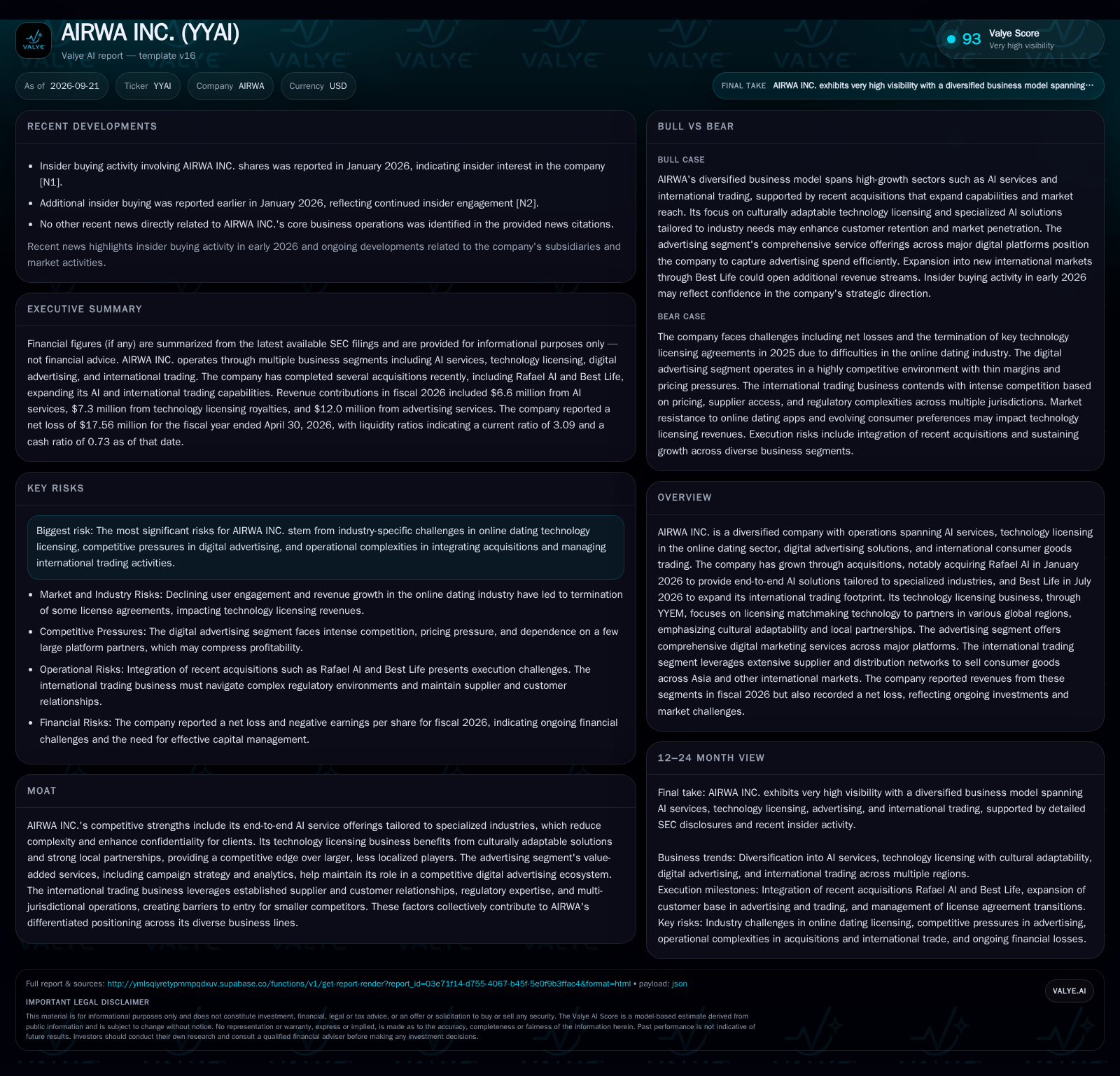
AIRWA INC. operates across four segments: AI services, technology licensing, digital advertising, and international trading. Recent acquisitions—Rafael AI and Best Life—have expanded its capabilities and international presence. For the fiscal year ended April 2026, AIRWA reported a net loss of $17.56 million, with advertising as the largest revenue generator. Terminated licensing agreements, integration risks, and ongoing financial losses highlight the challenges of managing a diversified portfolio amid competitive and operational pressures.Insider transaction activity was reported in the cited source; this activity does not by itself establish insider confidence. [S1] [N1] [N2]
AIRWA INC. is attempting to build a diversified technology and trading conglomerate, spanning AI services, technology licensing for online dating, digital advertising, and international consumer goods distribution. The company’s recent acquisition spree—Rafael AI for end-to-end AI solutions and Best Life for global trading—signals an ambition to participate in multiple high-potential sectors. However, a significant net loss in fiscal 2026, terminated licensing agreements, and the operational complexity of integrating distinct business models raise the question: Can AIRWA generate durable value from its breadth, or will diversification dilute focus and profitability?
Recent Acquisitions and Segment Performance Shape Strategic Direction
AIRWA completed two major acquisitions in 2026: Rafael AI Sdn. Bhd., an AI specialist targeting healthcare, industrial, and autonomous driving sectors, and a 97% stake in Hongkong Best Life Trade Co., Limited, a cross-border consumer goods distributor with recent expansion into the UK, US, Canada, and New Zealand. These moves have diversified AIRWA’s revenue streams, with the advertising segment leading ($12.0M), followed by technology licensing ($7.3M) and AI services ($6.6M) for the fiscal year ended April 2026. Despite these topline figures, the company reported a substantial net loss of $17.56 million, highlighting the lag between revenue growth and operational profitability. Notably, some technology licensing agreements were terminated in 2025 due to challenges in the online dating industry, indicating revenue risk in that segment. [S1]
Segment Economics: Margin Profiles and Capital Demands Vary Widely
AIRWA’s business model is a patchwork of segment economics. The advertising segment, while the largest by revenue, is typically characterized by low gross margins and high dependence on major digital platforms, limiting pricing power. The technology licensing segment historically benefits from high-margin, asset-light royalty streams but faces volatility from contract churn and industry-specific headwinds—particularly as online dating platforms confront user fatigue and regulatory scrutiny. The AI services business, newly acquired, may require significant up-front investment in R&D and human capital to build proprietary models and win enterprise contracts, but could achieve operating leverage if it scales. International trading through Best Life is likely to be working-capital intensive, with thin margins, exposure to FX and regulatory risk, and reliance on supplier/customer relationships. Operating leverage across the group is limited by the heterogeneity of business lines; capital allocation decisions and the ability to cross-sell or synergize offerings will determine whether the conglomerate structure adds value or simply aggregates risk. [S1]
Diverse Markets, Distinct Challenges: Competitive Landscape by Segment
AIRWA competes in four distinct arenas. In AI services, it faces both global cloud/AI giants and specialized regional providers. Its pitch of end-to-end, industry-specific solutions may resonate with customers seeking confidentiality and customization, but large incumbents often have deeper resources and established reputations. The technology licensing business is pressured by shifting user preferences, regulatory challenges, and competition from both established matchmaking platforms and emerging dating technologies. In digital advertising, AIRWA acts as an intermediary between clients and major platforms (like Google, Meta, TikTok), a category where scale, data analytics, and cost efficiency are critical; competition is fierce and margins are thin. The international trading arm must contend with global trading houses, e-commerce specialists, and local distributors, where regulatory expertise and supply chain agility are essential. While AIRWA’s multi-jurisdictional reach and local partnerships provide some moat elements, the risk is that each segment’s competitive intensity could erode group-level returns unless synergies can be realized.
Unlocking Synergies Across Segments Could Drive Sustainable Growth
A favorable outcome for AIRWA would be predicated on realizing cross-segment synergies and operational efficiencies. If the AI services arm succeeds in building proprietary, industry-specific solutions that become embedded in client workflows—particularly in high-value sectors like healthcare or industrial automation—it could command premium pricing and recurring contracts. Technology licensing could stabilize if AIRWA pivots to new verticals or geographies less exposed to the volatility of online dating. The advertising business could deliver higher margins if it leverages AI-driven analytics to deliver demonstrable ROI for clients, moving up the value chain. International trading could benefit from leveraging AIRWA’s AI and data capabilities to optimize logistics, inventory, and supplier management. Evidence supporting this scenario would include rising segment margins, new long-term contracts, successful cross-selling, and declining group-level losses. Material announcements of new enterprise AI wins or expansion of licensing into adjacent categories would further bolster the case.
Breadth Brings Modest Growth, but Integration and Margin Expansion Remain Elusive
The most plausible medium-term scenario is that AIRWA achieves incremental revenue growth across its segments but continues to struggle with integration and margin expansion. AI services may win niche contracts but face long sales cycles and lumpy revenue. Technology licensing likely stabilizes at lower levels after the loss of some contracts, while advertising and trading remain competitive and margin-constrained. The company may reduce its net loss, but persistent operating expenses, acquisition integration costs, and the challenge of scaling multiple disparate businesses could prevent a near-term return to profitability. Confirmation would come from sequential revenue growth but only gradual improvement in operating margins and continued reliance on cash reserves. Falsification would be a sharp improvement in segment margins or clear evidence of successful cross-segment integration and cost discipline.
Diversification Dilutes Focus, and Persistent Losses Force Retrenchment
In a negative scenario, AIRWA’s diversification strategy fails to deliver synergies, and the company is unable to achieve profitability across any of its segments. Prolonged net losses could erode cash reserves, especially if integration costs from recent acquisitions outpace revenue synergies. Technology licensing revenues may further decline if online dating industry headwinds persist or expand, while advertising and trading segments could be squeezed by larger competitors and unfavorable market conditions. In this scenario, AIRWA might be forced to divest underperforming segments, restructure operations, or seek additional capital on unfavorable terms. Early warning signs would include deteriorating cash flow, further contract terminations, stagnant or declining segment revenues, and negative working capital trends.
Milestones and Metrics That Will Define AIRWA's Multi-Segment Thesis
Gross margin progression by segment (if disclosed), especially for AI services and technology licensing, to gauge the potential for scalable, high-value revenue.
Contract win rates and pipeline conversion in AI services, as evidence of traction in high-value, industry-specific verticals.
Stability and renewal rates in technology licensing—specifically, whether new agreements offset terminated contracts and diversify end-market exposure.
Advertising segment client retention, average contract size, and the share of revenue from performance-based fees versus traditional media buying.
Integration milestones and cost savings from the Rafael AI and Best Life acquisitions, including any realized cross-selling or technology transfer.
Cash burn rate versus available liquidity, as ongoing losses could necessitate capital raises or strategic retrenchment.
If disclosed, revenue or margin contribution from cross-segment initiatives (e.g., AI-enabled trading analytics or advertising optimization), as a leading indicator of synergy realization.
Disclaimer: This is research-only, informational analysis and not investment advice. It may include AI-generated interpretation and general industry context. Always verify important details using primary sources.

Comments