
LENDWAY, INC.: High Leverage, Leadership Transition, and the Search for a Sustainable Model
LENDWAY, INC. faces persistent operating losses, substantial long-term liabilities, and a recent executive shake-up. With liquidity above short-term obligations but no clear business model disclosure, the company’s path forward hinges on strategic clarity and operational turnaround.
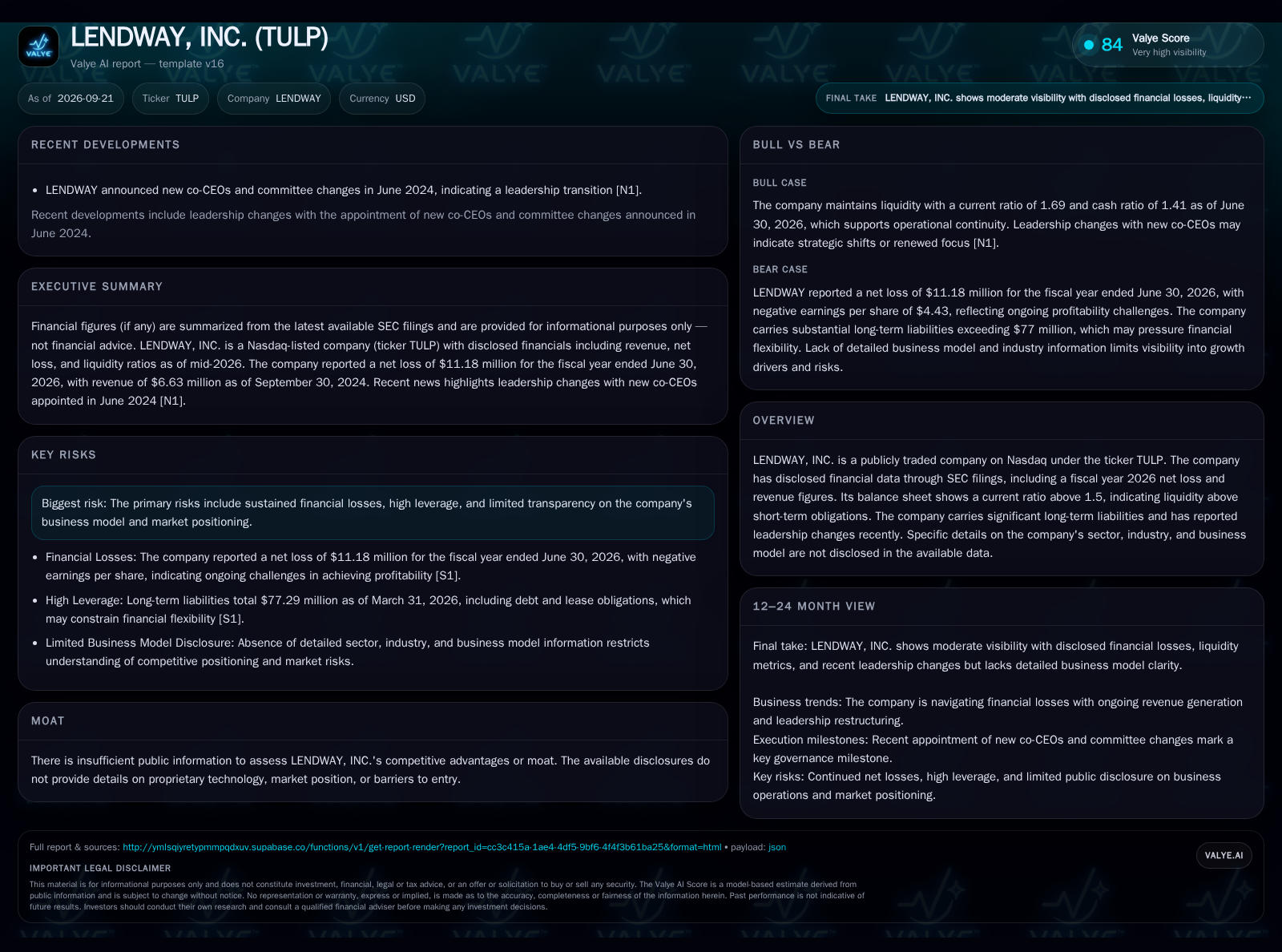
LENDWAY, INC. (Nasdaq: TULP) reported a net loss of $11.18 million for fiscal 2026, with revenue of $6.63 million as of Q3 2024 and significant long-term liabilities over $77 million. A leadership transition brought new co-CEOs in June 2024. While the company’s current ratio (1.69) and cash ratio (1.41) suggest liquidity above near-term needs, the absence of business model details and persistent losses raise questions about long-term viability and strategic direction. [S1] [N1]
LENDWAY, INC. (Nasdaq: TULP) stands at a crossroads marked by persistent operating losses, a heavily leveraged balance sheet, and a recent overhaul of its executive team. Despite maintaining liquidity above immediate obligations, the company’s lack of business model transparency and sector identity leaves its future direction unclear. The new co-CEOs face a formidable challenge: reversing negative earnings and navigating a capital structure weighed down by over $77 million in long-term liabilities. The company’s next moves will determine whether this is a turnaround story or a cautionary tale.
Recent Financial Performance and Leadership Overhaul Define the Current Landscape
LENDWAY, INC. reported a net loss of $11.18 million for the fiscal year ended June 30, 2026, with basic and diluted EPS at negative $4.43, indicating severe profitability challenges. Revenue disclosed for the period ending September 30, 2024, was $6.63 million, without any accompanying detail on growth drivers or segment performance. However, long-term liabilities stood at $77.3 million as of March 31, 2026, against total assets of $103.3 million. Notably, LENDWAY underwent a significant leadership transition in June 2024, appointing new co-CEOs and restructuring board committees, which may signal a change in strategic direction. [S1] [N1]
Economic Viability Hinges on Revenue Model Transparency and Cost Structure Reform
The absence of sector and business model disclosure makes it difficult to assess LENDWAY’s core economic engine. With reported revenue of $6.63 million dwarfed by an $11.18 million net loss for fiscal 2026, the company’s cost base is evidently too high relative to its scale. The magnitude of long-term liabilities—over $77 million—suggests either historical investments, acquisition activity, or a capital-intensive model, though the specifics are undisclosed. If the company operates in a sector with high fixed costs (such as specialty finance, leasing, or asset-heavy operations), operating leverage could be a double-edged sword: fixed costs would amplify both upside and downside, but without growth or margin expansion, losses persist. Conversely, if LENDWAY’s business is services- or software-oriented, such losses may indicate structural inefficiency or a failed scaling effort. The company’s liquidity ratios enable near-term survival, but the real test lies in generating positive operating cash flow and servicing long-term debt. Without clarity on customer concentration, pricing power, or recurring revenue, it is plausible that LENDWAY’s economics are currently unfavorable and require either a business model pivot or significant cost restructuring to become viable.
A critical component in assessing LENDWAY’s economic viability lies in understanding its cost structure dynamics relative to revenue scalability. If the company’s fixed costs dominate, incremental revenue growth could substantially improve operating margins through operating leverage. However, in the absence of growth or if revenue is volatile, these fixed costs exacerbate losses. Conversely, a variable cost model tied closely to revenue generation could imply more flexibility but might limit margin expansion potential. Furthermore, the capital intensity implied by high long-term liabilities suggests that asset utilization rates and return on invested capital (ROIC) would be pivotal metrics to evaluate efficiency. Without improving asset productivity or reducing capital costs, the company may struggle to generate sufficient returns to justify its leverage.
Another dimension worth exploring is the potential impact of capital structure on strategic options. High leverage can constrain operational flexibility, limiting the company’s ability to invest in innovation, marketing, or market expansion. If debt servicing consumes a large portion of cash flow, management may be forced into short-term cost-cutting measures that undermine long-term growth prospects. On the other hand, if the company can renegotiate debt terms or refinance at lower rates, it may unlock breathing room to pursue strategic initiatives. The interplay between capital structure and operational strategy is crucial, as an optimal balance could enable sustainable growth, while an over-leveraged position could precipitate financial distress.
Competitive Standing Obscured by Lack of Market and Product Disclosure
LENDWAY’s competitive landscape cannot be directly assessed in the absence of information on its industry, customer base, or offering. If the company is in a commoditized market, high leverage and operating losses would place it at a disadvantage relative to peers with stronger balance sheets or differentiated offerings. Should it operate in a niche market or possess unique intellectual property, those advantages are not evident from current disclosures. The risk of revenue concentration, as mentioned in forward-looking statements, implies potential vulnerability to customer churn or contract renegotiation. Furthermore, the reference to dependency on Dutch tulip bulbs in risk factors—while possibly an artifact or placeholder—raises questions about supply chain stability or market specificity. Until LENDWAY articulates its value proposition, product differentiation, or customer stickiness, its ability to defend market share, raise prices, or withstand competitive pressure remains speculative.
Turnaround Potential: Can New Leadership Unlock Strategic Clarity and Margin Recovery?
A favorable scenario for LENDWAY hinges on the new co-CEOs executing a strategic reset—either by rationalizing costs, pivoting to a higher-margin business model, or unlocking underutilized assets. If the leadership transition in June 2024 catalyzes operational discipline, renegotiation of debt, or a refocus on profitable segments, the company could stem losses and gradually restore market confidence. Evidence supporting this scenario would include a clear articulation of the company’s sector and business lines, a shift to positive operating cash flow, narrowing quarterly losses, and stabilization or growth in revenue without a proportional increase in costs. Additional confirmation would come from successful refinancing or reduction of long-term liabilities, new commercial partnerships, or product launches that signal competitive differentiation. Any sign of recurring revenue or customer retention improvements would further validate a turnaround.
Should the new leadership successfully clarify LENDWAY’s market positioning, it could unlock latent value by focusing on core competencies and shedding non-strategic assets or business lines. A disciplined approach to portfolio management might reduce complexity and improve resource allocation, thereby enhancing operational efficiency. Additionally, if the company can identify and capitalize on recurring revenue streams or subscription-based models, it could stabilize cash flows and improve predictability. Enhancing customer retention and expanding lifetime value through differentiated offerings would further bolster competitive advantage. Such strategic clarity, combined with prudent financial management, could create a virtuous cycle of margin improvement and deleveraging.
Prolonged Restructuring Amid Ongoing Losses and Strategic Uncertainty
The most plausible path is a period of continued operating losses and strategic ambiguity, with LENDWAY relying on its liquidity cushion to meet short-term obligations while searching for a viable long-term model. The company may attempt incremental cost reductions or modest revenue growth, but without clarity on its core business or market, these efforts may not be enough to offset high fixed costs or service its debt. Confirmation of this scenario would be persistent negative earnings, flat or declining revenue, and continued absence of detailed business strategy in public filings. Falsification would require disclosure of a specific growth plan, margin improvement, or successful restructuring. In the absence of such developments, the risk of creditor pressure or dilutive capital raises could increase over time.
Escalating Losses and Liquidity Erosion Could Lead to Distress or Forced Asset Sales
In a negative scenario, LENDWAY’s operating losses persist or worsen, eroding its liquidity position and triggering covenant breaches or creditor action on its $77 million in long-term liabilities. If revenue concentration is high and key customers are lost, or if the company fails to adapt its cost structure, cash burn could accelerate. The absence of a credible business model or turnaround plan would limit access to new capital, increasing the likelihood of distressed asset sales, debt restructuring, or even insolvency proceedings. Evidence confirming this pathway would include rapid declines in cash and current assets, missed interest or principal payments, layoffs or asset divestitures, and going-concern warnings in filings. Any sign of inability to refinance debt or raise equity would further validate this downside.
Milestones and Disclosures That Will Shape the LENDWAY Thesis
Quarterly operating cash flow trends, if disclosed, to assess whether the company is reducing its cash burn or moving toward breakeven.
Any detailed breakdown of revenue by segment, customer, or geography, which would clarify business model and growth sources.
Updates on long-term debt covenants, refinancing, or repayments, indicating potential financial flexibility or looming distress.
Public articulation of the company’s sector, competitive positioning, and product/service offering—essential for evaluating moat and strategy.
Evidence of cost restructuring, layoffs, or asset sales, which would signal management’s commitment to restoring profitability.
Announcements of new commercial partnerships, product launches, or customer wins that demonstrate traction and market relevance.
Changes in board or senior management beyond the June 2024 co-CEO appointments—could confirm further strategic shifts.
Disclosure of major customer concentration or loss, which would materially impact revenue visibility and risk.
Disclaimer: This is research-only, informational analysis and not investment advice. It may include AI-generated interpretation and general industry context. Always verify important details using primary sources.

Comments