
Thunder Power Holdings: Early-Stage EV Aspirations Meet Execution and Capital Hurdles
Thunder Power Holdings, Inc. is positioning itself as a developer of premium electric vehicles with proprietary modular technology, but faces major headwinds: no commercial products, reported liquidity position, ongoing operating losses, related-party debt, and material internal control weaknesses. The next phase will test whether its technology, capital, and execution can support a credible market entry.
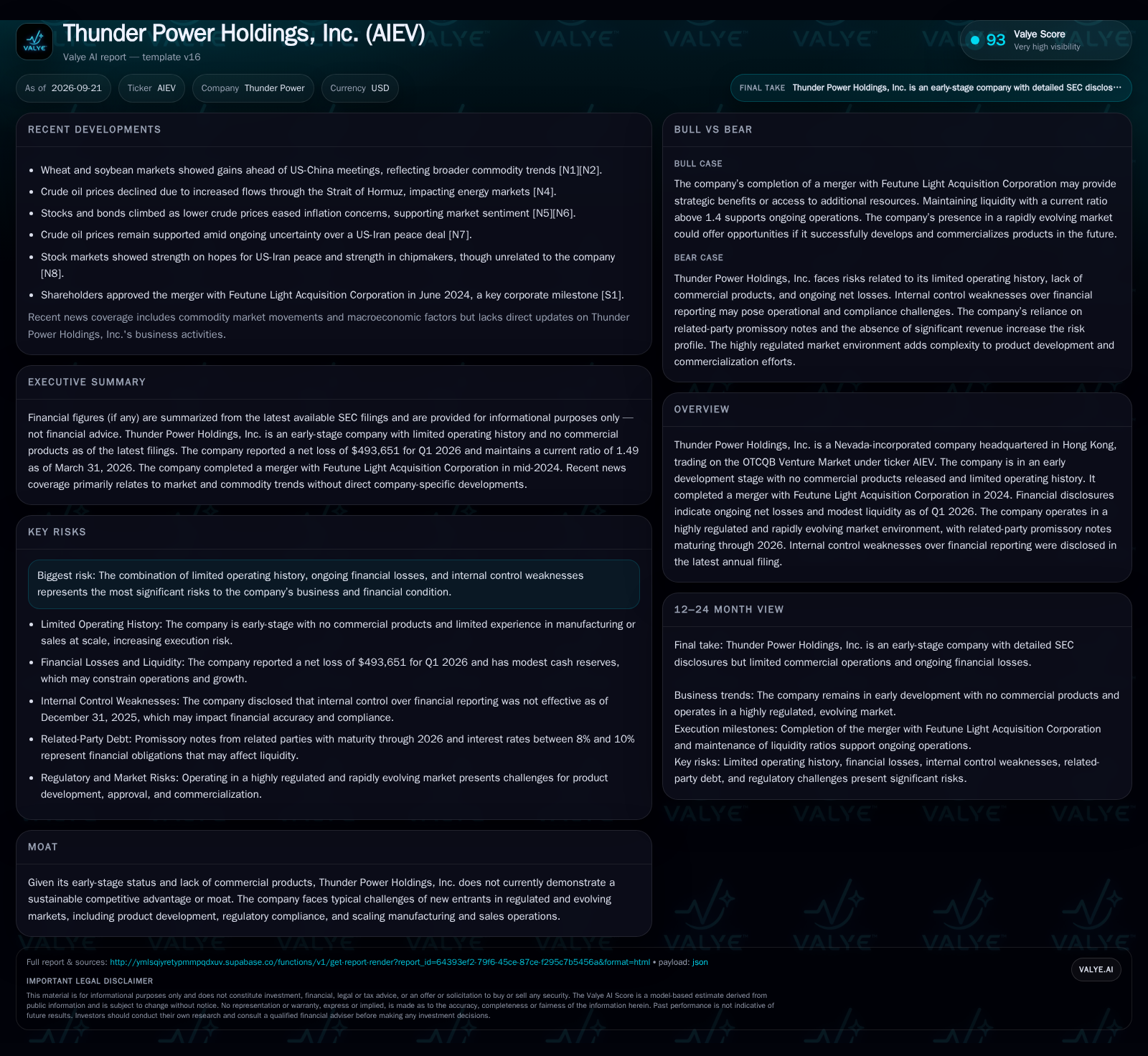
Thunder Power Holdings, Inc. is an early-stage EV company with no commercial products, persistent operating losses, and reported liquidity position. The company touts proprietary modular EV technology and plans to offer multiple premium models, but must overcome execution, capital, and regulatory risks to achieve initial commercialization. Current financials and internal control disclosures highlight significant challenges ahead. [S2]
Thunder Power Holdings, Inc. is trying to carve out a space in the premium electric vehicle market with a modular, technology-driven approach. However, as of the first quarter of 2026, the company has yet to launch a commercial product and continues to post operating losses, with cash reserves below $1 million. The post-merger entity now faces the daunting challenge of turning its proprietary concepts into viable, regulated, and scalable products—all while contending with internal control weaknesses and a capital structure that includes related-party debt. The question is whether Thunder Power can execute on its ambitions before financial or operational constraints force a strategic pivot or dilution. [S2]
Thunder Power’s Financial and Operating Status: Early-Stage Realities
As of March 31, 2026, Thunder Power Holdings, Inc. reported $921,349 in cash and cash equivalents, $13.1 million in current assets, and $8.8 million in current liabilities, yielding a current ratio of 1.49. The company posted a net loss of $493,651 for the quarter, and there are no commercial products on the market as of the latest filings. The capital structure includes 70.7 million shares issued, 20 million of which are earnout shares contingent on revenue milestones through 2026. Material weaknesses in internal controls over financial reporting were disclosed for 2025. The company also carries related-party promissory notes maturing through 2026 at rates of 8–10%. The company reported cash and liquidity metrics for the period; these figures do not by themselves establish operating runway, investment capacity, financial flexibility, or financing capacity. [S2]
Prospective Economics: Modular EV Ambition, Capital Demands, and Scaling Hurdles
Thunder Power’s stated mission is to develop premium electric vehicles using proprietary modular chassis technology, enabling a lineup that includes a coupe, sedan, city car, and SUV. If realized, this modular approach could lower design and production costs by sharing components across models, potentially accelerating time-to-market and reducing capital intensity per vehicle variant. However, the economics of automotive manufacturing are notoriously challenging for new entrants: high upfront R&D and tooling costs, minimum viable scale needed for unit cost efficiency, and substantial working capital requirements for inventory and supply chain management.
Without commercial products or disclosed preorders, it is unclear whether Thunder Power will pursue direct sales, dealership partnerships, or a hybrid go-to-market model. Each path carries distinct margin, capital, and working capital profiles. Related-party debt and earnout share structures may further complicate future financing or shareholder dilution. Achieving positive operating leverage in automotive typically requires ramping to tens of thousands of units per year—a threshold that remains distant for Thunder Power absent clear commercial traction.
Assessing Competitive Prospects in the Crowded Premium EV Segment
Thunder Power is targeting a premium EV market already populated by established global automakers and aggressive new entrants, many with deeper capital bases, proven manufacturing capabilities, and extensive regulatory experience. The company claims proprietary modular chassis technology and differentiated design as its core innovation, which, if validated, could offer cost, speed, or customization advantages. However, Thunder Power currently lacks brand recognition, a sales network, and a demonstrated ability to meet stringent regulatory and safety standards.
Switching costs in the EV market are typically low for consumers, especially absent an installed base or network effect. Larger players can leverage vertical integration, software ecosystems, and scale-driven cost advantages. Unless Thunder Power’s technology provides a substantial and demonstrable range, cost, or quality edge, it may struggle to break through the noise—especially given the rapid rate of innovation and intense competition from both incumbent automakers and well-funded EV pure-plays.
Catalysts for a Breakout: Technology Validation and Strategic Partnerships
A favorable trajectory for Thunder Power would require successful validation of its modular chassis technology, leading to the launch of at least one commercial model that meets regulatory and consumer expectations. Early partnerships—either with established OEMs, supply chain partners, or capital providers—could accelerate time-to-market and de-risk execution. Positive independent testing results, regulatory approvals, and credible preorder or distribution agreements would be strong signals of commercial viability.
The upside scenario would be further supported by clear evidence of cost or range advantages versus competitors, a scalable manufacturing strategy, and access to sufficient growth capital. If Thunder Power can demonstrate that its modular approach materially reduces capex and opex per model, and if initial customer feedback is positive, it could carve out a niche in the premium EV segment. Confirmation would come from public disclosure of binding orders, strategic alliances, or non-dilutive funding, as well as evidence of progress on internal control remediation.
Incremental Progress Amid Ongoing Funding and Execution Risks
The most plausible near-term outcome for Thunder Power is a gradual pursuit of its development roadmap, marked by continued R&D spending, periodic capital raises, and efforts to remediate internal control issues. The company may announce prototype unveilings or initial regulatory submissions, but actual commercial launch is likely to be delayed by the need for additional funding, supply chain development, and regulatory approvals.
Operational milestones could be achieved in phases—such as securing pilot production partners or limited demonstration runs—but large-scale commercialization within the next 12–24 months appears unlikely without a step-change in capital or a major partnership. Evidence supporting this scenario would include ongoing net losses, further dilution via equity or convertible debt, and incremental but non-transformative product development updates.
Potential for Strategic Setbacks: Liquidity Strain and Dilution Risk
The risk scenario centers on Thunder Power’s inability to secure sufficient capital or strategic partners to advance past the prototype or pre-commercial stage.
Failure to remediate internal control weaknesses, secure regulatory approvals, or demonstrate clear technology differentiation could erode any remaining investor confidence. Confirmation of this scenario would come from repeated going-concern warnings, delays or cancellations of product development milestones, and a lack of credible commercial announcements. In the extreme, Thunder Power could face delisting or be forced into a distressed merger if liquidity dries up before meaningful traction is achieved.
Milestones and Metrics That Will Define Thunder Power’s Viability
Disclosure of binding commercial orders, preorders, or signed distribution agreements for any of the planned vehicle models would be a material sign of demand and commercial traction.
Updates on regulatory submissions, safety certifications, or prototype testing outcomes—especially if independently validated—would help gauge product readiness and regulatory risk.
Progress reports on internal control remediation efforts, including auditor opinions or material weakness resolution, will be crucial for investor confidence and future capital raises.
Details on capital raises, funding partnerships, or non-dilutive financing arrangements would clarify the company’s ability to sustain operations and invest in scaling.
Evidence of pilot production runs, prototype unveilings, or supply chain build-out—if disclosed—would indicate tangible movement toward commercialization.
Disclosure of customer feedback, product reviews, or third-party technology validation could help assess whether Thunder Power’s modular approach delivers on its promised advantages.
Milestones related to the performance-based earnout shares (e.g., revenue thresholds met or missed) would provide objective benchmarks for commercial progress.
Disclaimer: This is research-only, informational analysis and not investment advice. It may include AI-generated interpretation and general industry context. Always verify important details using primary sources.

Comments