
Sparta Commercial Services: Niche Platform Ambitions Confront Severe Liquidity and Execution Hurdles
Sparta Commercial Services, Inc. combines blockchain-enabled trade finance, municipal equipment lending, mobile technology, and health supplements under one roof, but persistent operating losses and acute liquidity shortfalls now threaten its ability to turn product innovation and niche focus into a sustainable business.
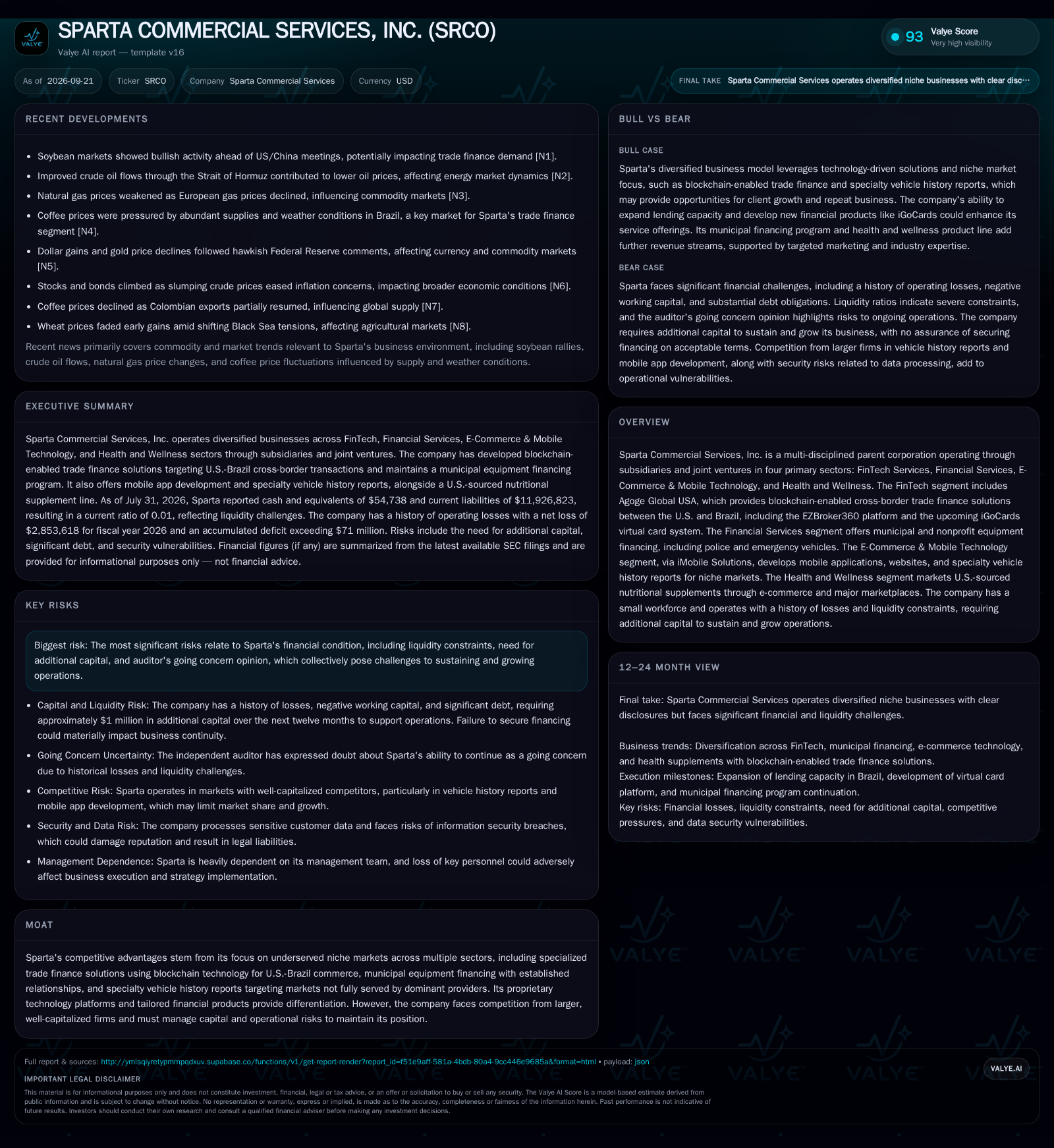
Sparta Commercial Services, Inc. operates across four segments—FinTech, municipal lending, e-commerce/mobile tech, and health supplements—using platforms like EZBroker360 for cross-border trade finance. Despite some product traction and niche positioning, Sparta faces an accumulated deficit over $71 million and a current ratio of 0.01, prompting a going concern warning and an urgent need for additional capital to avoid business disruption [S1] [S2].
Sparta Commercial Services, Inc. pursues a unique blend of blockchain-enabled trade finance, municipal equipment lending, mobile technology, and health supplement e-commerce—each targeting underserved or specialized markets. While the company has demonstrated some product traction, particularly with its Agoge Global USA subsidiary in U.S. The next twelve months will likely hinge on the company’s ability to secure new funding and demonstrate that its technical and market innovation can be translated into scalable, profitable growth.
Liquidity Crisis and Going Concern Dominate Sparta’s 2026 Outlook
Sparta Commercial Services reported a cash balance of $54,738 and current liabilities of $11,926,823 as of July 31, 2026, resulting in a current ratio of 0.01 and a cash ratio of zero [S2]. These figures underscore an acute liquidity crunch, with management and auditors explicitly questioning the company’s ability to continue as a going concern [S1] [S2].
The company’s accumulated deficit reached $71.8 million as of April 30, 2026, with a net loss of $2.85 million for the most recent fiscal year [S1]. Operationally, Agoge Global USA has deployed $2 million in loans since inception, and the company claims repeat business from clients such as Patta Brazil, suggesting some commercial traction in its FinTech segment [S1].
Despite progress in product development—such as the launch of blockchain-based EZBroker360 and the pending iGoCards virtual card platform—Sparta’s financial position has become the dominant concern, overshadowing its technical innovations and market expansion efforts.
How Sparta’s Multi-Segment Model Could (or Might Not) Generate Returns
Sparta’s business model relies on layering multiple niche offerings—blockchain-enabled trade finance, municipal equipment loans, mobile/web development, and health supplements—each with distinct revenue mechanics and risk profiles. The FinTech segment, via Agoge Global USA, seeks to monetize cross-border trade inefficiencies by charging fees and interest on short-term, staged loans, with blockchain and stablecoins reducing transaction costs and settlement delays. The economics depend on loan volume, fee levels, loss rates, and the platform’s ability to attract repeat business. Early evidence of repeat loans to Patta Brazil suggests some initial stickiness, but scale is currently limited [S1].
Municipal financing generates income from interest on equipment loans to public-sector entities, a model that can provide stable, recurring cash flows when properly capitalized. However, Sparta’s limited capital base and negative working capital severely restrict its capacity to expand this book or absorb losses. The e-commerce/mobile tech segment likely operates on a project- and retainer-fee basis, with possible recurring revenue from hosting, maintenance, or specialty vehicle history reports. The health supplements business is transactional, with potential for higher margins through direct channels but requiring ongoing marketing spend to drive volume.
Operating leverage is theoretically available if Sparta can drive higher volumes through its platforms without proportionate increases in fixed costs—particularly in software or data-driven businesses. However, the small workforce (four full-time and three part-time employees as of April 2026) and persistently negative net income suggest that fixed costs remain burdensome and that scale benefits have not yet materialized [S1]. Capital needs are acute across all segments, with the company stating a need for at least $1 million in new funding over the next year simply to maintain operations [S1].
Niche Focus and Proprietary Platforms: Can Sparta Carve Out Defensible Ground?
Sparta’s perceived advantage lies in targeting underserved market niches: blockchain-enabled U.S.-Brazil trade finance, municipal equipment lending for smaller jurisdictions, and vehicle history reports for specialty vehicles. The EZBroker360 platform’s use of blockchain and stablecoins could offer real-time settlement and transparency benefits that legacy providers do not match, while the municipal lending program leverages long-standing relationships with over 100 public entities [S1].
However, these advantages are countered by formidable competitive forces. In vehicle history reports and mobile/web development, Sparta competes with larger, better-capitalized firms capable of offering lower prices, broader features, and more aggressive marketing. In trade finance, global banks and FinTechs with deeper capital pools and broader compliance infrastructure represent significant competition. The e-commerce health supplements market is crowded, with low switching costs and high customer acquisition costs.
Without the capital to scale, invest in customer acquisition, or absorb shocks, Sparta risks being outcompeted in all segments unless its platforms can establish deep integration, regulatory differentiation, or network effects. At present, there is little evidence that recurring revenue, high retention, or technology-driven switching costs have been established at scale.
If Capital Arrives and Platforms Demonstrate Scale, What Could Go Right?
A favorable scenario would see Sparta successfully raising at least $1 million in new capital, stabilizing its liquidity, and investing in the expansion of its FinTech and municipal lending platforms. If EZBroker360 can continue to attract repeat business, expand its loan book, and demonstrate low default rates, the company could begin to capture a meaningful share of U.S.-Brazil trade flows, especially among SMEs underserved by traditional banks.
The launch and adoption of iGoCards could add a high-margin, recurring revenue stream if it gains traction among global businesses seeking expense management solutions. Municipal lending could grow if Sparta leverages its public-sector relationships and secures external funding lines. The e-commerce and health supplement businesses could benefit from digital marketing or marketplace partnerships.
Evidence that would confirm this upside includes: a successful capital raise; sequential quarter-over-quarter growth in loan volume and platform users; new, multi-year municipal lending contracts; and positive operating cash flow. Falsification would come from continued loan book stagnation, inability to raise capital, or further deterioration in net income and liquidity metrics.
Most Likely Trajectory: Survival Mode and Selective Progress in Niche Markets
Under the most plausible near-term scenario, Sparta manages to secure just enough capital to avoid insolvency but remains severely constrained in its ability to scale. The company continues to operate its four segments, with incremental growth in EZBroker360 loan volume and some ongoing municipal lending activity, but without the resources to achieve critical mass or invest aggressively in product development or customer acquisition.
Operating losses persist, but management prioritizes cash conservation and seeks out opportunistic partnerships or licensing deals. Some product development—such as iGoCards—may be delayed or launched in limited form. The company’s diversified approach provides some revenue stability but also limits focus and increases the risk of execution missteps.
Confirmation of this scenario would include continued but modest loan growth, stable or slowly declining revenues in other segments, and lack of material improvement in liquidity ratios. Falsification would come from a major capital infusion or a sudden collapse in operating activity.
Liquidity Exhaustion or Strategic Asset Sale: What Failure Could Look Like
The downside scenario sees Sparta unable to secure the necessary external funding, resulting in a cash crunch that forces drastic cost-cutting, asset sales, or even bankruptcy. Operations in all segments would be curtailed, and the company might be forced to sell or license its proprietary platforms—such as EZBroker360 or iGoCards—at distressed valuations.
Customer and partner confidence would erode, leading to a decline in repeat business and further shrinking of the loan book. Municipal lending relationships might be transferred to competitors or liquidated. The e-commerce and health supplement businesses, being less capital-intensive, could persist in a reduced form but would likely lack the scale to generate meaningful cash flow.
Evidence supporting this scenario would include missed payroll or debt payments, rapid declines in reported revenues or loan volumes, or announcements of asset sales or bankruptcy filings. A useful falsification would be any material capital raise or a strategic partnership that provides a financial lifeline.
What Will Determine If Sparta’s Multi-Segment Strategy Survives the Next Year?
Quarterly updates on cash balance, current liabilities, and working capital—does Sparta raise new capital or does liquidity erode further?
Growth in total loan volume, number of active borrowers, and repeat customers on the EZBroker360 platform—are volumes scaling and defaults contained?
Progress and adoption metrics for the iGoCards platform—are there early customers, and what is the pace of onboarding and transaction volume?
New or renewed municipal equipment financing contracts—does the company retain or expand its footprint among public-sector clients?
Gross margin and segment contribution trends, especially in FinTech and e-commerce/mobile tech—are any segments approaching break-even?
Disclosure of external funding events, credit line expansions, or strategic partnerships—does Sparta secure the capital needed to execute its plan?
Retention rates and recurring revenue metrics in vehicle history reports and mobile/web services—are customers sticking with Sparta’s platforms?
Updates on auditor opinion and management guidance regarding going concern status—does the risk of insolvency abate, or does it intensify?
Disclaimer: This is research-only, informational analysis and not investment advice. It may include AI-generated interpretation and general industry context. Always verify important details using primary sources.

Comments